
F-35Bs From the U.S. Marines Give Britain’s Aircraft Carrier a Much Needed Firepower Boost
Military Watch Magazine Editorial Staff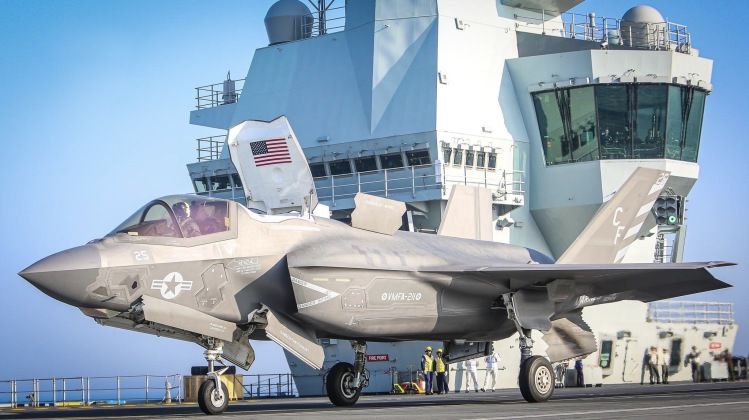
American F-35B on British Carrier HMS Queen Elizabeth
British Royal Navy
F-35B fifth generation fighter jets from the U.S .Marine Corps have begun operations from the British Royal Navy’s aircraft carrier HMS Queen Elizabeth, the first of two 65,000 warships recently commissioned to provide island nation with a renewed power projection capability. This has provided a serious boost to the ship’s air wing, which due to a combination of factors including the very high costs of the F-35B and its relatively low rate of production is currently fielded in very limited numbers by the British Armed Forces. A devaluation of the British pound in 2016, and more recently a severe economic crisis in the country, mean Britain's ability to afford a full complement of F-35B fighters has been repeatedly brought to serious question - making support from the U.S. Marines all the more important. The F-35B is the most expensive class of fighter jet in production anywhere in the world today, costing over 50% more per unit than its less complex counterpart the F-35A which is used by the U.S. Air Force. The B variant notably has a shorter range, a lower endurance, lower manoeuvrability and currently cannot reach comparable speeds to the F-35A, but is prized for its ability to perform short takeoffs and vertical landings. The lack of catapults or even arresting gear on British carriers means that they cannot operate any other class of fighter.
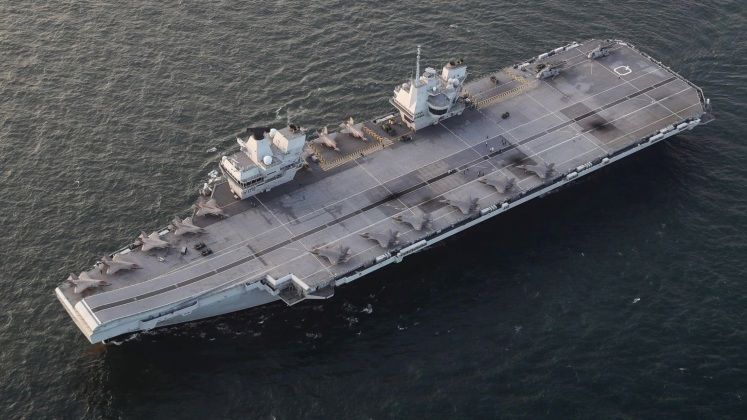
The F-35B was designed to operate from light carriers such as the 40,000 ton American Wasp Class and America Class ships, and is even set to be pressed into service onboard Japan’s smaller 27,000 ton Izumo Class carriers, although the decision to use it on ships as large as the Queen Elizabeth Class has been highly controversial due to its questionable cost effectiveness. The F-35C, which could have deployed from British carriers if they had integrated arresting gear, is not only much cheaper to acquire, but is also more capable in combat and a lot less costly to operate due to its lack of complex vertical landing technologies. The British Royal Navy’s use fo the F-35B does allow it to maintain a high level of interoperability with the U.S. Marine Corps - much as the French Navy’s use of the steam catapult and arresting gear equipped carrier Charles De Gaulle with American E-2 Hawkeye jets created high interoperability with the U.S. Navy which deploys carriers using a similar system.
