
F-35A vs. F-35B: Why Britain's Armed Forces Are Considering a Cheaper Stealth Fighter Variant to Cut Costs
Military Watch Magazine Editorial Staff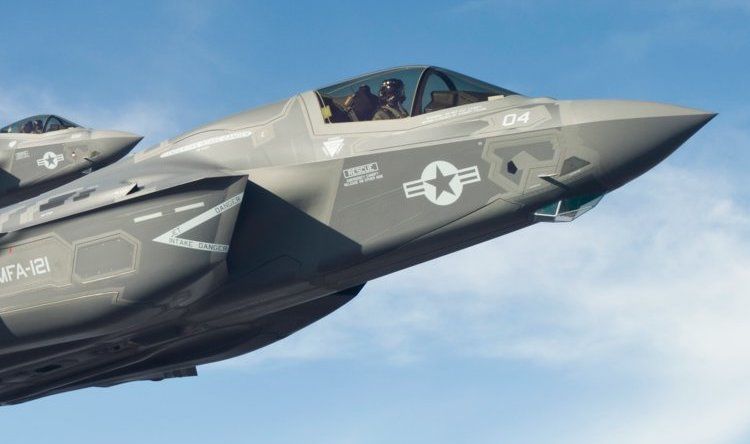
F-35 Fighters
With the British Armed Forces having planned the acquisition of 138 F-35B fifth generation stealth fighters, the service was set to become the largest operator of the cutting edge new combat jets outside the United States. The fighters were set to be jointly operated by the British Royal Navy and Royal Air Force, with the F-35B variant specifically selected for its compatibility with the Navy’s Queen Elizabeth Class aircraft carriers. The B variant’s short takeoff and vertical landing (STOVL) capabilities were valued for eliminating the need for arresting gear on the carrier decks, which are needed to allow conventional carrier based fighters to land. While the carriers between them would deploy an absolute maximum of 96 fighters, a larger order for the F-35B was placed with the retaining of some ground based units in mind, despite the fact that the Air Force did not have any specific needs for STOVL capabilities.
The F-35A is set to be manufactured in far greater numbers than the B variant, with 11 countries having placed orders for the aircraft and the U.S. Air Force alone planning to acquire around 1,750. The F-35B by contrast has seen little foreign demand due to its highly specialised nature, with costly STOVL technologies increasing the maintenance burden as well as the acquisition cost. A combination of STOVL systems and their inability to benefit from the economies of scale of the F-35A mean that the F-35B’s cost remains approximately 50 percent higher than that of the A variant - a difference of around $40 million. As a result, Britain may make considerable savings from acquiring the A variant and reducing orders for the F-35B by several dozen - likely over $1.5 billion.
With the British armed forces increasingly struggling with budgetary constraints, which have made the retention of of large naval and fighter fleets difficult, senior figures in the Royal Air Force have reportedly proposed that the country cut planned numbers of F-35B fighter jets and instead acquire the F-35A - the variant developed for the United States Air Force. While Britain has contributed considerably to the development of the F-35B, with the country retaining particular expertise in STOVL technologies due to its experience developing the Harrier jet, replacing a portion of its planned orders for F-35B fighters with the A variant could save hundreds of millions of dollars in acquisition costs. It could further lead to considerable savings across the fighters’ service life due to the far lower maintenance requirements of the F-35A. With the retirement of the Cold War era Harriers, and imminent retirement of the Tornado fleet, Britain will soon deploy a ground based fighter fleet a fraction of its prior size, standing at approximately 120 Eurofighters. To put this in perspective, the French ground based fighter fleet stands at over 280 Rafale and Mirage 2000 fighters despite the two countries having similar defence spending levels, while the South Korean ground based fleet stands at approximately 510 fighters despite the country’s significantly smaller defence budget and acquisition of costly F-15s and F-35s. At a time when there is a perceived urgent need for a larger fleet, the preventatively high price of the F-35B has been a major factor leading the British Armed Forces to consider alternatives.
A further factor in the F-35A’s favour is that it is not only less costly and easier to maintain than the F-35B, but it is also very considerably more capable in combat. The fighter has a much greater internal fuel capacity allows it to stay in the air for close to 50 percent longer, while its airframe can endure a g force of 9 - compared to the B variant’s endurance of just 7. This discrepancy has considerably implications for their manoeuvrability. The F-35A also has much larger weapons bays, which is expected to allow it to carry around 50 percent more ordinance internally. Cutting orders for the F-35B will, however, raise the fighter’s unitary cost - marking a further major blow to the overall program. The vast majority of these jets are set to be acquired by the U.S. Marine Corps, potentially drawing the ire of Pentagon, with at least one American military source having referred to British proposals to acquire F-35As as a “betrayal.” It currently remains highly uncertain whether the Royal Navy will be able to acquire the 48 fighters planned for each of its two Queen Elizabeth Class aircraft carriers, with a significant possibility remaining that even if both ships remain in service, a surged capability to put 96 F-35Bs out to sea simultaneously will not be achievable.
