
What We Know About France’s Ambitious Plans For a Nuclear Supercarrier With Sixth Generation Fighters
Military Watch Magazine Editorial Staff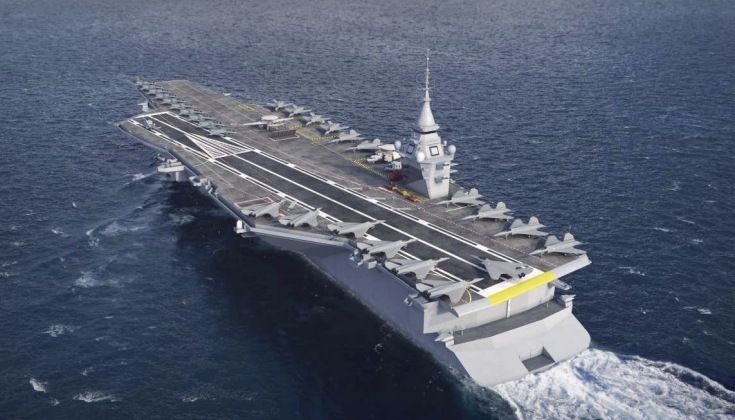
French Nuclear Supercarrier - concept art
Despite serious ongoing economic woes, France is looking to cement its overseas maritime power projection capabilities with the commissioning of a highly ambitious nuclear powered supercarrier. French President Emmanuel Macron officially announced that the program to develop a new nuclear powered ship was underway, with these expected to replace the country's troubled medium sized carrier Charles de Gaulle. France has collaborated closely with the United States on its carrier program in the past, and fields the only non-U.S. carriers with either catapult launch systems or fixed wing ‘flying radar’ airborne early warning aircraft - both technologies integrated with American assistance. With the new carrier expected to benefit from many of the latest technologies from advanced AESA radars to electromagnetic catapult systems, reliance U.S. support for the program is likely to compensate for the serious limitations of France's domestic technological and industrial bases. While it was previously speculated in light of France’s economic situation that the country would look to a less ambitious carrier design, following in Britain’s footsteps which commissioned non-nuclear ships without catapults, AEW aircraft or arresting gear for conventional fighter jets, it remains to be seen whether it can see through its commitment to field a large supercarrier. Such ships are currently fielded only by the U.S. Navy, with two ships with similar capabilities but without nuclear propulsion currently also under construction in China.
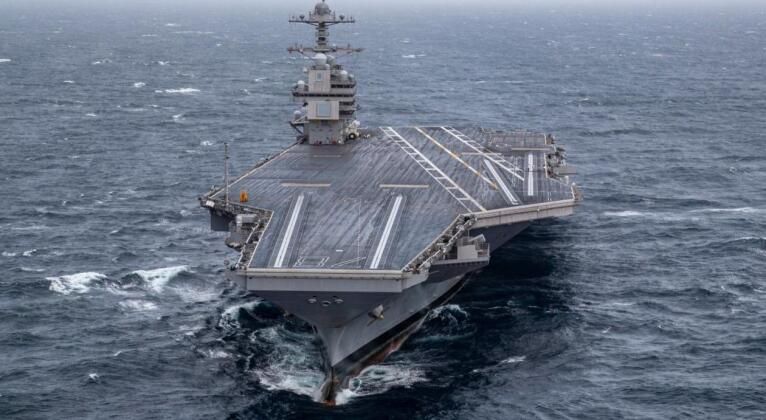
French shipbuilder Naval Group notably released new concept art for the New Generation Aircraft Carrier - or Porte Avion Nouvelle Generation (PANG). The artwork was subsequently shared on Twitter by the country’s defence minister, and showed the warship deploying stealthy sixth generation fighter aircraft. While no country other than the U.S. or China has yet to deploy even fifth generation fighters developed indigenously, although Russia promises to do so before the end of 2020, France appears to be planning to navalise the sixth generation jet it is currently developing jointly with Germany. The feasibility of a European sixth generation program has been seriously questioned, as has its price competitiveness compared to those being pursued in the U.S., China and Russia. It is likely that, as was the case with the older carrier Charles de Gaulle, France’s new carrier will feature a high level of interoperability with the U.S. Navy’s supercarriers - namely the Gerald Ford Class as the two will likely use similar electromagnetic catapult systems. The Ford will deploy F-35C fifth generation fighters and sixth generation jets currently under development, although the more limited nature of France’s defence sector means it is unlikely to be able to deploy more than a single fighter class - one which will also be relied on by the Air Force.
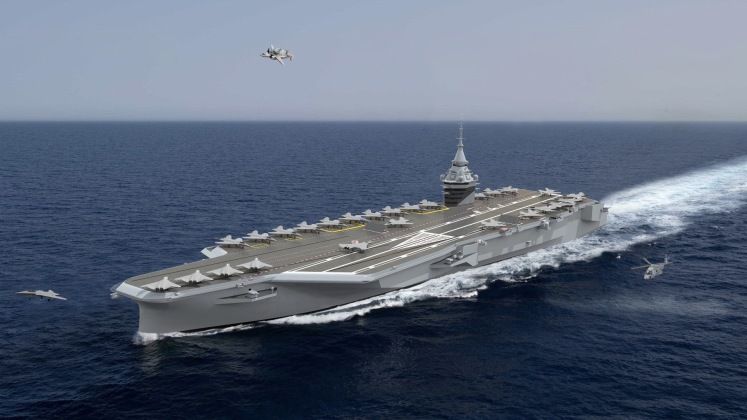
Announcing the new carrier program in December 8 in an address at Framatome, a French company which builds nuclear reactors, President Emanuel Macron stated:
"Charles de Gaulle, as you know, will come to the end of its life in 2038. This is why I have decided that the future aircraft carrier that will equip our country and our navy will be nuclear-powered like the Charles de Gaulle... Your plant in Le Creusot, which has been producing parts essential to our navy for a long time, will produce, among others, several major parts of the nuclear boiler [reactor] of the future aircraft carrier by forging and machining them right here. … By these choices, we confirm France’s desire to preserve its strategic autonomy."
The new ship is expected to cost considerably more than Gerald Ford Class supercarriers built in the United States despite being 25% smaller, due to the significant difference in the efficiency of the defence sectors and shipbuilding industries of the two countries. The French carrier will be almost twice as large as the Charles De Gaulle, at around 75,000 tons each where the older ship displaced just 40,000 tons. Each will use twin nuclear reactors like American supercarriers do, but unlike the De Gaulle which has just a single one. Regarding the affordability of the program, it is highly possible that with closer integration of the member states of the European Union, France will gain support from across the continent to see through its carrier ambitions. This could make its ships a ‘European carrier’ more than it is a French one as part of the initiative to create a joint military organisation for the union.
