
U.S. Navy Loses Two of its Most Valuable Combat jets in Major Air Collision
Military Watch Magazine Editorial Staff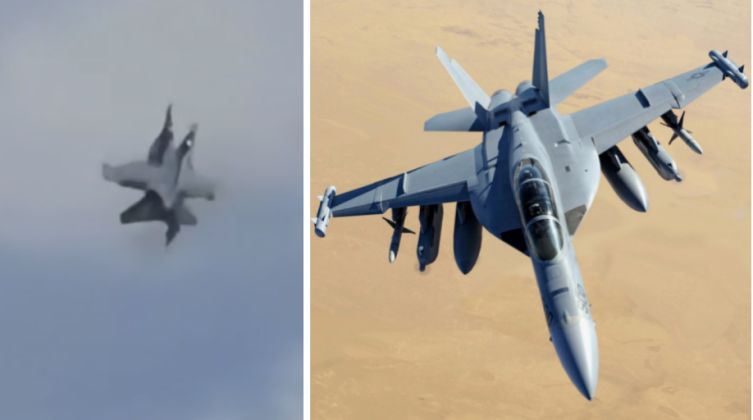
EA-18G Crash (left) and EA-18G
The U.S. Navy has lost two EA-18G Growler electronic warfare aircraft in a midair collision at the Gunfighter Skies air show at the Mountain Home Air Force Base in Idaho, with the four airmen onboard ejecting and surviving. Each EA-18G has two crew members, a pilot and an electronic warfare officer who handles the electronic attack mission of the aircraft. The aircraft gained considerable publicity in January after they were confirmed to have played a central role in providing U.S. forces with near unrestricted access to airspace over the Venezuelan capital Caracas during attacks on the country early that month, with weeks of preceding operations near Venezuelan territory reportedly having been key to paving the way to this.
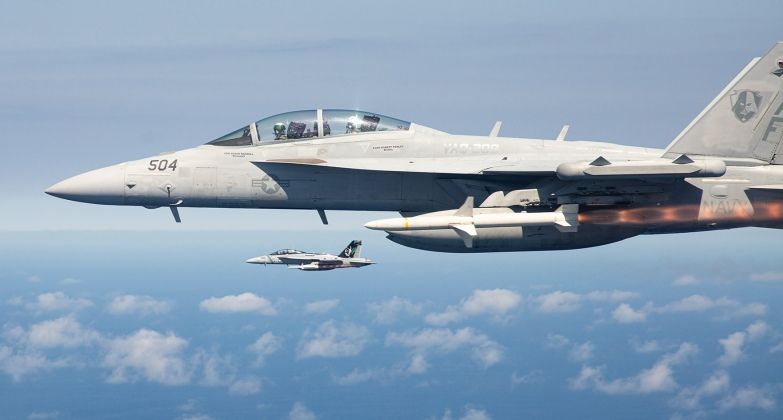
EA-18Gs integrate vast arrays of passive sensors, and when flying close to Venezuelan territory from December they were reportedly able to collect considerable electronic intelligence on local radars and air defences. Near the end of January, the U.S. Navy deployed six EA-18Gs to Muwaffaq Salti Air Base in Jordan, where they are thought to have similarly played important roles in gathering intelligence on local air defences preceding a U.S.-led attack on Iran from February 28. The aircraft were considered by a number of analysts to have been significantly less successful in the latter mission, with the U.S. losing 39 aircraft in as many days of hostilities with Iran before a ceasefire deal was reached. Nevertheless, Iran relied far less heavily on radar-guided air defence systems to achieve shootdowns of U.S. targets, potentially as a result of successful operations by EA-18Gs and other supporting assets to suppress these systems.
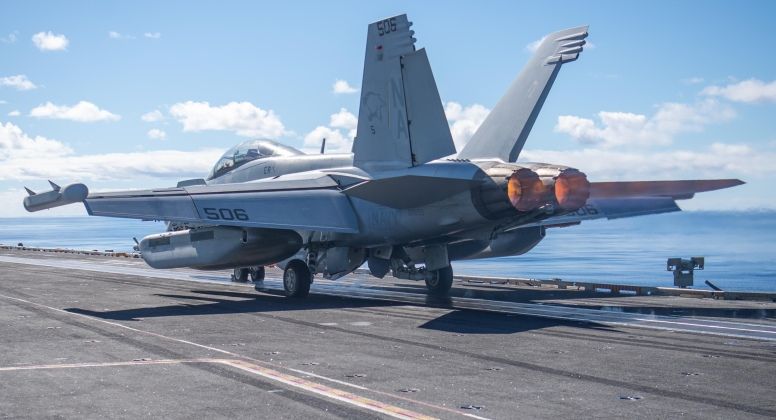
The EA-18G was developed as a specialised derivative of the F-18F Super Hornet fighter, which was itself developed in the post-Cold War years as a much more conservative and less costly alternative to other proposed fighter types, including the A-12 long range stealth attack jet, and a planned carrier-based long range air superiority fighter with fifth generation capabilities. With the F-18’s survivability having been highly questionable at the time, the support provided by the EA-18G was considered vital to allowing the Navy to rely on the aircraft. EA-18Gs integrate wide ranges of electronic warfare pods optimised for jamming in a range of frequencies, allowing them to shield accompanying aircraft from radar detection or radar-guided missile attacks. Its sensors and computer systems were designed to allow it to systematically map out radar systems, identifying their strengths, and probing or weaknesses, while also providing intelligence to allow for the development of more effective countermeasures. The loss of two of the aircraft represents a significant loss for the Navy, with only an estimated 160 of the aircraft estimated to have been produced. The loss is particularly significant considering that plans to field a successor to the F-18E/F and EA-18G under the F/A-XX fighter program have faced considerable delays.
