
A Look at the World’s Only Four 4th Generation Battle Tanks: Elite Armour From Turkey’s Atlay to Russia's T-14
Military Watch Magazine Editorial Staff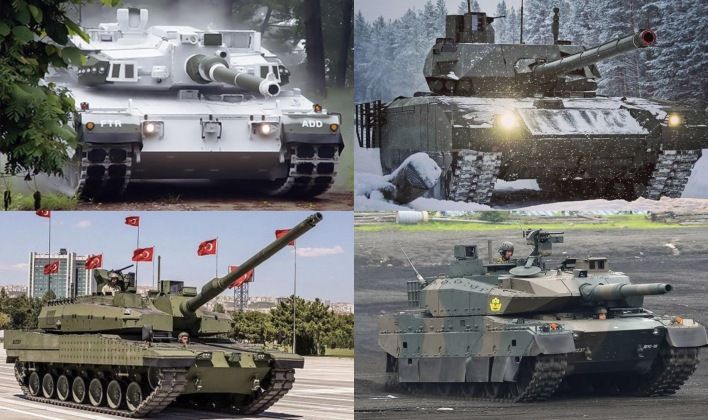
Fourth Generation Tanks K2, T-14, Type 10, Atlay (clockwise from top left)
Leading military powers have been competing for over a century to field the most modern and capable battle tanks - ever since the tank first proved its usefulness during the First World War which led to widespread investment in such vehicles as a key asset for a state’s ground forces. While the tank has arguably been superseded at the very high end of countries' arsenals for a ground war by combat aircraft, ballistic missiles and other assets which are considerably times more costly, making superior armour far less decisive than it used to be during the Second World War and in its aftermath, major powers have still continued to strive to field the most capable armour.
Post-Second World War battle tanks today are today classified into four distinct generations. The first generation included platforms such as the Soviet T-55 and American M48 Patton, while the second, which began to enter service from the early 1960s, was dominated by the Soviet T-62 and American M60. Third generation tanks would follow from the mid-1970s, and represent the vast majority of tanks in production today including features such as advanced composite armour and computer-stabilised fire control systems. The most prolific among these have been the Soviet and Russian T-64, T-72B3, T-80 and T-90, the American M1 Abrams and the Chinese Type 99.
Superseding these, three fourth generation tanks are in service today with a fourth in limited service as a slightly modified license produced variant of one of the other three. South Korea, Russia and Japan have increasingly led the world in armoured warfare technologies, and are likely to be closely followed by China and the U.S. which have their own fourth generation programs under way. Most countries have otherwise sought to enhance their older third generation tank designs with some fourth generation technologies for a cheaper alternative, such as the Chinese Type 99A which entered service in the early 2010s and the American M1A2D Abrams which is set to join the U.S. Army by the end of 2022. A look at the fourth generation tank designs in service today and their capabilities is given below.
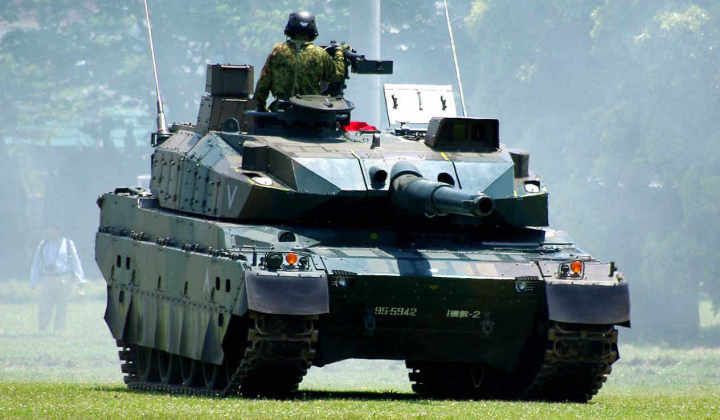
Type 10 - Japan
The world’s first fourth generation battle tank, the Japanese Type 10 entered service in 2012 and was developed by Mitsubishi Heavy Industries as a lightweight platform to complement existing much heavier third generation Type 90 tanks. The tank uses a completely new gun developed by the Japan Steel Works, which has options for longer L50 and L55 calibre rounds and produces a range of both indigenous and NATO standard ammunition. The cannon is notably more advanced than the standard 120mm Rheinmetall main gun used by most Western tanks and by the older Japanese Type 90 platform, and can fire the unique armour-piercing fin-stabilised discarding sabot kinetic energy penetrator round developed specifically for the Japanese vehicle. The tank’s C4I (Command, Control, Communication, Computer & Intelligence) system was widely considered the most advanced in the world when it entered service, and facilitates more effective network-centric operations both with other armoured units and with infantry.
The Type 10’s light weight notably allows it to to deploy anywhere in Japan using normal roads and bridges, which older Japanese desiigns could not. The platform is highly prized for its modular and replaceable armour panels, allowing them to be easily updated over its lifetime to keep up with advances in anti tank weaponry. The tank also benefits from an advanced and very reliable autoloader for its main gun, continuously variable transmission (CVT) allowing the driver to change seamlessly through a continuous range of gears, and hydropneumatic active suspension which allows the Type 10 to adjust its stance and more effectively absorb recoil when firing. The platform’s situational awareness is also boosted by sights mounted around the turret which provide 360 degree coverage and information which inputs into its C4I system. While the Type 10 may struggle against heavier tank designs such as the Russian T-90M, in terms of sophistication and versatility the platform has few rivals in the world.
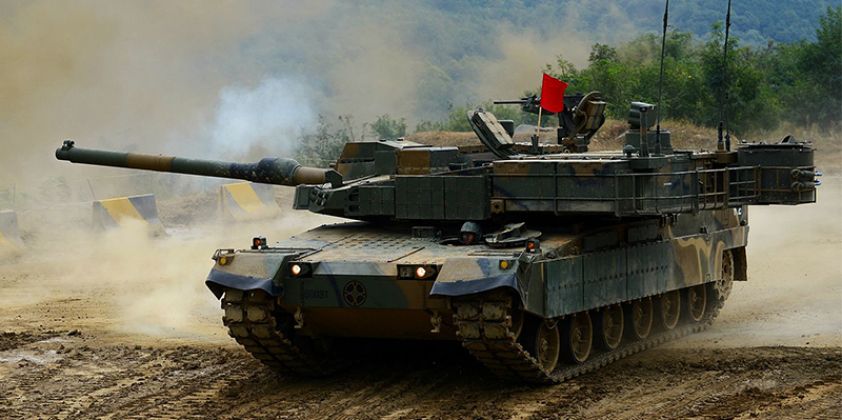
K2 Black Panther - South Korea
The K2 Black Panther tank entered service in the South Korean Army in 2014, and was developed by Hyundai Rotem to follow on from the K1 platform of the 1980s. While the K1 was closely based on the American M1 Abrams, but featured a number of advanced features not seen on the U.S. built original on its newer variants such as the K1E1, the K2 was an entirely new and indigenous design which placed South Korea in the lead in terms of the quality of its frontline armour. The tank benefits from some of the most advanced composite armour and both explosive and non-explosive reactive armour in the world, combining them for a degree of survivability with few rivals. Its millimetre band radar system is capable of operating as a Missile Approach Warning System which complements the Black Panther’s computer's ability to triangulate incoming projectiles and fire visual and infrared screening smoke grenades - which can block the tank’s visual and infrared signatures. The K2’s sensors are also extremely powerful, with its fire control system linked to a high frequency radar deployed on the frontal arc of its turret complemented by crosswind sensors and laser rangefinders and a powerful a thermographic camera - with a 'lock on' mode allowing it to track targets at ranges of 9.8km.
Since its entry into service the K2 has been considered the most capable tank in the world, although a long pause in production and a relatively low rate of production may undermine the rate at which it is able to integrate upgrades meaning it could lose this title as more sophisticated competitors enter the field over the coming two decades. The Black Panther deploys a 120mm cannon and two heavy machine guns, and its cannon is capable of firing at extreme angles allowing the tank to function effectively as a mobile artillery piece.
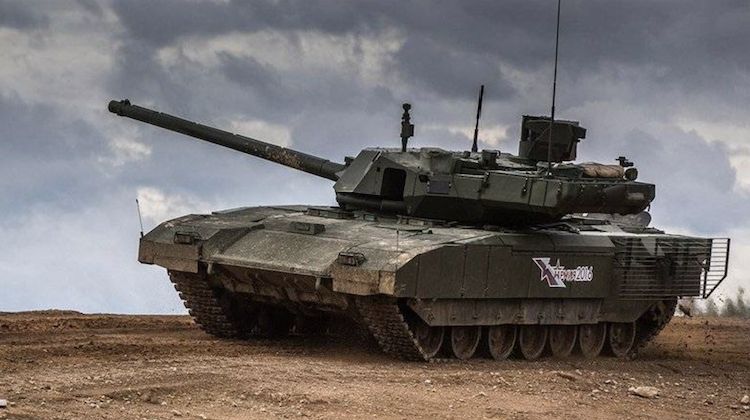
T-14 Armata - Russia
Entering service in small numbers in 2015, the T-14 Armata next generation battle tank was a less ambitious program than the cancelled Soviet T-95 - but still represents a considerable leap over both existing Russian armour and competing Western designs. The tank is notably much heavier than the T-90, and is a successor to the heavyweight T-80 design which will serve as a heavier complement to the T-90M in the Russian Army. The tank uses an innovative arrangement with an armoured capsule for the crew, ammunition and fuel, and remote-controlled fire control system, which improves its survivability on the battlefield relative to older Russian designs. The military is reportedly considering integrating a 152mm cannon onto the tank, a concept previously also tested on the T-80, which would significantly improve the Armata’s firepower and widen its existing advantage over Western competitors.
What is particularly notable about the T-14 is the number of new technologies currently under development to improve the design, from new composite armour to penetrative munition types. The tank's 2A82-1M main gun and Kalina fire control system allow it to deploy a wide range of specialised munitions which are among the most capable in the world, and allow the Armata to engage a wide range of targets from fortified bunkers to infantry positions. The platform is also expected to have an advanced anti aircraft capability to counter helicopters and low flying attack jets. Other notable new technologies integrated onto the T-14 include the Afghanit active protection system and Relikt explosive reactive armour. The tank’s large size and relatively high maintenance requirements mean it is unlikely to be fielded in large numbers as the T-90 and T-72 are, but the platform did enter mass production in the summer of 2020 which was much earlier than anticipated - possibly in expectation of an export order.
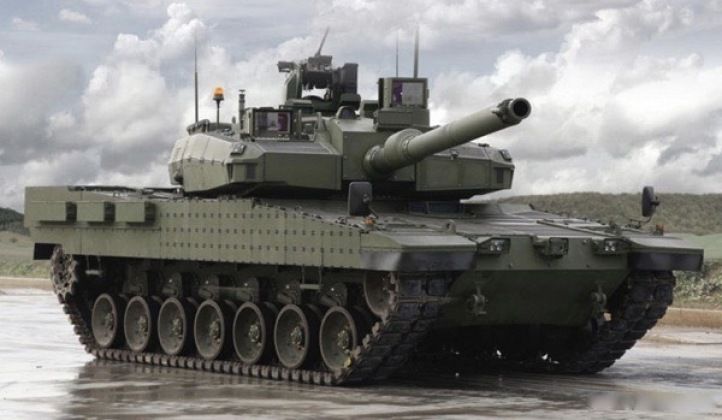
Atlay - South Korean Design, License Produced With Modifications in Turkey
The Atlay tank is a close derivative of the South Korean K2 Black Panther being produced under license in Turkey, and was developed jointly by South Korea’s Hyundai Rotem and a number of Turkish contractors - primarily the military vehicles manufacturer Otokar. Primary differences from the Black Panther include integration of the indigenous Volkan-III modular fire control system, and in future will reportedly include an indigenous engine. The tank’s capabilities are far ahead of the second generation M60 and third generation Leopard II which currently form the bulk of Turkish armoured units, and the design has gained interest from Ankara’s close defence partners Qatar and Azerbaijan. The Atlay won a contract estimated at between $3.5 and $4 billion in 2018 for 250 tanks, and three more similarly sized batches are planned for a production run of around 1000 platforms plus export sales. Turkey’s very limited industrial base has restricted its ability to develop armour indigenously, and the country’s ability to develop even a viable third generation tank without South Korean assistance is questionable. Turkey cannot be considered a genuine developer of fourth generation level armour, meaning South Korea, Russia and Japan are as of yet the only countries to have developed such tanks. Nevertheless, the Turkish decision to acquire advanced South Korean technologies for its armoured units will provide it with the most advanced tanks in NATO for many years to come.
