
Role of the T-90M in Russia’s Plans to Modernise its Armoured Units: Lethal New Battle Tank Integrates T-14 Armata Technologies
Military Watch Magazine Editorial Staff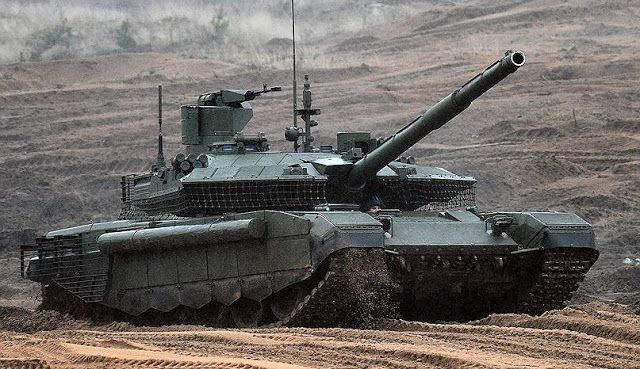
T-90M Battle Tank
The Russian Army is expected to induct its first T-90M battle tanks into frontline service by the end of 2020, providing a serious upgrade over existing tanks. The T-90M builds on the previous strengths of the T-90, including among others its reliability, endurance, firepower and situational awareness, and improves on many of them by integrating next generation technologies from the T-14 Armata next generation battle tank. The T-14 is today under low level production for the Russian Army, and is one of just three active fourth generation battle tanks alongside the South Korean K2 and Japanese Type 10. While officially the T-14 is a combat ready platform, it is unlikely to enter mass production before the mid 2020s as the design continues to be further refined, meaning the T-90 will continue to form the backbone of Russia’s elite armoured units in the near future. Not to be confused with the T-90MS, an older and less sophisticated design intended for export markets, the T-90M is second only to the T-14 in its capabilities and is a full generation ahead of the original T-90 design in its sophistication. The platform is not only significantly cheaper than the heavier T-14, but is also more importantly much cheaper to operate and requires less maintenance meaning maintaining large numbers of active platforms will be more affordable.
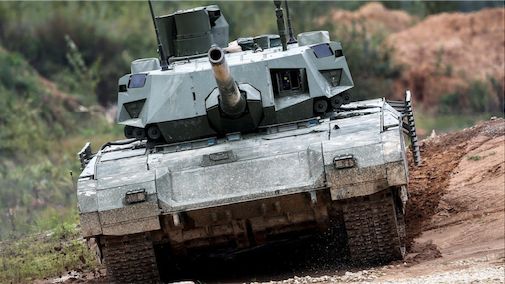
Perhaps the T-90M’s most significant upgrade over the original platform is the integration of the 2A46M-5 gun and the T-14 Armata’s Kalina fire control system, allowing it to deploy the wide range specialised munitions developed for the next generation platform. The new tank also integrates a similar communication and command suite and digital communications systems as the T-14, improving situational awareness and improving network-centric warfare capabilities. While the tank is less well armoured than the T-14, its survivability will be brought up to a far higher level than other third generation designs with the integration of the Afghanit active protection system and Relikt explosive reactive armour. Induction of the T-90M into frontline service in larger numbers represents only a small part of Russia’s plans to modernise its armoured units, which alongside acquisitions of the T-14 Armata includes enhancement of older T-72 and T-80 tanks to the T-72B3 and T-80BVM standards, which similarly emphasise improvements to firepower situational awareness, and survivability by integrating systems such as new autoloaders, and Relikt or Kontakt-5 explosive reactive armour. For Russia’s reserve units, T-62M and MV units are also being upgraded to allow them to remain at least somewhat viable against modern adversaries. While less capable than the T-64 design, the T-62 is prized for its ease of maintenance and low operational costs making it ideal for such units.
