
The Emergence of East Asian Carrier Powers in the 21st Century - From the Dokdo and Hyuga to the Izumo and Liaoning
Military Watch Magazine Editorial Staff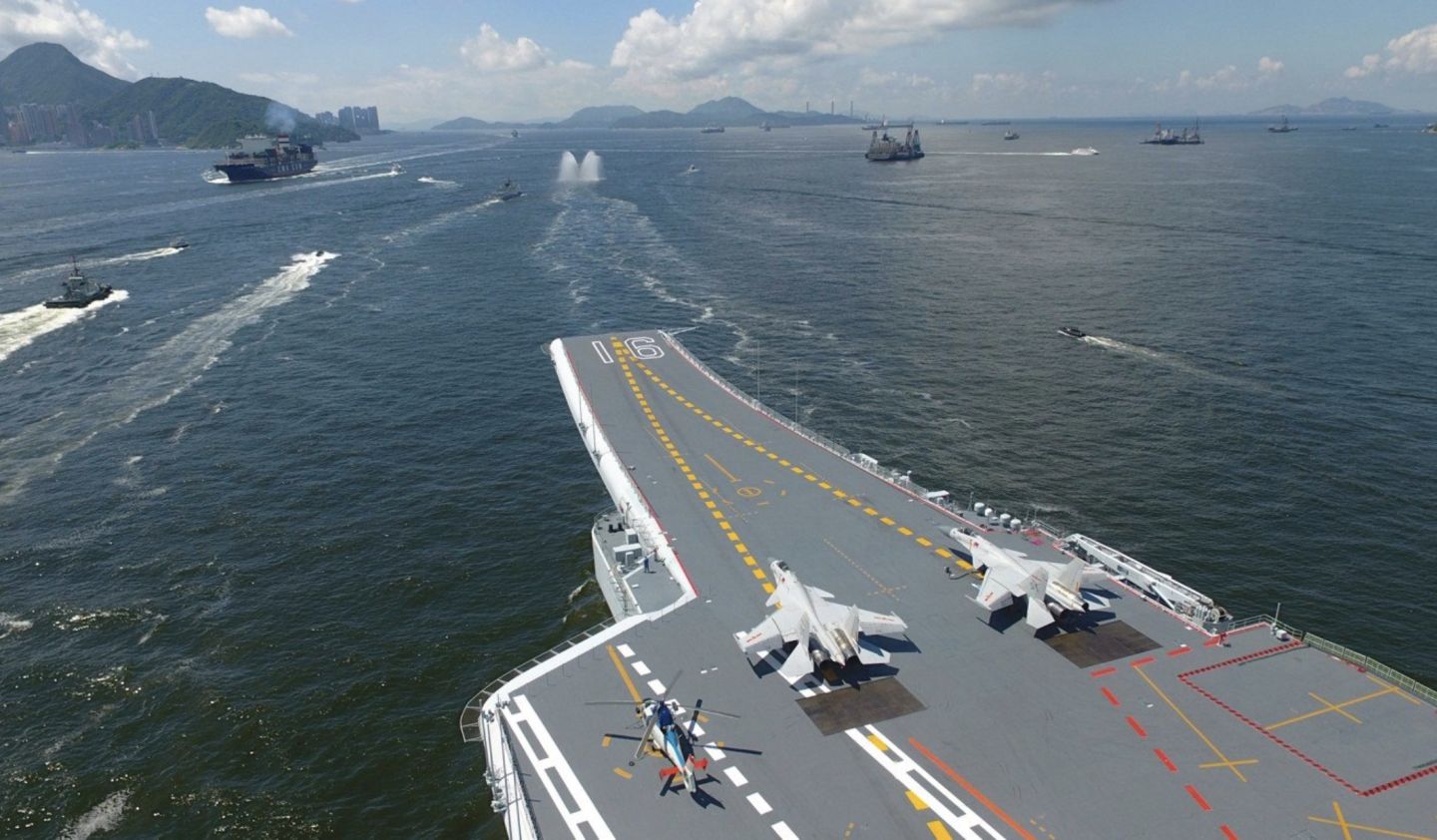
Now of the Liaoling - China's First Aircraft Carrier
East Asia has in the 21st century seen by far the greatest growth of its carriers fleets of any region in the world. From almost no carrier capabilities at the turn of the century, the region today fields eight carriers with several more in development or under construction. Japan by 2017 had inducted four platforms, two 19,000 ton Hyuga Class and two 27,000 ton Izumo Class warships. Though they are termed Helicopter Destroyers by the Japanese Self Defence Force rather than carriers to avoid contradicting the country's Pacifist constitution, their capabilities eclipse those of many of the world's less capable aircraft carriers such as the British Invincible Class, Brazilian Sao Paulo, Thai Chakri Naruebet, and Spanish Juan Carlos. These new Japanese warships are likely only the beginnings of a larger carrier fleet which will deploy larger and more sophisticated platforms in future. Japan's ruling Liberal Democratic Party (LDP) has proposed the developing of a larger 'mothership' capable of deploying fighter aircraft, likely considerable larger than the Izumo Class, while the Izumo itself was revealed to have been designed from the outset to accommodate F-35B stealth fighters specialised for short takeoffs from short carrier runways.
Japan has hardly been alone in developing its carrier fleet. China in 2012 inducted the first aircraft carrier in its history, the Liaoning, which was based on the hulk of a Soviet Kuznetsov Class warship acquired from Ukraine. The country has since designed three more advanced carriers, the Type 001, Type 002 and Type 003, and the first is currently undergoing sea trials while the latter two are under construction. China's carriers are unique in the region as the first since the Japanese Imperial fleet of the Second World War to accommodate conventional takeoff fixed wing aircraft. China is also one of only four countries in the world, alongside the United States, Russia and France, to have developed its own modern fixed wing aircraft for its carriers. The J-15 Flying Shark heavy air superiority fighter is one of the most capable carrier based aircraft in the world today, and the platform's capabilities are set to be enhanced considerably as more capable variants are manufactured for deployment abroad upcoming carrier warships. These are set to be accompanied by electronic attack jets, derived from the J-15 airframe, and advanced KJ-600 AWACS platforms - making the China the only nation in the world to have developed such advanced and highly specialised aircraft other than the United States.
South Korea, despite its far smaller defence budget, has also invested in limited carrier capabilities of its own. The country currently fields a single Dokodo Class amphibious assault ship, displacing 18,800 tons and carrying up to 10 helicopters, and a second ship of the same class is currently under construction. The military is reportedly seriously considering converting this second ship to deploy F-35B short takeoff vertical landing (STOVL) capable light fighters to operate from its short runways, which would also represent the first aircraft carrier capable of deploying fixed wing jets in the country's history. Seoul is far more likely to pursue such a course of action should Japan deploy the F-35B from its own Izumo Class carriers, as the country seeks to maintain a form of near parity with its larger neighbour. Due to the limited size of its warships, the Korean Navy must rely on STOVL capable platforms - and the F-35B is currently the only aircraft in production with such capabilities. Unlike Japan and China, South Korea is unlikely to develop larger carriers fielding conventional takeoff platforms in future due to budgetary constraints and the huge costs of acquiring and operating these larger warships.
With vast seas separating regional powers from one another, development of carrier capabilities remains an invaluable asset for the militaries of East Asia more than others. Budgetary constraints and differing defence doctrines have however prevented the region's other two powers, North Korea and Taiwan, from developing carrier capabilities of their own. Outside East Asia two other Pacific powers, Thailand and Australia, have sought to develop light carrier capabilities with limited success. Unlike the East Asian carrier programs, Thai and Australian platforms were Spanish built rather than domestically procured - with neither maintaining the industrial base or ship building capabilities required to construct its own carrier warships. Economic development in the region could see South East Asia develop its own carriers in future, with archipelagic nations such as Indoensia potentially benefitting from such capabilities.
Ultimately China and Japan are set to emerge as two of the world's leading carrier powers, particularly with the decline of European economies and resulting budgetary constraints on European carrier programs which have left France the only European nation capable of operating conventional aircraft carriers - with other European navies operating less capable STOVL only warships. Weather the growing Chinese and Japanese Naval capabilities will be aimed at one another in the East China Sea, or whether the two can peacefully settle mutual disputes and tailor their growing fleets to face extra regional threats as European powers succeeded in doing decades ago, may well prove a decisive factor in determining if the region's future.
