
F-35B Onboard the Dokdo Class; South Korea Seeks to Transform its New Warships Into Carriers for Stealth Fighters
Military Watch Magazine Editorial Staff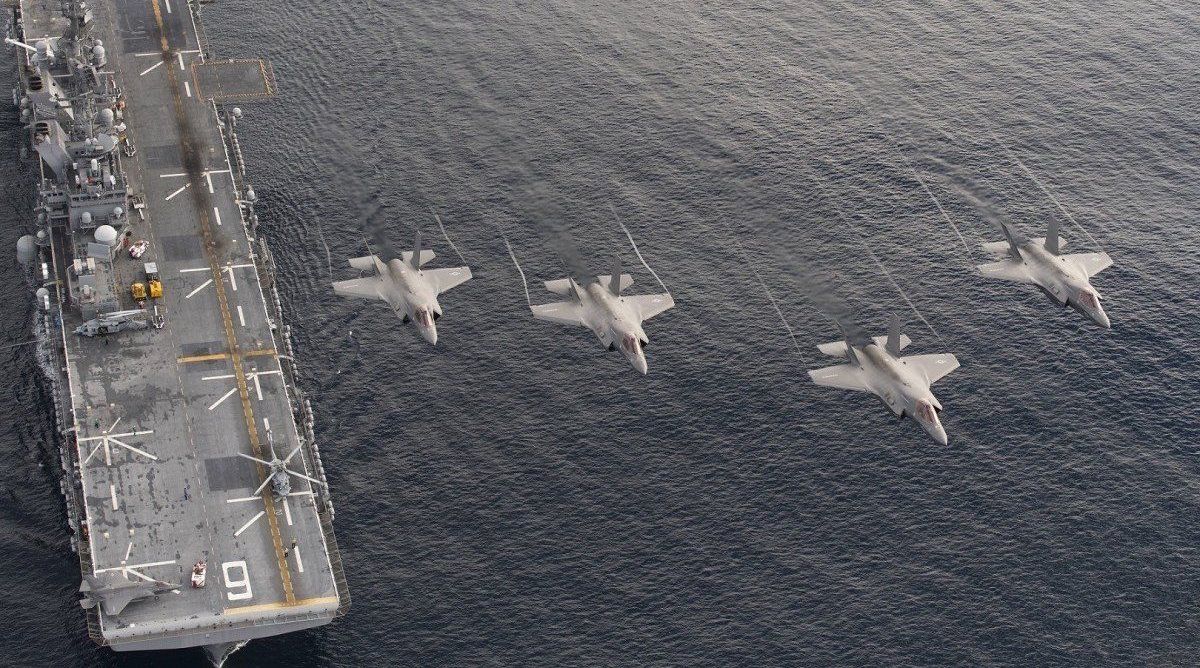
F-35B Stealth Fighters Deploy from Light Aircraft Carrier
With a single Doko Class amphibious assault ship, ROKS Dokdo, in service and a second platform, ROKS Marado, launched and currently undergoing sea trials in preparation for its commissioning, the South Korean Navy is reportedly considering converting at least one of these helicopter carrying warships into an aircraft carrier capable of deploying F-35B stealth fighters for combat operations at sea. The Navy has put up a public notice of tender to research the potential of operating the U.S. made jets onboard its 18,800 ton carrier warships, a process initiated through the state run Defence Acquisition Program Administration’s electronic defence procurement system. While analysts have long speculated that the Seoul may seek such capabilities for its navy, the tender has confirmed not only the country’s intention but also the reason long suspected of pressing the military to obtain such capabilities. The tender was reportedly launched citing the threat posed by neighbouring countries’ plans to deploy the F-35B onboard their own carriers - a clear reference to Japan which is the only potential export client for the fighter outside the Western Bloc.
With inter Korean relations fast improving, the remilitarisation of Japan and a drive to attain world power status and develop long range power projection capabilities have increasingly become dominant influences on South Korean defence planning. As Japan’s armed forces have reportedly long been planning to attain naval blue water power projection capabilities, commissioning a pair of 19,000 ton Hyuga Class carriers from 2009 closely followed by two 27,000 ton Izumo Class platforms from 2015, the former imperial power’s rapid rearmament and abandonment of its longstanding policy of pacifism and non interventionism have been cause for much concern in Seoul. The Izumo Class warships, while long suspected of being purpose built to deploy fighter jets due to their considerable size relative to conventional helicopter carrying designs, were in 2018 confirmed to have been purpose built with the accommodation of the F-35 in mind. This has prompted South Korea to consider equipping its own carriers with the very same fighters, which despite the considerably smaller size of the warships would ensure its Navy would not be entirely outmatched in its blue water capabilities should it need to face the Japanese fleet.
The F-35B is currently the only fighter jet in production anywhere in the world capable of deploying from short runway carriers - designed to operate from the U.S. Navy’s Wasp and America Class assault ships which lack either catapult systems or ski jumps. The fighters ability to land vertically also eliminates the need for arresting gear, making modifications to a light carrier a realistic prospect. The stealth jets nevertheless sacrifice manoeuvrability, range, payload and ease of maintenance relative to other less complex F-35 variants, and as a result of the complexity of STOVL systems they are considerably more costly than the F-35A operated by the Japanese and South Korean Air Forces - making the F-35B the most expensive fighter jet in production anywhere in the world. Should the Dokdo Class deploy the F-35B, it would likely be seriously restricted in the number of fighters it can carry relative to the Japanese Izumo Class or the American assault ships which were initially purpose built to accommodate the jets. The Korean carriers would be the smallest in the world to deploy modern fighter jets, and the viability of a conversion remains unknown. Ultimately, while studies may well conclude that the Dokdo Class is unfit to operate the F-35B, this conclusion could well be key to prompting investment in a heavier aircraft carrier class - taking advantage of the country’s advanced shipbuilding capabilities to manufacture a warship comparable in size to the Japanese Izumo Class - or possibly even the 40,0000 ton U.S. Wasp Class. Considering the size of the South Korean defence budget and the high cost effectiveness of its defence industry, which has manufactured warships at approximately half the cost of often inferior similarly sized European counterparts, such a program also remains a considerable possibility should Seoul intend to retain parity at sea with its larger neighbour and further enhance its Navy’s already formidable blue water power projection capabilities.
