
Japan's Izumo Class Warships Designed as Aircraft Carriers from the Outset, Met with Much Apprehension Abroad
Military Watch Magazine Editorial Staff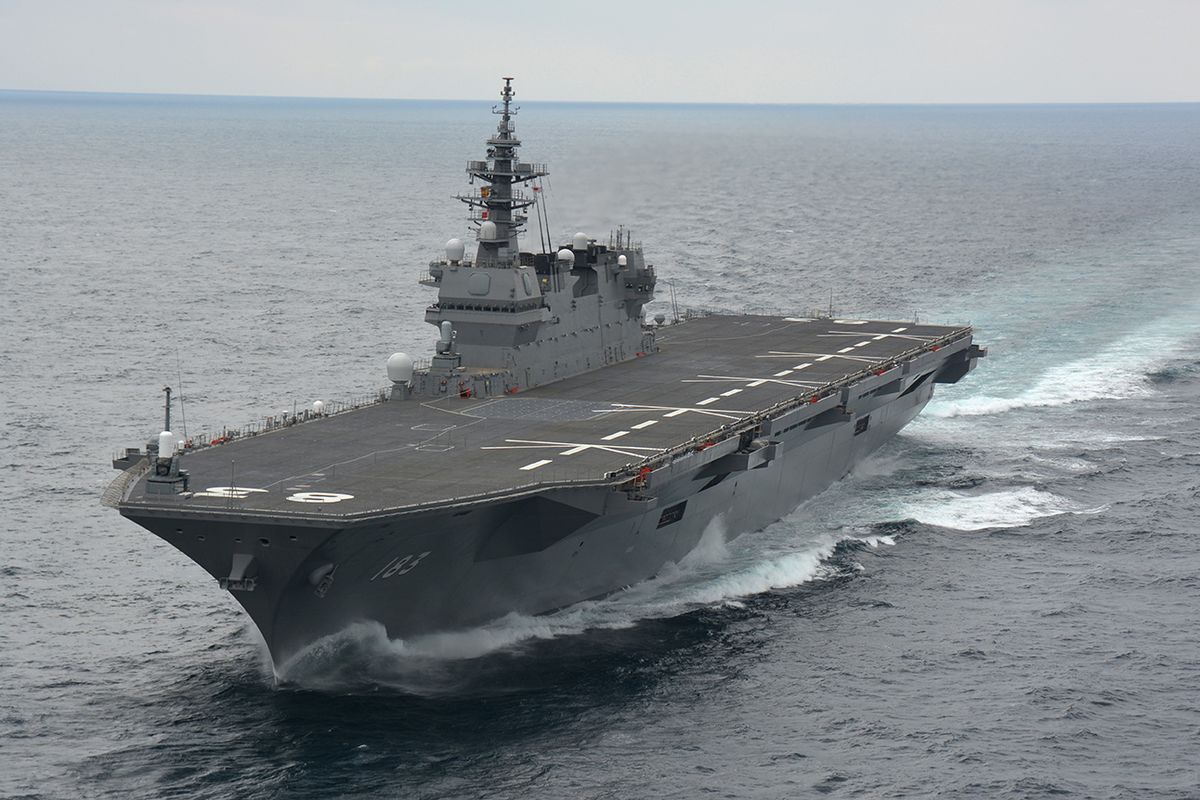
Izumo Class Carrier
While Japan's pacifist constitution has long restricted its Navy's ability to develop a carrier fleet, or any weapons which could be perceived as offensive or designed to project power abroad, the country has since the turn of the century commissioned four large 'helicopter destroyers' into service. These platforms are among the most capable warships in service anywhere in the world, and are capable of deploying large numbers of rotary wing aircraft far from Japanese waters. While such platforms can deploy combat aircraft and personnel abroad for power projection, Japan's archipelagic topography means that helicopter carriers can also be developed under the pretext of providing assistance for disaster relief to outlying islands. The development of the country's carrier fleet has nevertheless been met with extreme apprehension among neighbouring countries, particularly China and North Korea which view Japan's military resurgence under Prime Minister Shinzo Abe as a threat to their security.
Japan's first two helicopter carriers, the 19,000 ton Hyuga Class Warships in service since 2009, were the largest warships built by the Japanese Navy since the fall of the Japanese Empire. The platform's size was particularly large for a helicopter carrier, comparable to light aircraft carriers such as those operated by Spain and Italy and Britain's recently retired Invincible Class warships. The platforms were followed by two 27,000 ton Izumo Class warships, platforms commissioned in 2015 and 2017, which were far larger than the many conventional aircraft carriers in service elsewhere in the world. Japan had deployed four advanced and fully operational carrier platforms in just eight years. The Izumo Class in particular was long suspected of being intended as an aircraft carrier to operate short takeoff vertical landing (STOVL) capable light fighters such as the U.S. made F-35B. The fact that the carriers' induction coincided with the F-35B's entry into service, and that Japan's government continued to pass laws which reduced the limitations on power projection abroad, only worsened the apprehension of Japan's neighbours.
While allegations that the Izumo Class warships were designed as power projection platforms rather than defensive 'helicopter destroyers' were widely made long before the program's completion in 2017, all of which were denied, it was revealed in February 2018 by Japan's Asahi Shimbun newspaper that the warships were in fact designed from the outset as aircraft carriers to operate fixed wing aircraft. The newspaper stated that executives from the country's Maritime Self-Defense Force (MSDF), its Navy in all but name, had confirmed that the Izumo Class' blueprints called for it to be turned into an aircraft carrier. As a former MSDF executive told the newspaper: “It is only reasonable to design (the Izumo) with the prospect of possible changes of the circumstances in the decades ahead. We viewed that whether the Izumo should be actually refitted could be decided by the government.” Alongside large orders for U.S. F-35A light fighters to modernise its Air Force and replace the ageing Vietnam War era F-4 Phantoms, the military has already shown interest in acquiring STOVL capable F-35B platforms. While these fighters have uses operating from short runways on outlying islands, they are widely suspected to be the fighters for Tokyo's future carriers and deploy from the Izumo Class warships.
