
Taiwan's Ageing M48 and M60 Patton Tanks; Attempts to Keep a 65 Year Old Design Viable for Modern Armoured Warfare
Military Watch Magazine Editorial Staff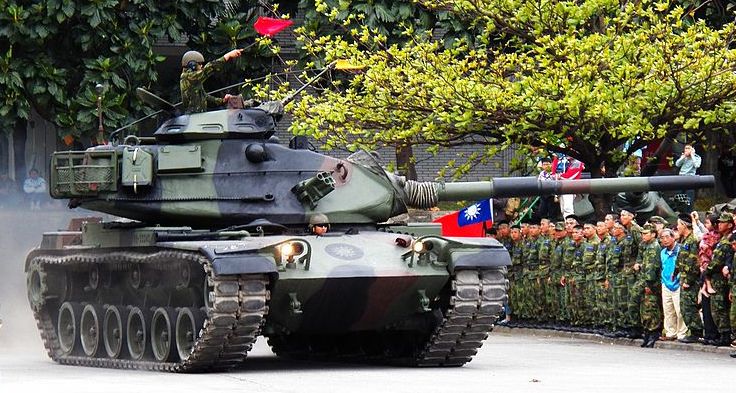
Taiwanese M60 Battle Tank
Amid simmering tensions in the Taiwan Strait, the armed forces of the Taiwan, officially the Republic of China, continue to regularly train for a potential war with the mainland (People's Republic of China, PRC), in what would be the final battle of the long unresolved Chinese Civil War. War preparations include not only the readying of air and naval assets, but also drills for coastal defence and a ground war should Beijing's forces attempt to launch an amphibious invasion. Such preparations have relied heavily on the army's large armoured warfare divisions comprised of over 2000 battle tanks - all of them Cold War era U.S. designs. Due to their importance to the ROC's defence plans to repel a ground invasion from the mainland, an analysis of the capabilities of Taiwan's armoured warfare units is potentially invaluable when evaluating the potential effectiveness of the military in a potential clash with Beijing's forces.
What is perhaps most notable about Taiwan's armoured divisions is their age, which far exceed those of the tank units of almost any other developed nation. This can in part be attributed to the prioritisation of funds for defending the island republic's air and sea space, as the territory remains surrounded by sea meaning the outcome of a war on the ground is unlikely to prove decisive in a potential cross strait conflict. The U.S. M60 “Patton” tank entered service in the U.S. Army in 1960, and represents the most modern battle tank in Taiwan's armed forces. The platform is itself heavily based on the pre Vietnam War era M48, named after the same General George S. Patton, which entered service seven years prior to the M60 with a highly similar design and capabilities. While the M60 was formidable in its day, when it saw its first major clashes with Soviet built analogues such as the T-62 in Israeli and Iranian hands in 1973 and 1980 respectively the platform left much to be desired. Both Israel and Iran notably turned away from the platform in the aftermath of its gross underperformance in their respective clashes with Egyptian and Iraqi tank divisions, with Israel beginning its much renowned Merkava program in the immediate aftermath of the 1973 Yom Kippur War to develop a more formidable replacement as Iran looked to Russia for more capable battle tanks.
Taiwan remains one of only a few major operators of the Patton alongside Turkey, Egypt and Thailand, which continue to modernise their M60 tanks in an attempt to keep the viable for modern warfare. What sets the ROC apart from other major operators however is the role prescribed to the M60. In other armies it is modernised to provide a supporting role for an elite of German, South Korean, Chinese and other modern platforms whereas in Taiwan it continues to represent the elite of its armoured warfare capabilities. Taiwan's modernisation program for the M60 is extensive and continues to this day. Recent upgrades have included a new fire control system, turret drive and sights as well as an automatic loading system - though whether this will be a fully automatic system or a semi automatic system with an assisting rammer remains to be seen. The M60's 105 mm main gun is also set to be replaced with a new 120 mm smoothbore cannon, allowing the tank to deploy modern ammunition developed for the U.S. M1 Abrams. This will represent a considerable increase in firepower. The ROC military also plans to integrate NBC, nuclear, biological and chemical defences, and environmental control systems onto the Patton tanks.
U.S. manufacturer Raytheon is reportedly heavily involved in the M60 modernisation program, though the vast majority of the program will be allotted to Taiwan's own defence manufacturers. Raythoen begun offering a Service Life Extension Program for the M60 from 2016, which included electric turret controls to replace older hydraulic controls, digital fire control and targeting systems with thermal sights, protection enhancements and 27% increase in engine power from 750hp to 950hp. Alongside significant improvements in firepower, Taiwan's enhanced battle tanks are set to make use of modern Active Protection Systems including reactive armour to allow them to better withstand strikes from modern anti tank missiles. The enhanced Patton tanks are set to make use of modern Active Protection Systems including reactive armour to allow them to better withstand strikes from modern anti tank missiles. Though using a highly dated chassis considered effectively obsolete even before the Cold War ended, upgrades applied to Taiwan's M-60 platforms could well leave the battle tanks with capability advantages over more modern battle tanks, including early variants of the Soviet T-72 and U.S. M1 Abrams. Indeed, the M60 would hardly be the only supposedly obsolete weapons system which Taipei has extensively modified and developed into a modern warfare platform - with the military's reliance on modernised MIM-23 Hawk surface to air missiles dating back to 1959 deployed to forward positions in early 2018 and acquisition of second hand Vietnam War era AAV-7 amphibious transports the same year being prominent recent examples.
Regarding Taiwan's ability to develop modern systems for its battle tanks, it is essential to consider the ROC military's long history of developing and producing battle tanks. While the M60 represents the elite of Taiwan's armoured units, the army fields approximately 750 domestically modified variants of the older M48 battle tank - a platform dating back to 1953 with a design based on the U.S. Army's requirements and experience during the Korean War. Of these, 450 were built in Taiwan itself under the Armoured Vehicle Center as the CM-11 battle tank. The platform was designed with significantly improved capabilities over any other variant of the M48 and integrated several state of the art weapons systems later installed on imported U.S. built M48 platforms. Though it ultimately pales in comparison to modern battle tanks and even second generation platforms such as China's Type 59, developing and modernising the CM-11 domestically has nevertheless given Taiwan's arms industry significant experience which is set to prove invaluable for its M60 modernisation program. With the M48 forming the bulk of its armoured divisions, supported by a smaller elite of also obsolete M60 platforms, Taiwanese battle tanks are unlikely to prove effective, even if enjoying a considerable numerical advantage, when facing Chinese platforms such as the Type 96 and Type 99A - which are among the most capable battle tanks in the world fielding capabilities decades in advance of anything currently in the Taiwanese arsenal. Ultimately Taiwan's key to an effective defence will be to deny Chinese warships and aircraft access to its territory through the deployment of anti access area denial (A2AD) systems - though these too are considered well below the standards needed to protect the territory from the latest Chinese assets.
