
Taiwanese Military Expert: 'Not Even the Gods Can Save Taiwan' Unless Air Defenses Upgraded
Military Watch Magazine Editorial Staff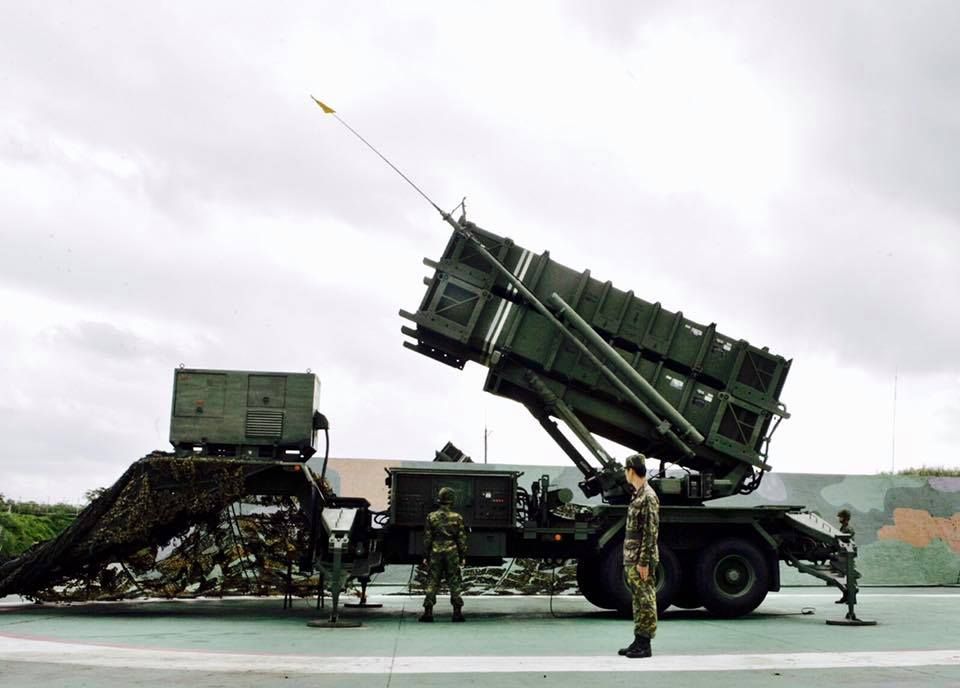
PATRIOT Missile Battery
Retired Taiwanese Navy Captain Lu Lishi, a renowned expert on the Taiwanese military, has published a report titled "Taiwan’s Imminent Air Defense Crisis." Lu argues that Taiwan's Air Force and air defense capabilities are urgently in need of an upgrade in light of the growing capabilities of neighboring China. He noted that should the country's capabilities not receive an immediate capability upgrade: “Not even the Gods or Buddha" would be able to avert a swift Taiwanese defeat. The threat to Taiwan lies primarily in its gross inability to contest air superiority even over its own airspace and in its vulnerability enemy missile attacks.
While Taiwan's armed forces long held a significant technological advantage over the Chinese mainland, with China's military military modernization beginning in the 1990s Taiwan's position was rapidly undermined. Today Taiwan's air fleet lacks any heavy or long range air superiority platforms, with its most capable fighters being the fourth generation Mirage 2000, F-16A and the indigenous Ching Kuo fighters. These are all light and short ranged platforms mostly developed in the 1970s and 1980s, which would struggle to match China's long range air superiority fighters in air to air combat. While China fields several light multirole platforms, its fleet also consists of some of the world s most advanced air superiority fighters such as the Su-35 and J-20. Such platforms would likely spearhead any attack on Taiwan, and are fielded in their hundreds. China's advantage is both numerical and technological, outnumbering Taiwan many times over with platforms significantly more advanced in their air to air combat capabilities.
Not only are Taiwan's fighters wholly incapable of countering Chinese attacks, but they are themselves highly vulnerable to attacks by Chinese surface to air missiles. Half of Taiwan is within range of China's S-300 and HQ-9 SAM systems. The entire island meanwhile is well within range of the country's latest SAM system, the S-400 Triumf, with a range of at least 400km. Chinese SAM systems can detect any aircraft flying over Taiwanese airspace and successfully target them in a matter of seconds. Indeed, with the most modern variants of the S-300 and the S-400 designed to combat advanced and highly maneuverable radar evading fighters such as the F-22, targeting the high cross section and relatively simple fourth generation fighters in Taiwan's fleet would be a simple task. The result is that Taiwan's Air Force would likely be grounded in times of conflict, and should any combat aircraft take off they would be neutralized within minutes either by SAMs or by Chinese air superiority fighters.
Compounding Taiwan's difficulties, the capabilities of its air defense systems leave much to be desired. Patriot missile batteries acquired from the United States have an extremely low effectiveness, estimated at between 2% and 30%. Even with a high interception rate however the missiles would only be able to target 160 Chinese missiles before running out of supplies - and they would not hit all of these. Chinese missiles capable of striking Taiwan meanwhile number in the thousands. With the Patriot systems also relied upon to target Chinese aircraft, they would prove wholly insufficient for the task. The country's indigenous Sky Bow system, derived from the Patriot, would serve little better.
An analysis of Taiwan's defense capabilities strongly support Lu Lishi's hypothesis. Taiwan would likely lose air superiority over its territory within a day, and from there a Chinese invasion would be inevitable despite the country's large and sophisticated ground forces. With a small and easily isolated territory Taiwan's military would struggle and an early surrender on favorable terms would be likely. While Taiwan's defense capabilities are negligible relative to the offensive capabilities of its potential adversary however, this most likely will prove wholly irrelevant. Large scale missile attacks against Taiwan, though they would be devastating against the modern high rises of its major cities, would be highly unlikely as China would hope to avoid alienating the population or causing excessive damage to a territory which it views as part of the same nation. China has little to gain from a regional conflict in the Asia-Pacific, and with a rising economy in the mainland and pro-unification sentiments on Taiwan peaceful reunification appears a far more likely prospect. China's room for military modernization is also substantially greater than that of Taiwan, and the longer China maintains peace the greater its advantage will grow and the easier an attack on the island would become.
