
Taipei’s Amphibious Dilemma; Why U.S. AAV-7 Assault Vehicles are Wholly Inadequate Against Chinese Positions in the Taiwan Strait
Military Watch Magazine Editorial Staff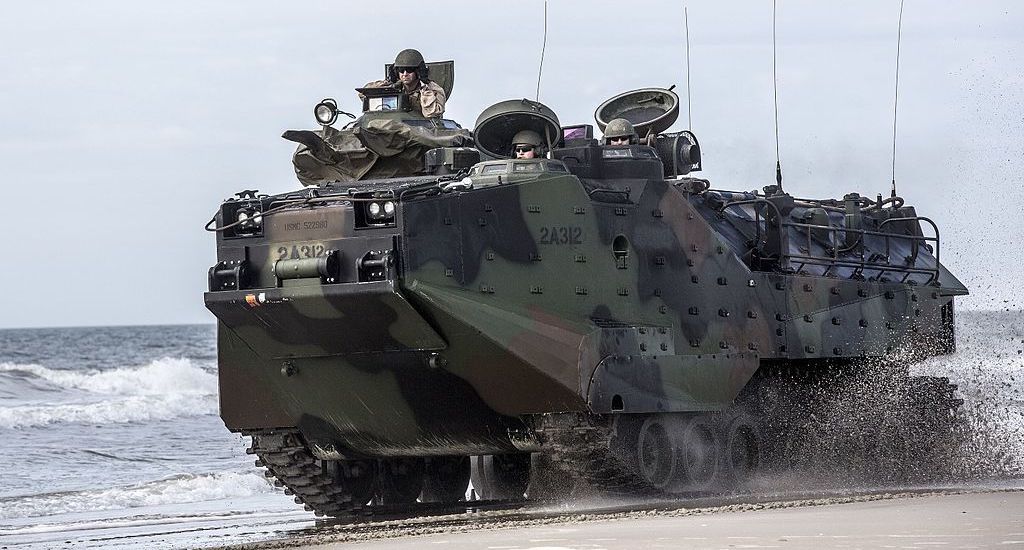
AAV-7 Amphibious Assault Vehicle
Lance Corporel Immanuel Johnson
The Untied States military has reportedly set aside 36 of its AAV-7 Amphibious Assault Vehicles for delivery to Taiwan, allowing its small East Asian defence partner to expand its fleet of armoured amphibious carriers to 90. The AAV-7 vehicles have reportedly been withdrawn from the United States’ own reserve forces, and represent the latest in a long line of many American older weapons systems provided second hand to Taipei. A Vietnam War era platform in service since 1972, the AAV has seen action in several U.S. military interventions abroad, including the Invasion of Genada in 1983 and the Gulf War in 1991. The vehicles were long ago expected to be replaced by considerably more capable Expeditionary Fighting Vehicle (EFV) in the early 2000s, a platform with significantly enhanced firepower and twice the armour protection for vastly improved survivability, critical to surviving strikes from modern anti armour munitions, which the AAV-7 lacked. The EFV was cancelled due to post Cold War budgetary constraints and the perceived unlikelihood of needing to make a beachhead landing against a near peer adversary with the Soviet Union effectively out of the picture.
The AAV-7 is lightly armed with M2HB .50 caliber heavy machine gun and a Mk19 40mm automatic grenade launcher, and carries four crew and up to 25 marines. The lightly armoured vehicles are designed for beachhead landings, much like those performed by the U.S. and its allies on D Day in 1944, though whether they remain viable against fortified beachheads given their age and relatively poor armour remains highly questionable. In Taiwanese hands, the military is likely to deploy them for amphibious landings to capture or recapture outlying Islands off Formosa held by the Chinese People’s Liberation Army (PLA). While the platform was designed for landing operations during the Cold War, its viability today against one of the most sophisticated armed forces in the world remains highly questionable.
Given the age and poor survivability of Taiwan’s assault vehicles, they are unlikely to pose a threat to China’s far more modern and sophisticated capabilities. Much like the M48 and M60 Patton tanks, platforms dating back to 1953 and 1961 respectively, the AAV-7 is will be an extremely soft target for the PLA’s heavily armed ground forces - which have developed capabilities to engage third and even fourth generation near peer adversaries against which the amphibious vehicle’s old and light armour will be of little use. Indeed, while Taiwanese Patton tanks have been heavily upgraded to somewhat enhance their survivability despite their age, the armour of the AAV-7 has seen no comparable improvements. While Taiwan’s former President Ma Ying Jeou, in light of the military’s dire need for the platforms, suggested that the armed forces supervise the production of an indigenous armoured assault vehicle, it was determined that Taipei lacked the industrial capacity to mass produce such platforms domestically. With Taiwan unwilling to acquire platforms from non Western sources for political reasons, this leaves the military with little choice other than to rely on an ageing American design which by the time of delivery will be entering its 50th year.
