
Combat Capabilities of the T-64 Tank: Why Ukraine Relies Heavily on this Soviet Era Powerhouse
Military Watch Magazine Editorial Staff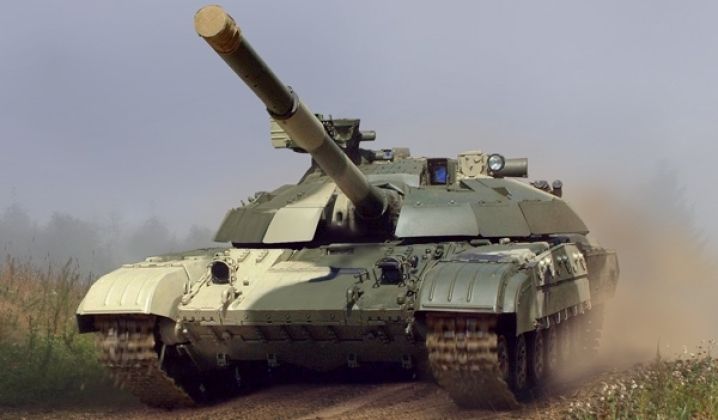
Ukrainian T-64 Battle Tank
Entering service in the Soviet Army from 1964, the T-64 is one of the least widely used Soviet tank designs ever to enter serial production. Ukraine is currently the only country to field the tanks in meaningful numbers, with it serving as the country primary battle tank, although Uzbekistan and DR Congo also field small numbers of T-64s. The tank was a revolutionary design for its time, integrating several features which would not be found on any Western counterparts for over 15 years, and boasted a very large 125mm cannon with autoloader which reduced crew requirements to just three men. It was remarkably compact with the armour and armament of a heavy tank integrated onto a small 38 tonne chassis. Approximately 13,000 of the tanks are thought to have entered service in the Soviet Military, with the design remaining in production until 1987 almost 25 years after serial production had begun. The T-64’s revolutionary design was used as the basis for development of the T-72 and T-80 tanks, the former which was much more widely used and exported and was 40% cheaper to produce and the latter which was heavier and used new engines better optimised to extreme climates.
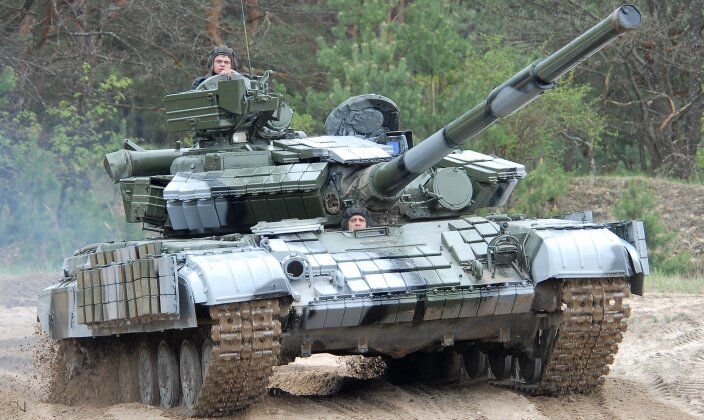
Like the T-80, the T-64 was never exported during the Soviet era and was reserved exclusively for the country’s own armed forces - although its cheaper counterpart the T-72 proved highly capable against Western built tanks in the hands of export clients. The T-64 was notably considered less cost effective to operate than it successors due to its high maintenance needs, and was retired by Soviet successor states that inherited them with the exceptions of Ukraine and Uzbekistan. The Ukrainian Army inherited 2,100 T-64s from the USSR when the superpower collapsed, alongside approximately 1000 T-72 and 300 T-80 tanks as well around 3000 older T-55 and T-62 tanks. The country subsequently saw a sharp collapse in both its economy and its military capabilities, and while it had planned to focus on production of new T-80 tanks after inheriting a factory for the vehicles it was ultimately forced to continue to rely heavily on the T-64 - which it does to this day with T-80s fielded in relatively small numbers. Plans to focus on the T-80, and the need to reduce the diversity of tank units, led Ukraine to export many of its T-72s in the immediate post-Soviet years.
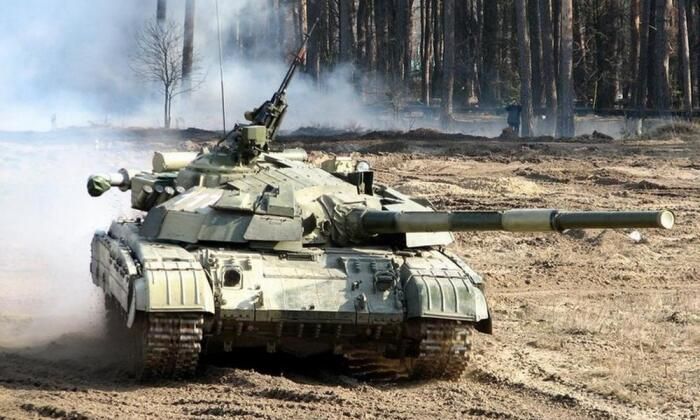
The T-64 today forms the overwhelming majority of Ukrainian tank units, with an estimated 720 in service alongside approximately 100 T-72 and 5 T-84 tanks - with the T-84 being an enhanced but somewhat troubled post-Soviet derivative of the T-80 produced primarily for export. Almost 600 more T-64s are currently in reserve. Modernisation of the Ukrainian Army’s tank units has centred around upgrades to the T-64, which has provided a much cheaper alternative to production of new T-84s that the country can ill afford. Approximately 100 of the T-64BM Bulat, which is one of the variants enhanced domestically, are in service and benefit from additional passive and explosive reactive armour, NBC protection, automatic fire suppression systems, and the same fire control system as that of the T-84. It also integrates an improved 850 hp engine, although this fails two compensate for the increase in weight from extra armour which leaves the tank slow and relatively unmanoeuvrable. Remaining T-64 tanks in service are of the T-64BV variant. T-64s have taken significant losses in combat against Russian-backed insurgents in eastern Ukraine, and while upgrades have provided improved survivability the design's age has limited its ability to go up against modern anti tank weapons. They are expected to fare poorly against modern battle tanks such as Russia’s new T-80BVM or T-90M, which the Ukrainian vehicles would likely face in the event of an escalation of hostilities..
