
Russian Su-30SM and NATO F-35A Fighters Just Went Head to Head Over the Baltic Sea
Military Watch Magazine Editorial Staff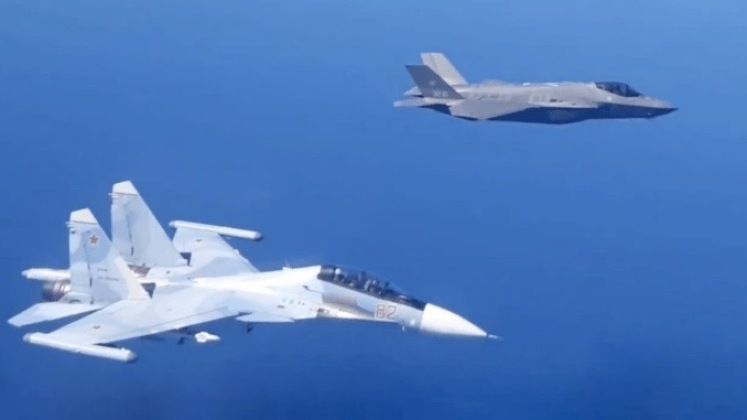
Su-30SM Intercepts F-35 Over Baltic Sea
Following the deployment of the first squadron of F-35A stealth fighters to Eastern Europe to participate in NATO patrols, the first engagement between the new American-built fighter and a Russian Su-30SM combat jet took place in the region. The F-35A was deployed by the Italian Air Force, which dispatched the 13th Squadron of its 32nd Air Wing from Amendola Air Base in the country’s south - a unit which has operated F-35s since 2016. These were the first F-35s in Europe to have an initial operational capability. The jets arrived in Estonia, a former part of the Soviet Union which closely borders Russia, on April 30, 2021. The jets took over NATO’s Baltic Air Policing mission from the German Air Force Eurofighter unit which had previously been stationed there. An F-35 from the Italian unit was intercepted by a Russian Su-30SM jet on June 9th, after the Western fighter reportedly approached a Russian An-12 transport aircraft.
The deployment of F-35s so near Russia’s borders has been highlighted as a potential vulnerability, since it provides Russia with an opportunity to learn more about the new aircraft and study its stealth profile - much as it had a chance to gain a ‘treasure trove of information,’ in the words of U.S. officials, on F-22s operating over Syria from 2015. The U.S. has invested very heavily in the F-35 with the program expected to cost $1.7 trillion dollars, making it by far the most expensive weapons program in history. Other than new variants of the venerable F-15 which first flew in February, the F-35 is the only fighter currently on order by the U.S. Air Force - as well as the only post-fourth generation fighter in production anywhere in the Western world. The value of information on the fighter, particularly considering the scale on which its will be deployed, is thus highly valuable and will likely be shared with other U.S. adversaries such as China and North Korea. Some analysts have speculated that the deployment of the Su-30SM to escort a basic transport over the Baltics may have been based on intelligence that an F-35 would be present to provide an opportunity to run in with the American-built fighter.
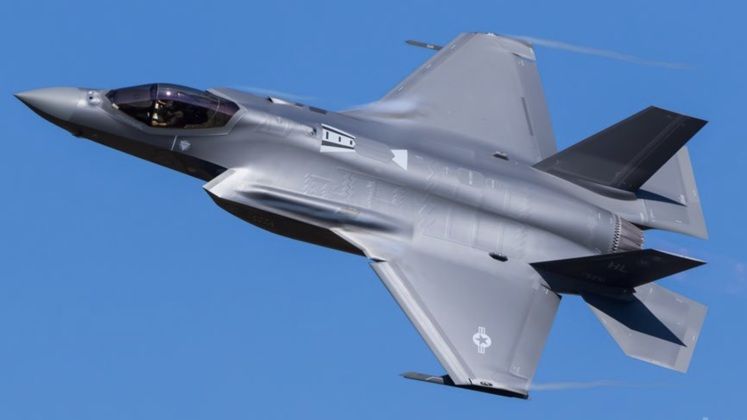
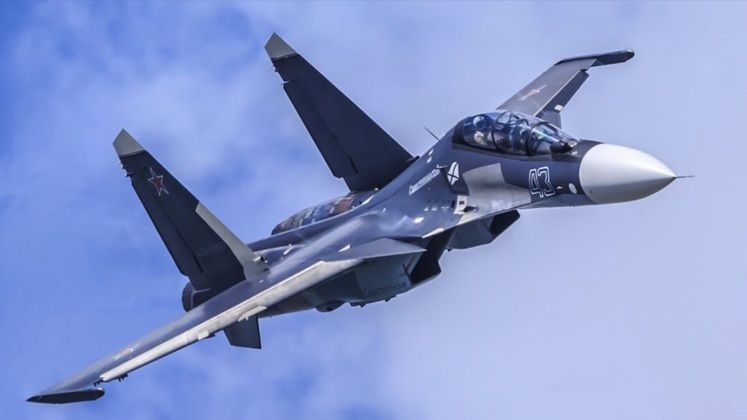
Although the F-35 has been in service since 2015, it is still very far from ready for medium or high intensity combat with only a basic initial operating capability. This allows it to carry out basic missions such as airstrikes on low level targets where electronic warfare countermeasures and surface fire are not expected. Over 300 deficiencies remain unsolved with the fighters, and new ones continue to be discovered, with the program having been harshly criticised by officials for its delays and for the fighter’s ongoing performance issues. The Su-30SM is one of the most widely deployed fighters in Russia, and is considerably heaver than the F-35 with a much larger radar, greater thrust, higher speed and a much higher operational altitude. The Russian jet’s sensor suit, data links and avionics are considered less sophisticated than those of the F-35, and the aircraft lacks its American rival’s stealth features, although it has a much higher endurance, a far superior flight performance and over double the engagement range in air to air combat.
The Su-30's twin seat configuration allows it to accommodate a weapons systems officer to assist pilots in combat, which can be a significant advantage particularly when engaging targets both on land and in the air simultaneously. The Su-30SM is considered a fully combat ready fighter, although production of the aircraft has ceased in favour of the more capable Su-30SM2 which is currently entering service in the Russian Air Force. Opinions differ widely among analysts regarding whether the F-35 or the Su-30SM would have an advantage in air to air combat once the F-35 becomes fully operational, with the two designs emphasising very different capabilities.
