
Russia Using Augmented Reality Technology to Produce More Advanced Su-57 Fighters
Military Watch Magazine Editorial Staff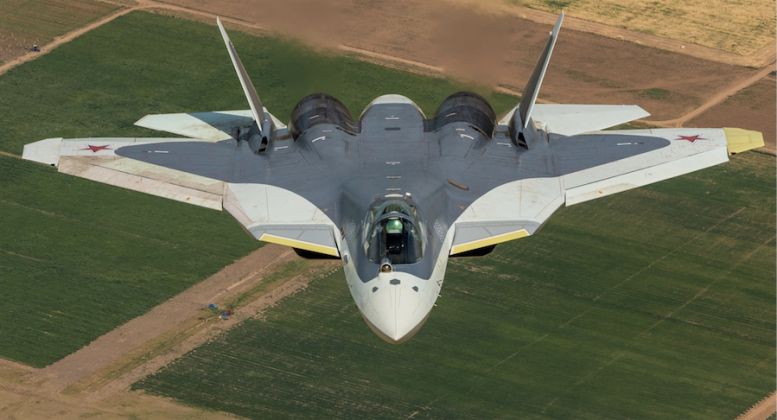
Su-57 Next Generation Fighter
Footage has emerged showing a production line for the Su-57 Felon next generation heavyweight fighter where workers are using augmented reality technologies to assist in manufacturing the aircraft. The Su-57 entered serial production in Russia in July 2019, and is intended to provide the country’s first sixth generation fighter jet - although early production variants are considered fifth generation aircraft with many key technologies still under development. The fighter is currently in production at the United Aircraft Corporation’s Komsomolsk on Amur Aviation Plant in Russia’s Far East, although further production lines are expected to be opened possibly in other locations as Russia moves to reduce production of the Su-30 and Su-35 Flanker aircraft - likely merging these older jets into a single production line. The Su-57s being produced at the plant have shown signs of a considerably higher manufacturing quality to the individually built prototype jets which were previously combat tested in Syria, with the prototypes now being used as testbeds for sixth generation technologies.
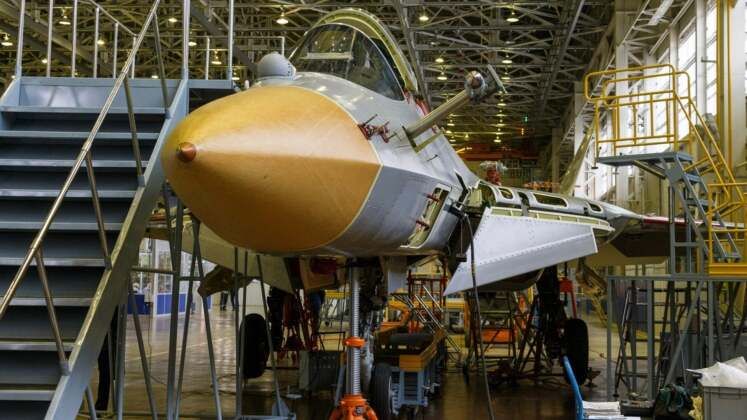
Augmented reality allows workers on the production line to see computer generated perceptual information over their real vision, meaning they see a combination of both real and virtual images which can assist them in manufacturing the Su-57. The augmented reality system allows workers to select different options to guide them through different stages of manufacturing, although it remains uncertain to what extent this will make production more efficient. Similar technologies are being used for Lockheed Martin’s F-35 program, which is the only Western fifth or sixth generation fighter in production. Future Russian combat jets such as the MiG-41 hypersonic interceptor and PAK DA stealth bomber are likely to also benefit from these technologies in their manufacturing stages should they prove beneficial for the Su-57. They may well also be used to improve production of Russia’s MiG-35 fighter which entered service in 2019 and integrates many of the same technologies as the early Su-57 variants. It remains uncertain to what extent these technologies are indigenous, with Russia’s defence sector increasingly reliant on Chinese inputs and with China being a world leader in augmented reality technologies which could have supplemented indigenous developments.
The Su-57 is expected to integrate a new Saturn 30 engine from 2022, which Russian sources indicate will be the most powerful fighter engine in the world and will be a key step towards boosting the fighter to a sixth generation level. Early variants of the fighter were reportedly scheduled to join the Russian Air Force in December 2020. 76 fighters are currently on order for the Russian Air Force for delivery by 2027, although this may be increased depending on the country’s security situation and the speed at which the design can be modernised. Export orders mean that the production rate even before 2027 is expected to be high, with multiple reports of an Algerian order for over a dozen fighters.
