
Russia’s New Su-57 Fighters to Each Command Four Stealthy Okhotnik Attack Drones
Military Watch Magazine Editorial Staff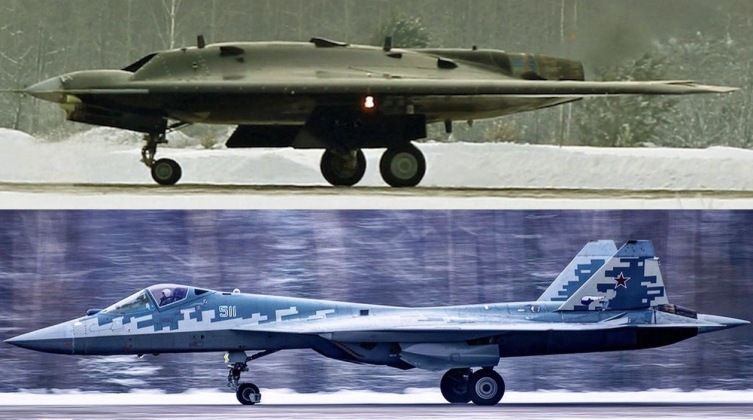
Okhotnik Drone and Su-57 Fighter
Russia’s new Su-57 fighters will reportedly each be able to control up to four Okhotnik stealth drones as ‘loyal wingmen’ to support them in combat, according to sources in the country’s military aviation industry cited by state media outlet TASS. "Currently, the options of controlling strike drones from a Su-57 cockpit are being worked out. A fighter jet is expected to carry from two to four Okhotnik drones," the source said. The drones are expected to enter service in the Russian Air Force from 2024, and make use of a flying wing design similar to the Iranian Shahed-191 and the American RQ-170. The unmanned aircraft will reportedly be capable of deploying not only standoff air to ground weapons, but also air to air missiles to supplement the firepower of the Su-57 itself. The number of drones that will be produced remains highly uncertain, with the Russian Air Force expected to field 76 Su-57 fighters by 2027 before the rate of production for the fighters is expanded considerably. The ratio of Okhotnik drones to Su-57 fighters in service, and how common it will be for the fighters to be supported by such drones, has only been speculated.
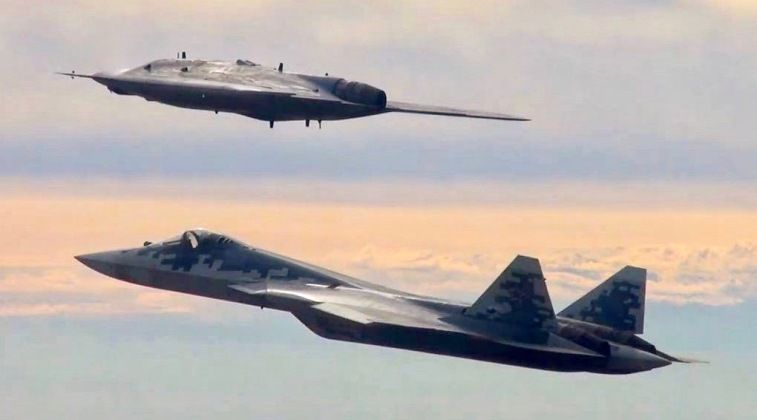
The possibility of developing a twin seat variant of the Su-57 to allow the fighters to better work alongside the Okhotnik drones has been raised in the past. This would allow a second officer in each fighter to focus on directing the drones, while the pilot would be responsible for flying the aircraft and operating its armaments and would likely be assisted by artificial intelligence in doing so. The Okhotnik may also be able to operate independently or alongside other classes of combat jet such as the Su-34 strike fighter. Development of ‘loyal wingman’ drones has been invested in by a number of countries, most notably China and the United States which lead the world in artificial intelligence technologies by a considerable margin. Russia has notably also tested flying the Su-57 itself as an unmanned aircraft, and the possibility of a heavier drone being developed and loosely derived from the Su-57 has been raised in the past.
