
Outflanking NATO From the South: Russian Airbase in Syria Set to Host Strategic Nuclear Bombers
Military Watch Magazine Editorial Staff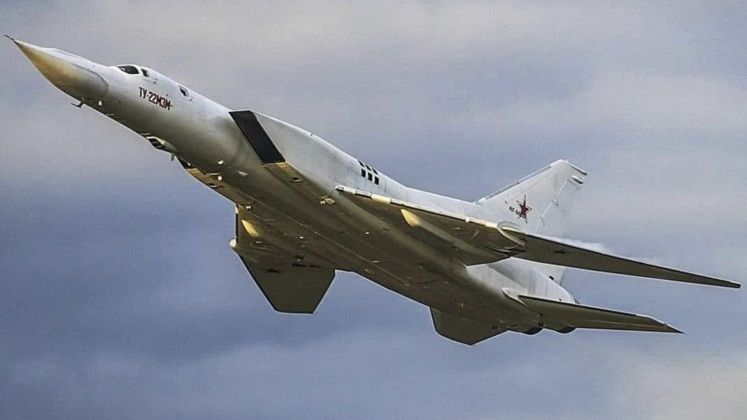
Tu-22M Bomber
In the weeks leading up to Russia’s military intervention in Syria in September 2015, the country’s armed forces invested in extensively refurbishing the country’s Khmeimim Airport near its western coast on the Mediterranean Sea to serve as a major military base. This would come to be known as Khmeimim Airbase, and would serve as the centre for Russia’s first major military operation outside the territory of the former Soviet Union since the 1980s. The airbase has hosted almost every class of Russian fighter jet in service, including Su-24M and Su-34 strike fighters which were responsible for the bulk of operations against Islamist insurgents in Syria, Su-35 and Su-27SM3 air superiority fighters which provided a deterrent against attacks on Russian forces by NATO member states, and even prototype Su-57 next generation fighters which saw multiple brief deployments for combat testing purposes. The airbase has been heavily defended by a range of air defence systems as well as artillery and tank units on the ground, and has been subjected to multiple strikes by jihadist insurgents mainly operating from bases near the Turkish border regions.
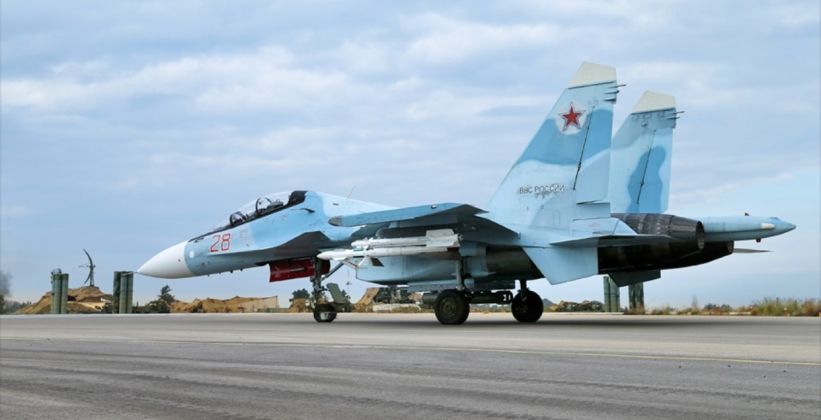
Russian air and naval operations in Syria have done much more than push back against jihadist groups such as the Islamic State and the Al Nusra Front, with the country’s foothold in the region allowing it to effectively outflank NATO from the south and demonstrate a range of revolutionary new offensive capabilities. In an apparent attempt to expand the potential use of Khmeimim Airbase, satellite imagery shows that Russia has extended the two runways at the facility by around 300 metres. With the prior length already having been sufficient to accommodate almost any kind of Russian combat jet, a longer runway likely signals a plan to deploy strategic nuclear capable bombers to Syria possibly permanently. Bomber strikes in the Syrian theatre were notably conducted from Russian soil, and briefly from Iranian territory using Tu-22M medium weight bombers, but the ability to deploy such aircraft to Syria would be a potentially valuable asset in the case of conflict with NATO.
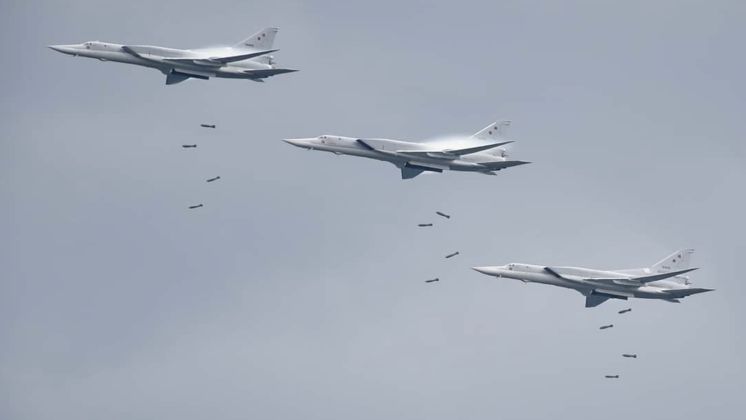
Russian currently deploys three classes of bomber, including the heavyweight intercontinental range Tu-160 and Tu-95 and the medium weight Tu-22M. The Tu-22M is most likely to be the one intended for deployment to Khmeimim airbase should Russia be planning a permanent rotation of aircraft to the facility, with the bomber being easier to maintain than its heavier counterparts, better suited to operating near the end of supply lines, and having sufficient range to strike targets across Europe from Syria. The bomber can deploy a wide range of cruise missiles for anti shipping, strike and nuclear delivery roles, and as one of the world’s only three supersonic bombers with an unsurpassed engagement range against ground targets it is potentially ideal for deployment to Syria. The bomber's Kh-101 missile has a range of over 3,500km, with some estimates placing it over 5000km, meaning it can be used for precision strikes across Europe and much of Africa. A nuclear tipped sister platform to the Kh-101, the Kh-102, can also be deployed by the Tu-22M. The bombers can also deploy shorter ranged Kh-47M2 hypersonic ballistic missiles, which are more manoeuvrable and have speeds of approximately Mach 10 but are restricted to a still impressive 2000km range. It remains to be seen what other assets could be deployed to Khmeimim Airbase, but a buildup of forces is likely to be accompanied by efforts to further strengthen the air force and air defences of Syria itself to reduce the burden on the small Russian contingent in the country in the event of war.
