
North Korea Surges Production of Combat Proven KN-23 Tactical Ballistic Missiles with Advanced Radar Evading Capabilities
Military Watch Magazine Editorial Staff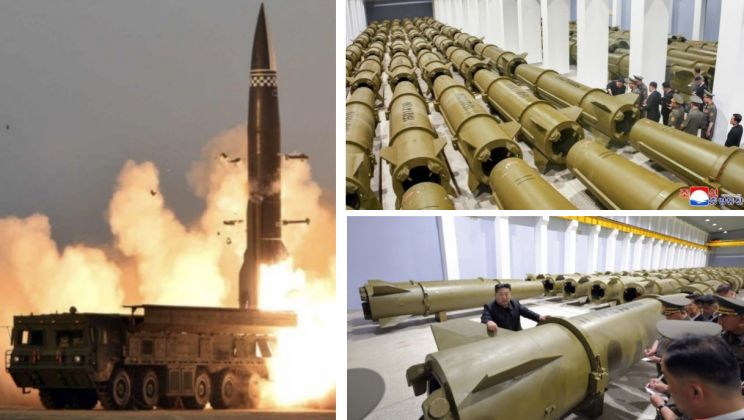
North Korean KN-23B Launch (left) and Production
North Korean state media has shown footage of a major facility producing tactical ballistic missiles for the KN-23 system, as the country’s leadership has announced plants for a 2.5 fold expansion in ballistic and cruise missile production capacity over five years. The planned increase in capacity was ordered as North Korea faces both high demand for its missiles abroad, most notably from Russia, as well as an increasingly unstable security situation as conflicts in Ukraine and the Middle East continue. The East Asian state remains officially in a state of war with the United States, and has achieved very significant gains in both increasing the scale and the sophistication of missile production over the past decade. The KN-23 was first flight tested in mid-2019, and has seen a wide range of specialised variants unveiled since then. The missile has been extensively combat tested in the Ukrainian theatre after large orders were placed by the Russian Defence Ministry.
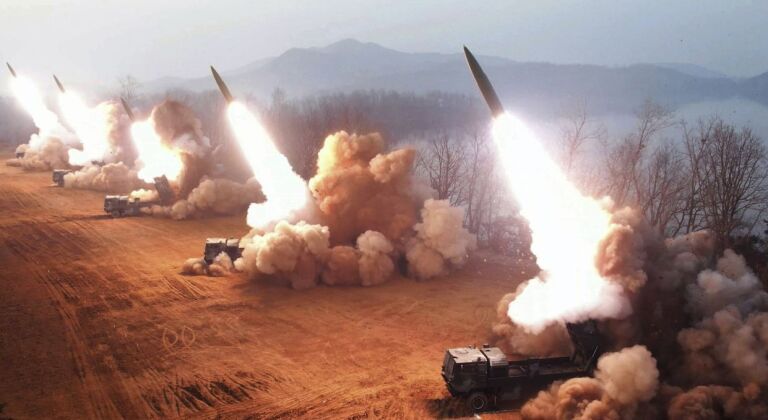
Commenting on the KN-23’s capabilities, a U.S. Congressional Research Service report highlighted shortly after the system’s entry into service that it “exemplifies the most notable advance” for North Korea in the field of tactical weapons, with the missile observed conducting a complex “pull-up” manoeuvres intended to confuse enemy air defence systems. Regarding the missile’s lighter counterpart, the KN-24, the report noted that the lighter missile “demonstrates the guidance system and in-flight manoeuvrability to achieve precision strikes.” Among the variants developed, the KN-23B represents a larger variant with an extended range a much enlarged 2,500 kilogram warhead. It was first test fired on March 25, 2021, and due to its larger size used a ten-wheel transporter erector launcher where the original KN-23 used an eight-wheel launcher. The KN-23’s ability to evade detection by South Korea’s U.S.-supplied AEGIS missile defence systems have been highlighted as cause for serious concern in Seoul and in the wider Western world.
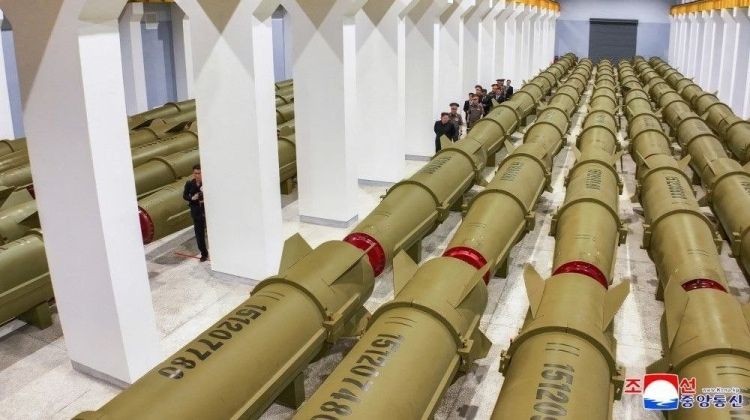
An unnamed defence enterprise producing missiles for the KN-23 system was visited by the chairman of the ruling Korean Workers’ Party Kim Jong Un, after it reportedly exceeded planned output ahead of schedule, demonstrating that North Korea’s wartime-industrial mobilisation efforts are in some cases exceeding production targets. State media imagery showing the chairman observing the ballistic missiles, as well as shorter ranged KN-24 missiles. Chairman Kim reportedly described the expansion of production as a “core task” required to satisfy “drastically increasing” demand linked to the reorganisation of the Korean People’s Army operational structures, indicating that the services’ warfighting doctrine was being redesigned around larger missile formations. Detailed briefings were given by senior military-industrial officials, including Munitions Industry Department Director Jo Chun Ryong and Missile General Bureau chief Jang Chang Ha, which was interpreted by analysts to reflect the centralised integration between political leadership, strategic missile administration, and production infrastructure.
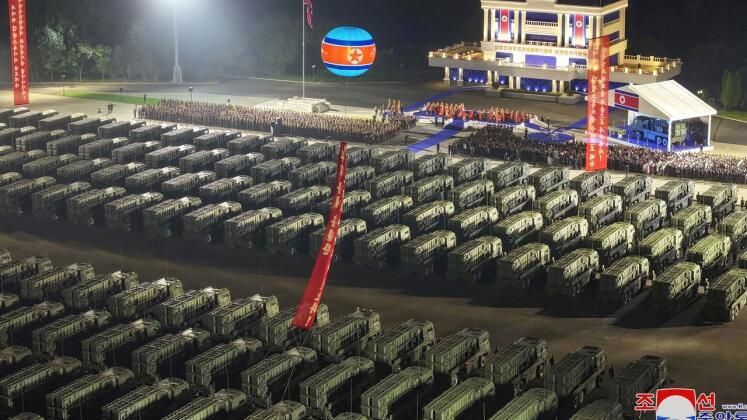
North Korea’s missile production scale has had few rivals in the world, with frontline units deployed near the inter-Korean Demilitarised Zone having received 1,000 KN-24 missiles and associated launchers in a single ceremony in August 2024. North Korea’s construction of new nuclear facilities, paired with the evident massive expansion in its capacity to produce ballistic and cruise missiles, places the country in a stronger position to deter and if necessary repel a potential U.S.-led assault on its territory. The United States came close to initiating attacks against the country on multiple occasions, including under the Lyndon Johnson, Richard Nixon, Bill Clinton, George W. Bush, Barak Obama and Donald Trump administrations, with several of these offensive plans including options for nuclear strikes. Chairman Kim in early June announced that the country's production capacity for weapons-grade nuclear materials has more than doubled during the past five years, which is expected to allow for more rapid expansion of the arsenal to equip a wide range of weapons, including short range KN-23 and KN-24 missiles. A successor to the KN-23, which appears to use a hypersonic glide vehicle to provide improved penetrative capabilities, began flight testing in October 2025.
