
‘Muslim Fighters’: When Islamic Countries Have Attempted to Develop Advanced Combat Jets
Military Watch Magazine Editorial Staff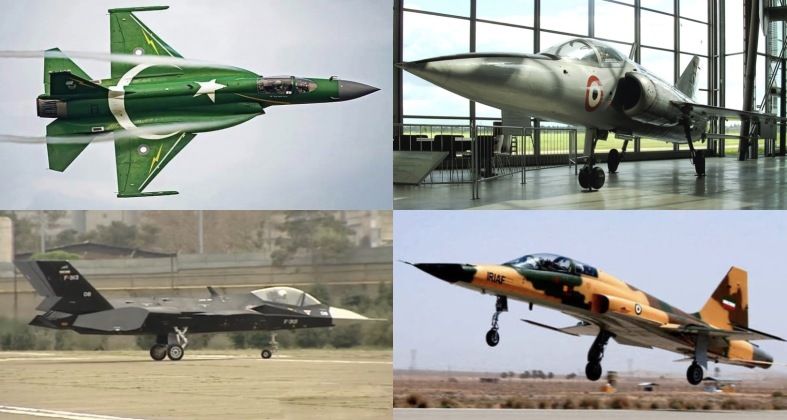
JF-17, HA-300, Kowsar, Qaher-313 (clockwise from top left)
The fighter aviation market has for decades been dominated by Russia and the Western powers, with the U.S. and USSR emerging as undisputed leaders in the field in the late 1970s and early 1980s for both the quantity and sophistication of their designs as European producers increasingly fell behind. More recently China has emerged as a leader in the field, the first and as of yet the only country other than the United States to develop a fifth generation fighter and put it into frontline service. While the leadership of these three parties is undisputed, a growing number of countries have more recently sought to develop their own smaller fighter programs, from South Korea with the ambitious KF-X fifth generation jet to Japan’s plan for an almost fully indigenous sixth generation fighter. As military aviation as continued to play a vital part in determining a state’s power, and given the significant advantages gained by developing fighters domestically, a number of analysts and even officials from Muslim states such as Iran, Pakistan and Turkey have increasingly lamented the fact that Islamic states, which have historically perceived themselves as one nation or ‘Ummah,’ have consistently had to rely on imported aircraft for their inventories. An assessment of the major fighter programs pursued by Muslim states indicates some of the reasons for historical failures, and in the cases of successes how these were achieved.
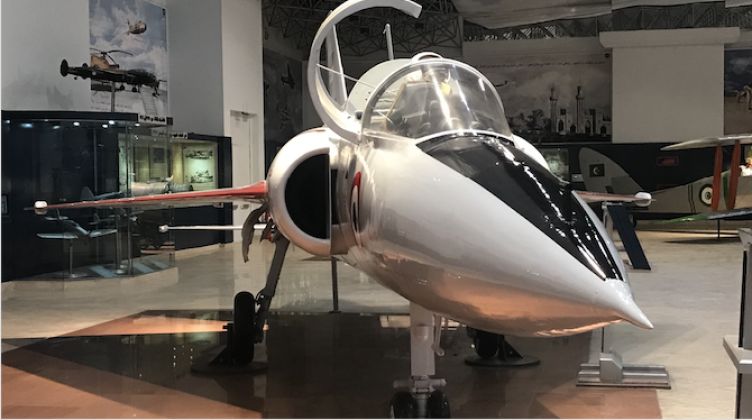
Ha-300
The only supersonic jet fighter developed by a country in Africa or the Arab world, the Ha-300 reached an advanced prototype stage in the mid-1960s as one of the world’s first third generation fighter jets, and was intended to provide a more advanced complement and possibly an eventual replacement for the Soviet MiG-21 and MiG-19 second generation jets in the Egyptian Air Force and in friendly Arab states such as Syria, Iraq and Algeria. Egypt at the time was investing heavily in domestic industries from car manufacturing and heavy industry to basic consumer goods, and self reliance in military aviation was considered central to the country’s aspirations to become a major world power under the presidency of the nationalist developmentalist President Gamal Abdel Nasser. The fighter was notably developed with assistance from Wilhelm 'Willy' Messerschmitt, former chairman of Nazi Germany's BFW company, who had designed several combat aircraft for the Third Reich such as the Me 210, Me 262, Me 410 and Bf 109. The Ha-300 aircraft made use of a powerful E-300 engine and had a top speed of Mach 2, an impressive range of 1,400km and a maximum altitude of 18km while carrying two cannons and four missiles. The fighter was in some ways comparable to the American F-5E Tiger II then under development, but appears to have had a superior flight performance and could perform better at high altitudes. It remains uncertain what classes of missies Egypt intended to equip the Ha-3000 with, but the fighter may have relied on Soviet R-23 missiles which had a formidable beyond visual range performance for their time.
The Ha-300 was the most capable jet fighter ever developed by a Muslim state relative to the state of global military aviation in its time, and had the potential to be a world leading combat platform. The program was suspended in 1969, when it was nearing serial production, due to the financial crisis brought on by Egypt’s overwhelming defeat in the Six Day War two years prior. It has been speculated that Egypt intended to restart the program after its immediate defence needs were met, for which it was more cost effective to concentrate on acquiring more cost effective Soviet MiG-21 fighters which were being offered at a discount of almost 50%. The death of President Nasser and coming to power of Anwar Sadat in 1970, who oversaw an effective shift away from developmentalism and self reliance and towards greater reliance on Western industrial products, meant that the program was never restarted with Egypt instead acquiring lightweight fighters from France and the United States. The HA-300 program’s cost reached $16 billion in the currency of 2020 - 135 million Egyptian pounds at the time - with development of an advanced engine taking up a considerable portion of the budget.
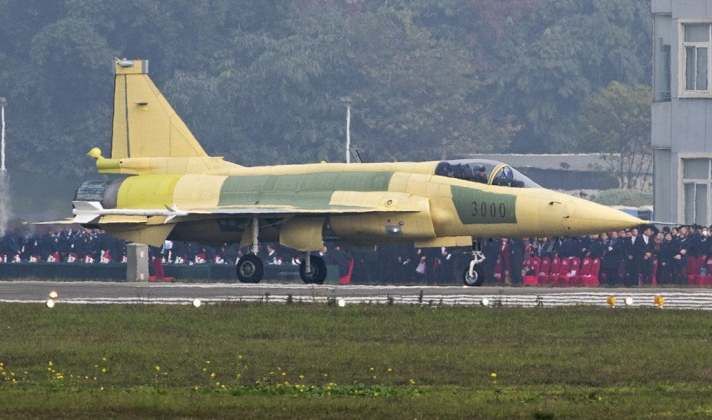
JF-17
The JF-17 today forms the backbone of the Pakistani Air Force with over 100 jets in service, and is a fourth generation lightweight design loosely derived from the Chinese J-7 jet but boasting state of the art sensors, avionics and armaments. The fighter was jointly developed by China and Pakistan and is the only fighter made in a Muslim state which is today produced on a large scale and exported. The fighter is comparable in its design to the Swedish Gripen jet, and like the Gripen which relies heavily on foreign technologies and components from across Europe and the United States, the JF-17 cannot be considered a fully indigenous Pakistani jet. Although the Pakistani Air Force has increasingly moved to integrate indigenously developed munitions onto the JF-17, the fighter’s engines, avionics, radar and its most capable standoff missiles are all sourced from abroad - with China contributing the vast majority of technologies to the program despite not fielding the fighter in its own Air Force.
The JF-17 has a standard performance for a fourth generation jet, but the upcoming JF-17 Block 3 variant unveiled in December 2019 is set to boast a far superior performance including a powerful AESA radar, new and more capable engines, PL-15 AESA radar guided long range air to air missiles, helmet mounted displays, formidable electronic warfare systems and a range of other highly sophisticated technologies which will revolutionise the Pakistani Air Force’s capabilities. As an advanced ‘4+ generation’ fighter which is expected to be unrivalled in ease of maintenance and inexpensiveness of its operation, JF-17 Block 3 variant will likely perform considerably better on export markets than its predecessors. Access to PL-15 missiles in particular, which are widely considered the most capable air to air missiles in the world, will make the aircraft particularly attractive.
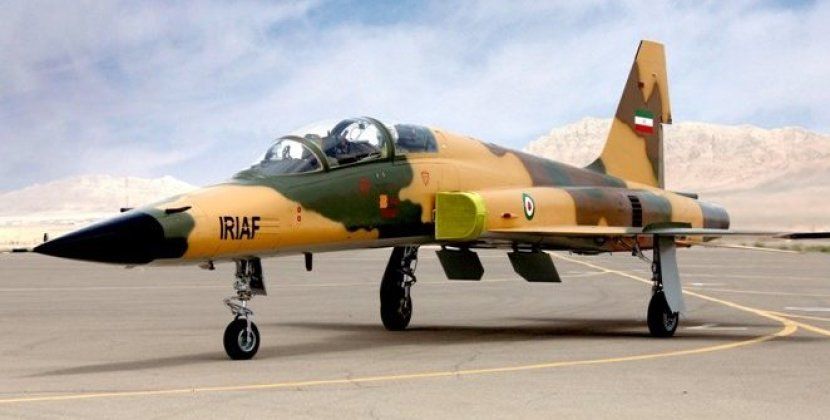
Kowsar
Unveiled in 2018, the Kowsar was the first Iranian fighter jet to enter serial production following years of development of similar designs under programs such as the Saqeh. The Kowsar is a lightweight fourth generation jet with capabilities thought to be comparable to the American F-20 Tigershark, and like the Tigershark it is closely based on the F-5E Tiger II third generation jet for which Iran was a leading client. The Kowsar is far from an outstanding jet today in terms of performance, and although it is thought to have a very low operational cost and be relatively cheap to produce its lack of modern standoff munitions seriously restricts its performance particularly in the air to air domain. It nevertheless represents an impressive feat given that it is perhaps the only fighter developed by a medium or small state in recent years which claims to be fully indigenous - relying on engines and missiles developed in Iran itself where rival light fighter programs such as the Taiwanese Ching Kuo and Indian Tejas have relied on American sourced engines. Iran’s claim regarding how fully indigenous the fighter is has drawn some questions in the past, with suspicions that it could rely on North Korean or Chinese technologies for electronic warfare, avionics or engines as Iran’s defence sector has traditionally relied very heavily on technology transfers from these two states. It is likely that at least some of the Kowsar’s technologies were purchased from abroad.
Qaher-313
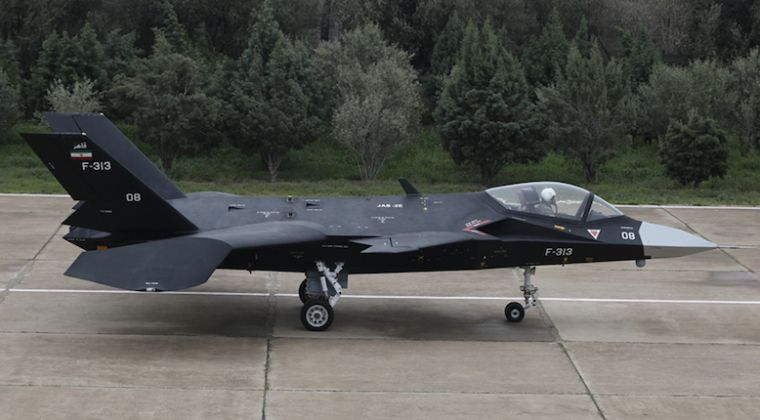
Iran unveiled the first mockup of its Qaher-313 lightweight stealth fighter in 2013 - the first and as of today the only Iranian fighter to reach prototype stage which is not directly derived from the American F-5. Iran has demonstrated the capabilities of its military aviation industry in the past, notably deploying a wide range of stealth drones and carrying out operations across much of the Middle East with them, and gained considerable knowledge of advanced stealth technologies after obtaining the American RQ-170 drone which was commandeered over Iranian airspace in 2011. The Qaher-313 has reached a non-flight prototype stage and has been seen taxiing in the past, although status of the program amid ongoing economic crisis in the country remains uncertain. It is likely that the Qaher will share many technologies with the Kowsar fighter which entered service in 2018, and the stealth fighter’s engines could be derived from those of the Kowsar but enlarged to support a heavier airframe. Iran notably gained access to a wide range of aviation technologies from the former Soviet Union in the 1990s, and as with most of its major defence projects it is likely to gain support in developing its fighter from North Korea and China. The Qaher-313 is unlikely to be considered a fifth generation fighter, with relatively weak engines and a lack of sufficiently advanced avionics, sensors or weaponry, but it could be quite unique as a fourth generation jet with limited stealth capabilities if it ever enters service.
TF-X
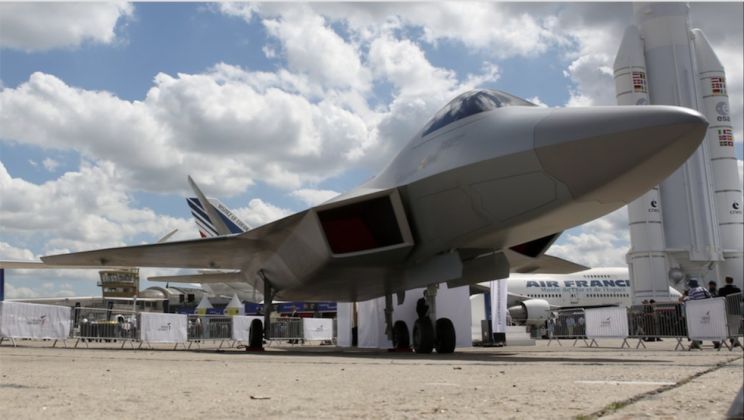
Turkey began to pursue development of a fifth generation fighter jet in December 2010 under the TF-X program, unveiling a mock up of the fighter at the Paris Air Show in 2019. Progress on the fighter has been slow, and serious doubts have been raised regarding Turkey’s ability to develop a fourth generation fighter, much less a fifth generation one, given its very limited domestic technological base. According to the CEO of Turkish Aerospace Industries, the TF-X’s first non flight prototype will be unveiled in 2023 with the fighter scheduled to make its first flight two years later. The first sixth generation fighter jets in China and the United States are notably expected to have made their first flights before the TF-X enters service, and with little interest from export clients the TF-X’s cost effectiveness remains in serious question. Shortfalls in Turkey’s technological base could notably be compensated for with a heavier reliance on either British or Russian technologies - possibly both - with each offering to assist in the program. Given Turkey’s lack of experience in the field of military aviation, its attempt to develop a fifth generation fighter is not expected to end as well as parallel programs being pursued overseas by states such as South Korea, Britain and Japan. The TF-X is the only fighter listed which has not yet reached a prototype stage.
