
Largest U.S. F-22 Fleet Deploys Raptors From Dispersed Arctic Locations For Stronger Defence
Military Watch Magazine Editorial Staff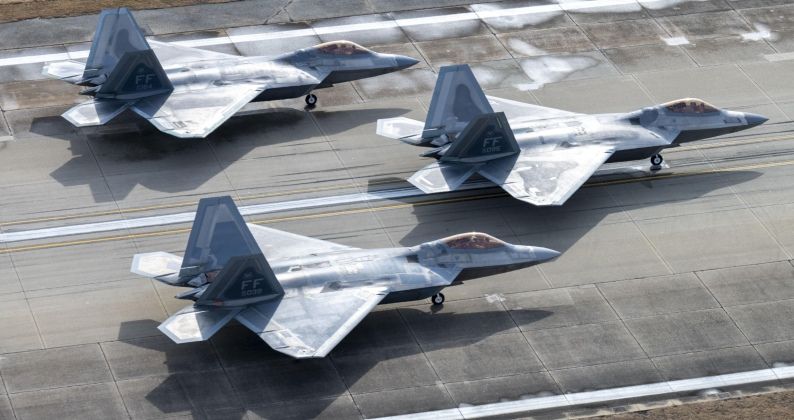
U.S. Air Force F-22 Fighters
The U.S. Air Force has begun to deploy F-22 Raptor fifth generation fighters from dispersed base locations across Alaska to provide a more robust and flexible air defence capability, which represents a shift toward faster and less predictable air defence operations to counter growing challenges from Russian and Chinese strategic aviation. Footage from recent exercises in the region has highlighted that the notoriously maintenance intensive F-22s are capable of operating from austere locations while sustaining aerospace warning and interception missions under an Agile Combat Employment concept. F-22s are more heavily concentrated in Alaska than any other location in the world, both due to the territory’s proximity to Russia, and to the ability of fighter units based there to rapidly redeploy to the Pacific such as forward facilities in Japan.
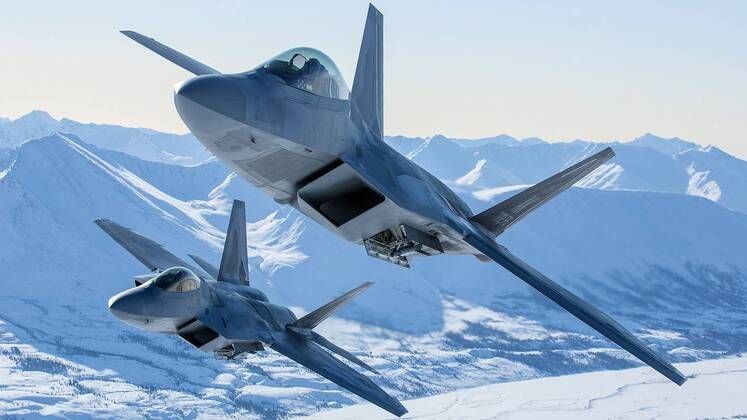
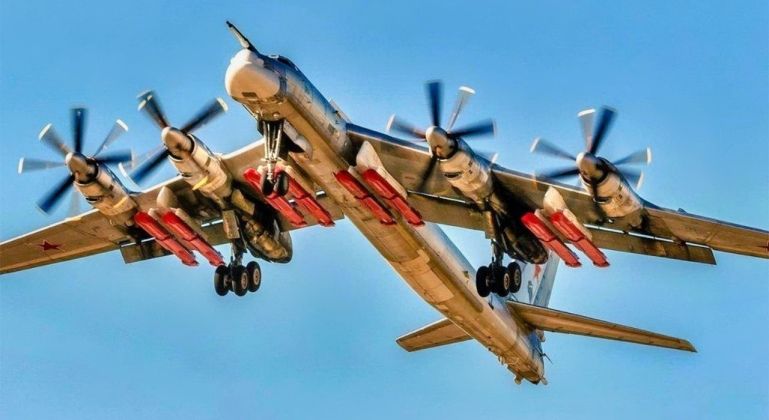
Footage has shown F-22s under the Air Force 3rd Wing taking off during an Alaskan NORAD Region practice alert response, which analysts have highlighted points to a wider transformation in regional air defence where speed, dispersion and survivability are becoming central. This may have been informed in part by observations of hostilities in Ukraine and the Middle East, where concentrations of advanced aircraft at major facilities have proven vulnerable to targeting particularly using cruise or ballistic missiles. The cruise and ballistic missile strike capabilities of Russian and Chinese bombers that have operated near Alaska have continued to be rapidly enhanced, with Russia bringing new variants of its Kh-101/102 radar evading cruise missile into service and testing them in combat in the Ukrainian theatre. China in 2022 unveiled the new YJ-21 air launched hypersonic ballistic missile designed for launch from H-6 bombers.
Despite its advanced radar-evading stealth capabilities, the suitability of the F-22 for air defence duties in Alaska have repeatedly being brought a question, as the aircraft suffers from extreme maintenance requirements that contribute to its very low availability rates, while having a very short range for an aircraft of its size. As by far the shortest ranged heavyweight fighter type in the world, F-22 squadrons rely on aerial refuelling and pre-positioning to cover Alaska’s vast airspace. The fighter’s AN/APG-77 radar dates back to the 1990s, while its data links and network centric warfare capabilities are highly limited. With the fighters scheduled for an early retirement from service, it is likely that F-35 or F-15EX fighters will replace them for Alaskan air defence operations, with both these newer fighter types being far easier to sustain and having longer ranges and better availability rates.
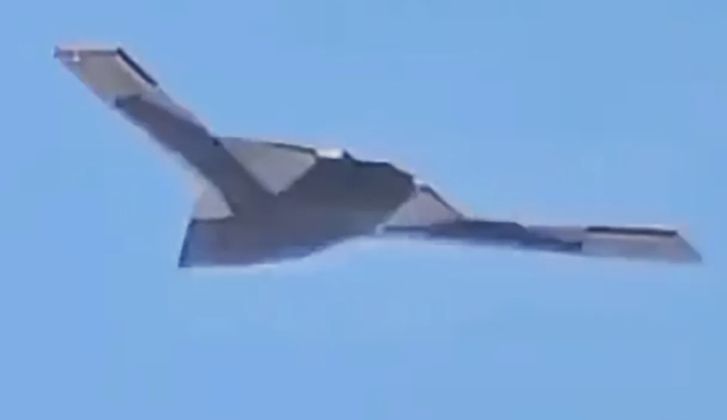
U.S. air defences in Alaska have come under growing strain from Russian bomber patrols, while in 2024 China conducted its first bomber patrol near the territory as H-6 bombers were temporarily based in Russia for such operations. China and Russia are currently the only ones in the world serially producing bomber aircraft, with China expected to begin fielding its first intercontinental range stealth bomber in the early 2030s, after the aircraft was first seen in flight testing in October 2025. Alaska’s air defences have been widely criticised as being inadequate, particularly due to their reliance on obsolete Cold War era E-3 Sentry airborne warning and control systems which have been described as leaving the territory’s defences ‘limping.’ The fact that both the F-22 and F-35 programs delivered fighters with far shorter ranges and lower availability rates than intended has further exacerbated the situation.
