
U.S. Deploys More F-22 Stealth Fighters to China’s Doorstep Next to Taiwan Strait Hotspot
Military Watch Magazine Editorial Staff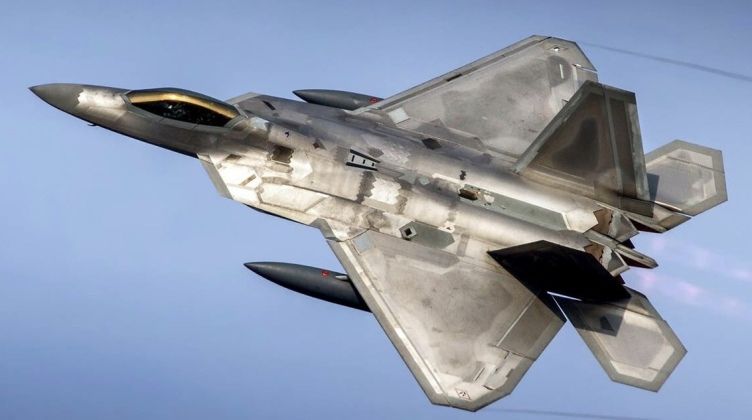
F-22 Fifth Generation Fighter with External Fuel Tanks
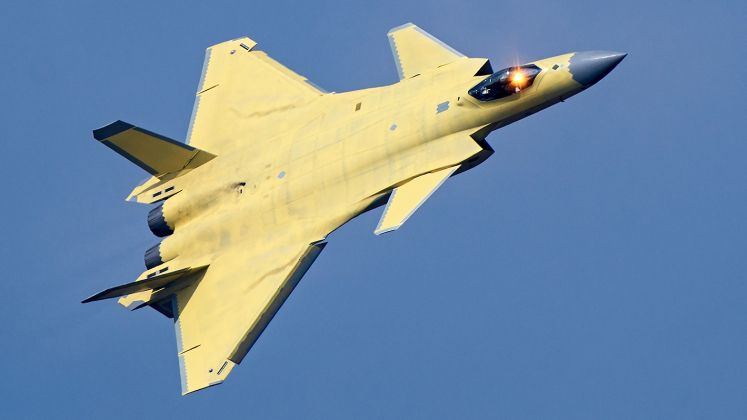
The United States Air Force has deployed additional F-22 Raptor fifth generation fighter aircraft to Kadena Air Base in Okinawa, Japan, just days after the deployment of F-22s to Basa Air Base in the Philippines for joint exercises with local forces simulating operations against Chinese forces. Kadena Air Base is a particularly sensitive facility due to ongoing tensions with China in the Taiwan Strait, with the Japanese island providing one of the closest locations for a potential response by Washington and Tokyo to contingencies in the area. Although the F-22 was developed for high intensity combat, and designed for demanding penetrating air superiority missions, the aircraft first flew in 1990 and ceased production in 2011, less than six years after it belatedly entered service. Its age and the lack of investment in modernisation have left its avionics very significantly behind those of rival fighter types such as the F-15EX and F-35A, as well as those of advanced Chinese fighter types such as the J-16 and J-20.
The deployment of F-22s occurred immediately after the withdrawal of rotational F-35A detachments from Kadena Air Base to Hill Air Force Base and Eielson Air Force Base on the U.S. mainland, with the Raptors’ arrival preventing a reduction in fifth-generation fighter presence on Okinawa. F-22s have been deployed under the 90th Expeditionary Fighter Squadron, which draws fighters and personnel from the Alaska-based 3rd Wing, one of the Air Force’s primary F-22 formations assigned to Pacific and Arctic contingency planning. Further F-22s have been deployed under the 27th Expeditionary Fighter Squadron, which draws fighters from Langley’s 1st Fighter Wing, historically the first operational F-22 unit. With China remaining the only country that poses a peer level challenge to U.S. air power, deployments of fifth generation F-22 and F-35 fighters have been particularly heavily concentrated in Japan and the broader Western Pacific.
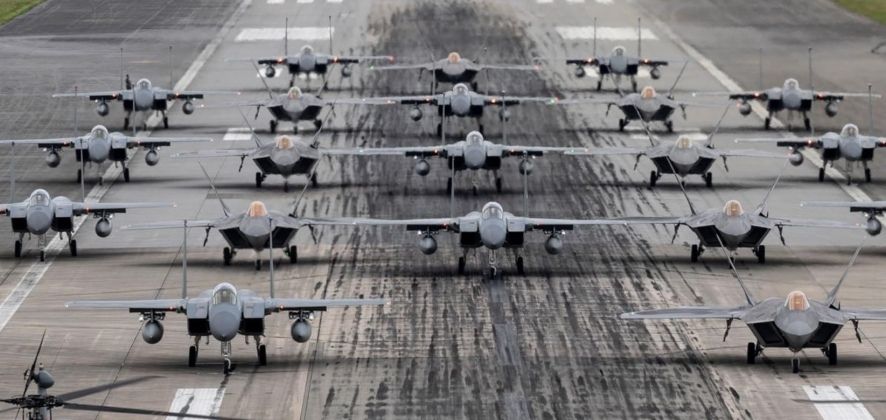
The suitability of the F-22 for Pacific operations has repeatedly been called to question, as although the fighter was initially required to have almost double the range of the Western world’s premier fourth generation air superiority fighter the F-15, its actual range is significantly lower than the F-15’s, making it by far the shortest ranged heavyweight fighter type operational anywhere in the world. Its radar, moreover, is not only far smaller than those of the F-15 and heavyweight Chinese fighters such as the J-20 and J-16, but is also far less advanced, limiting its situational awareness when operating over wide areas. Although rotational deployments were previously considered a temporary measure until sufficient F-15EX fighters could be produced for a permanent deployment at Kadena Air Base, major delays to F-15EX production have meant that the air force has continued to rely on rotations of F-22s and other shorter ranged fighter types.
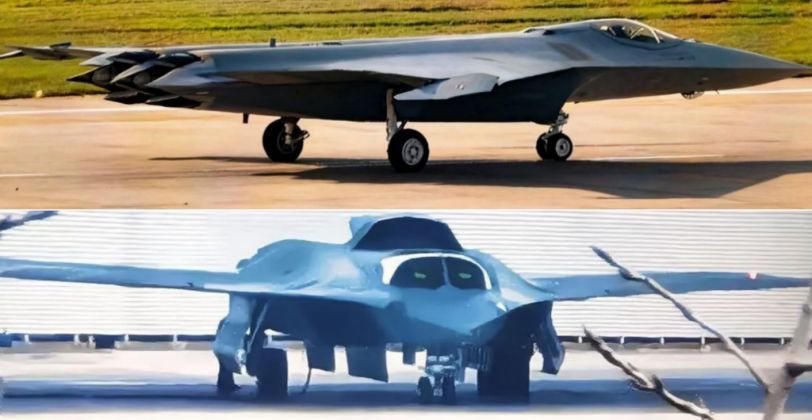
The limitations of the F-22, and continued reliance on the F-15 including the new F-15EX variant, are direct result of the significant decline in the American defence after the end of the Cold War. The F-15EX is considered far outmatched by new Chinese J-20 fifth generation fighters, which are similarly large but benefit from much longer ranges and cutting edge stealth capabilities. China is set to introduce its first sixth generation fighters into service in the early 2030s, while the U.S. will not bring in next generation fighter into service until the 2040s, leaving U.S. Air Force units in the region increasingly outmatched and by a growing margin.
