
India in a Strong Position to Handle American Sanctions Threat; U.S. Applying CAATSA to China Unlikely to Deter Delhi From Acquiring Russian Arms
Military Watch Magazine Editorial Staff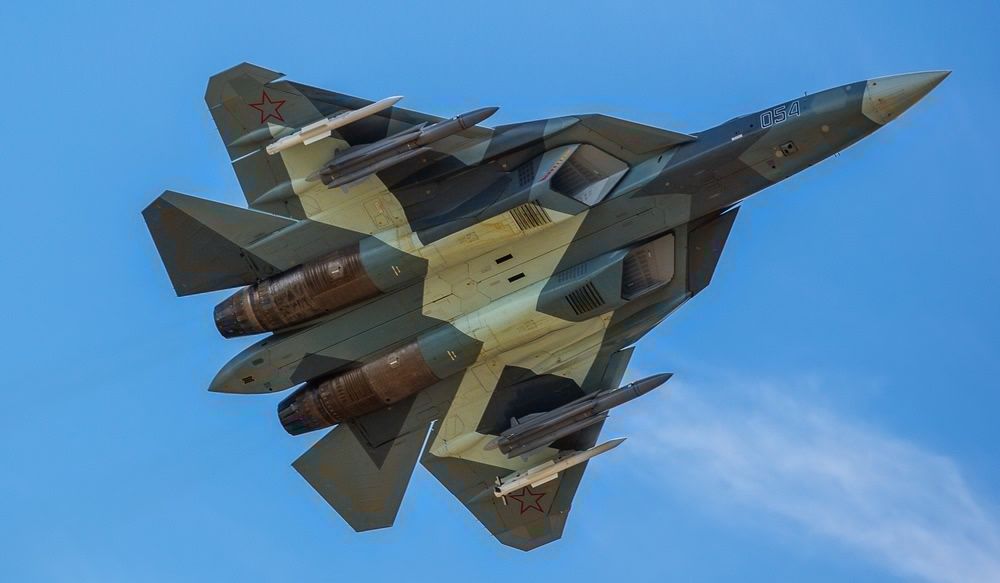
Su-57 Next Generation Air Superiority Fighter
On September 20th 2018 the United States Treasury placed economic sanctions on the Chinese Military Commission's Equipment Development Department and the department’s head Li Shangfu, reportedly in response to Chinese acquisitions of the S-400 missile system and Su-35 air superiority fighter. The sanctions were applied under the Countering America's Adversaries Through Sanctions Act (CAATSA), signed into law by President Donald Trump on August 2nd 2017, which allowed the U.S. Treasury to impose economic punishment on Russian defence clients worldwide - a measure intended to deter countries from acquiring Russian arms and thereby strengthen the position of competing Western defence industries. What was notable about this development in relation to China was that it was the first time CAATSA was so directly applied against a Russian defence client, as well as the fact that China’s People’s Liberation Army had already received the weapons systems which eliminated the possibility that sanctions were in this case employed to deter the acquisition. While sanctioning China is highly unlikely to impact the country’s defence cooperation with Russia however, it is more likely intended as a warning to other Russian defence clients.
The United States has since 2017 issued several warnings to potential clients for high end Russian weapons systems that it is willing to target such countries to economic sanctions should they proceed with their planned acquisitions. Russia’s S-400 Triumf long range surface to air missile system in particular has been singled out, with Iraq, India and Turkey having openly been threatened with economic punishment and strong warnings having been sent to Saudi Arabia, Qatar, Egypt, Morocco and Vietnam - other parties which have shown interest in the weapons platform. As the largest importer of Russian arms, which planned contracts for a particularly large acquisition of S-400 systems by the end of 2018 alongside plans to acquire derivatives of Russian Su-57 next generation air superiority fighter under a joint FGFA program, CAATSA’s successful application to India has been considered particular critical for the United States.
By directly threatening Delhi with economic sanctions under CAATSA, the U.S. has sought to carve out a larger share of the country’s large defence market for its own manufacturers at Russia’s expense, while also stripping Almaz Antey, the manufacturer of the S-400, and United Aircraft Cooperation, the manufacturer of the Su-35 and Su-57, of billions of dollars in export revenues. The United States has notably offered India its THAAD surface to air missile system to replace the S-400, while indicating its willingness to provide the South Asian state with its F-35 stealth fighter should India require it. With THAAD’s capabilities extremely limited and poorly suited to India’s defence needs, and with the troubled and high maintenance F-35 lacking the advanced air superiority capabilities of the Su-57, India has not shown interest in either of the two American weapons platforms - while reiterating its intention to acquire advanced Russian arms regardless of the policy of the United States.
For the U.S., applying sanctions to India’s neighbour China is very likely at least in part intended to make the threat of economic punishment under CAATSA appear more imminent to discourage Delhi from seeing through plans to contract the S-400 - while also pressing the country to withdraw from the FGFA fighter program. How Delhi will respond remains to be seen, but should India effectively call Washington’s bluff and proceed with the acquisition it will leave the United States in an extremely difficult position. With India playing a key role in the American rebalancing strategy towards the Asia-Pacific, and as arguably the crux of the U.S. led Quad alliance targeting China, the United States cannot afford to alienate India with economic sanctions - which would if anything push Delhi closer towards Moscow and Beijing. On the other hand, should the United States fail to see through its threats to sanction India for violating CAATSA, the legislation will begin to appear toothless - potentially prompting other parties interested in acquiring Russian arms such as Saudi Arabia and Iraq to proceed with their purchases. India thus finds itself in a very strong position to ignore American threats of economic sanctions, and while recent sanctions against China were very likely intended at least in part as a message to Delhi, the country is likely to continue with its plans to acquire Russian arms undeterred.
