Hunting Iranian Stealth Drones: American Super Hornets With New Infra Red Sensors Patrolling Middle East
Military Watch Magazine Editorial Staff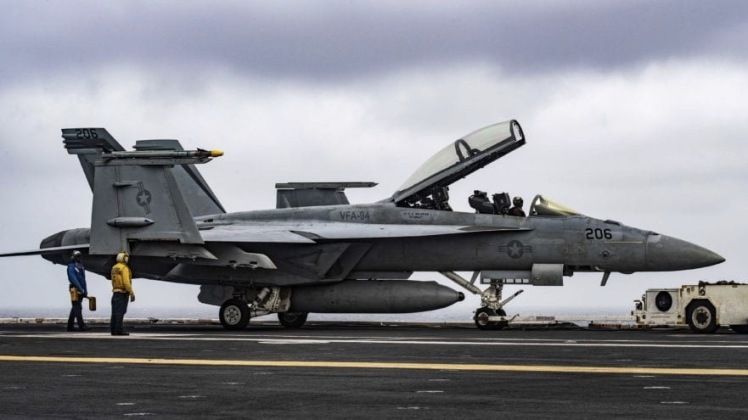
U.S. Navy F-18E Super Hornet with IRST on Carrier Deck
Pentagon
Recent photos posted on the Pentagon’s Defense Visual Information Distribution Service (DVIDS) website shows that the U.S. Navy has deployed F-18E/F Super Hornet carrier based twin engine fighters equipped with a new infrared search and track system (IRST) pod to patrol the Persian Gulf region. The sensor is appears as a small black button on the front of the plane’s centreline external fuel tank below the fuselage. The Navy’s eleven 100,000 ton Nimitz and Gerald Ford Class supercarriers currently rely exclusively on the Super Hornet, a fourth generation design which, although lacking in stealth capabilities and having a very modest flight performance, has recently been equipped to engage stealth targets. The Navy expects to commission its first Block 3 variants of the Super Hornet in the near future, with these jets all configured with IRSTs and powerful new AESA radars which proved an unprecedented degree of situational awareness.
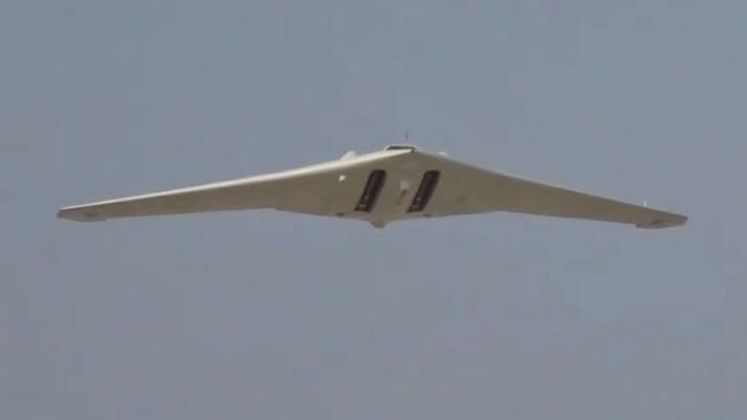
Rather than relying on radar waves, which stealth aircraft are well suited to evading and which modern jammers are designed to impede with electromagnetic interference, IRSTs hone in on heat signatures making them ideally suited to locking onto stealthy targets. Although IRSTs have been part of a standard configuration for all Russian fighter and interceptor designs since the beginning of the 1980s, including the Soviet-suppled MiG-29A jets which serve in the Iranian Air Force today, American aircraft have only begun to integrate them much more recently. Other than the Block 3 Super Hornet, the F-15SA QA and EX variants and the new F-35 stealth fighter come equipped with IRSTs. Deployment of IRST-equipped Super Hornets to the Persian Gulf region comes as Iran has demonstrated the capabilities of advanced radar evading stealth drones, which include both strike and reconnaissance variants. These jets have flown sorties over Iraqi, Syrian and Israeli airspace, and have proven a serious challenge for Israeli air defences to shoot down and for U.S. forces in Syria to detect. The lifting of a UN arms embargo on Iran is expected to be followed by sales of new combat aircraft to the country, with some of the leading contenders to equip the Iranian Air Force such as the Chinese J-10C and Russian Su-57 benefitting from modern stealth technologies.