
New Footage Shows China’s J-16 Fighter with Heavy Air Defence Missile Arsenal
Military Watch Magazine Editorial Staff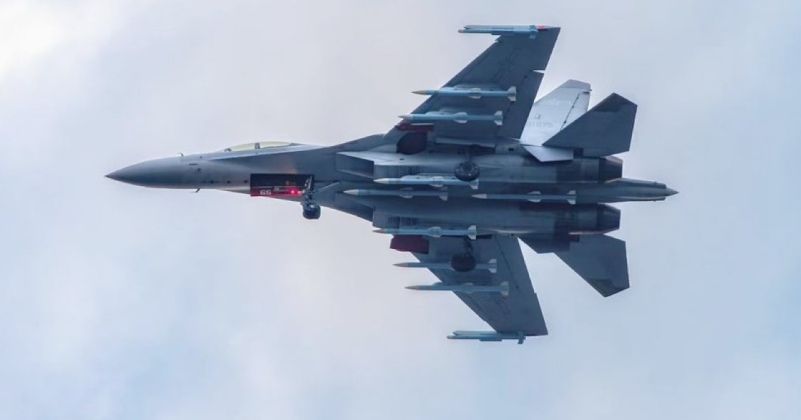
J-16 Fighter with Eight PL-15 and Two PL-10 Missiles
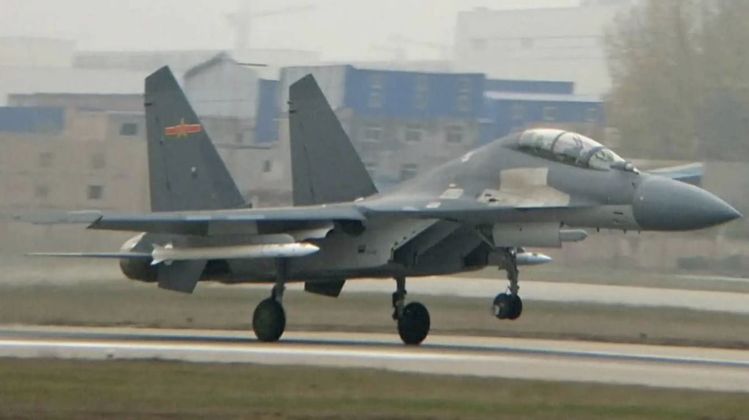
New footage released on Chinese social media has shown a J-16 fighter aircraft with a heavy payload of air-to-air missiles, highlighting the type’s very considerable weapons carrying capacity which contributes to its potency for air defence operations. The fighter was seen carrying eight PL-15 active radar guided medium-long range missiles and two smaller PL-10 infrared guided missiles for visual range combat. The fighter was operating under the 6th Air Brigade based at Suixi, southern Guangdong province, near major economic heartlands such as Guangzhou and Shenzhen. The J-16 is being procured and much larger numbers by the Chinese PLA Air Force than any other fourth generation type is by any other single service in the world, and alongside the J-20 fifth generation fighter currently forms the fleet’s backbone.
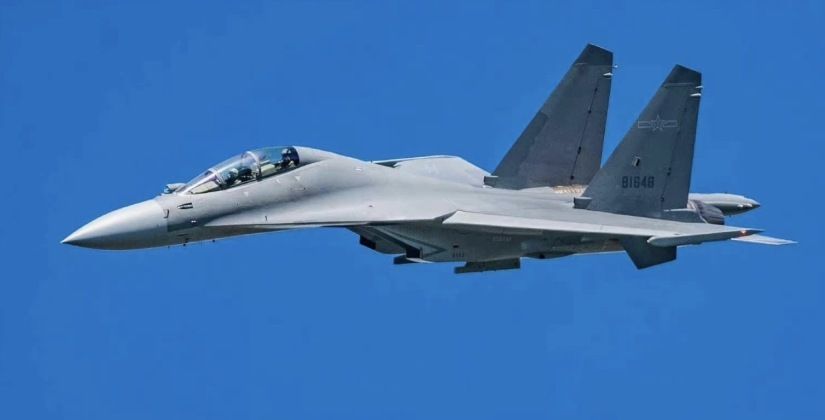
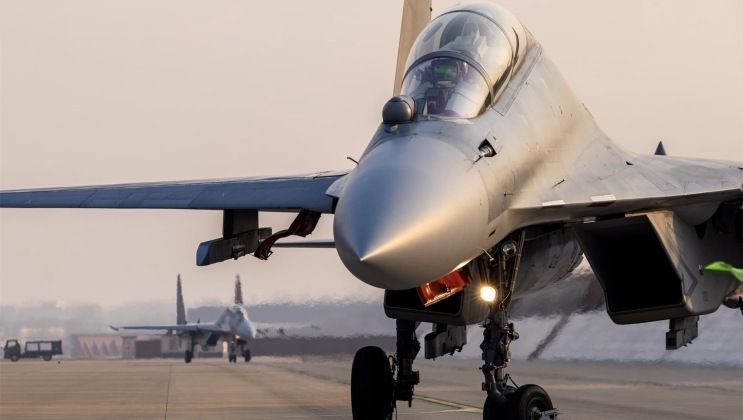
The J-16 is a heavily enhanced derivative of the Soviet Su-27 Flanker design, and compared to Russian derivatives of the same design such as the Su-35 it makes higher use of more advanced composite materials, while integrating considerably more sophisticated avionics including use of an AESA radar. The Flanker design can accommodate a particularly large sensor suite and weapons payload, and was the longest ranged fighter design fielded in any NATO or Warsaw Pact air force, with the J-16 design building on these advantages. The fighter’s primary radar is widely assessed to be the most powerful in the world due to its unique combination of size and sophistication. These characteristics make it optimal for long range air-to-air operations, with the fighter type having been extensively tested in simulated engagements against J-20 fifth generation fighters.
The PL-10 is considered a close contender for the title of most capable visual range air-to-air missile in service worldwide, and makes use of thrust vector controls and a gimbaled imaging infrared seeker to facilitate high off boresight targeting at angles exceeding 90 degrees. The missile’s strong advantages have been widely acknowledged by Western sources, with the British Royal United Services Institute observing that the missile had a “superior kinematic performance to the American AIM-9X Sidewinder.” With a range considered very long for an infrared guided missile, the PL-10 is also capable of targeting at lower beyond-visual ranges. The missile’s capabilities are particularly potent when paired with the J-16’s high levels of manoeuvrability, and have continued to be incrementally improved since entering service in the mid-2010s as new variants of the design are brought into service.
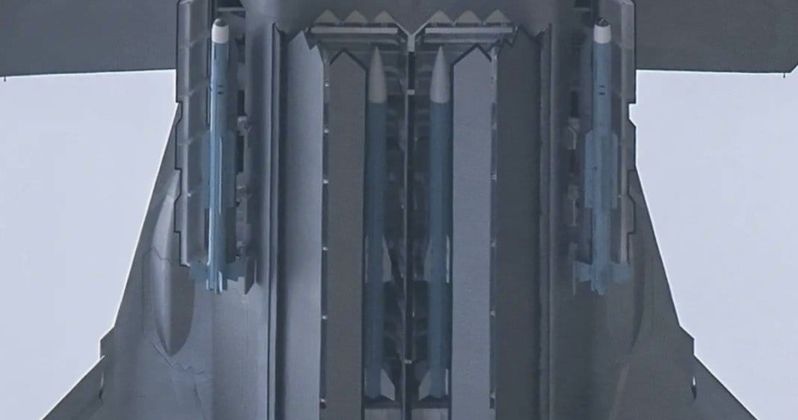
The PL-15 is prized for its very long range, modern guidance systems, and strong resistance to electronic warfare, and was developed as a successor to the older PL-12 which was also a world leader in performance in its time. Another major strength is the missile’s AESA radar seeker. Unlike older mechanically scanned seekers, the PL-15 reportedly uses an active electronically scanned array radar in its terminal guidance phase, which significantly improves target tracking precision, enhances resistance to jamming, and makes the missile more effective against stealthier or low-observable aircraft. AESA seekers can also switch frequencies rapidly and operate in more complex electronic warfare environments, making them harder to deceive. Several analysts regard this as one of the PL-15’s most important technological advances, with very few other air-to-air missile types integrating an AESA radar seeker.
J-16 fighters have been involved in multiple engagements with hostile fighter types, including an interception of U.S. Air Force F-22 fifth generation air superiority fighters reported in October 2025, and multiple engagements with Republic of China Air Force F-16s. The fighter’s capabilities are considered highly complementary to those of the J-20, particularly due to the development of the J-16D dedicated electronic warfare variant. While the PL-15 can achieve a very long range of over 200 kilometres due to its dual-pulse solid rocket motor, the J-16 has also integrated the larger PL-17 which is widely assessed to be the world’s longest ranged air-to-air missile type. The world leading performances of all three missile types complement the J-16’s own performance characteristics to provide the Air Force with a top tier air defence capability that has few rivals abroad.
