
South Korean FA-50 vs. Swedish Gripen: Mock Engagement in Australia Highlights Golden Eagle’s Superiority
Military Watch Magazine Editorial Staff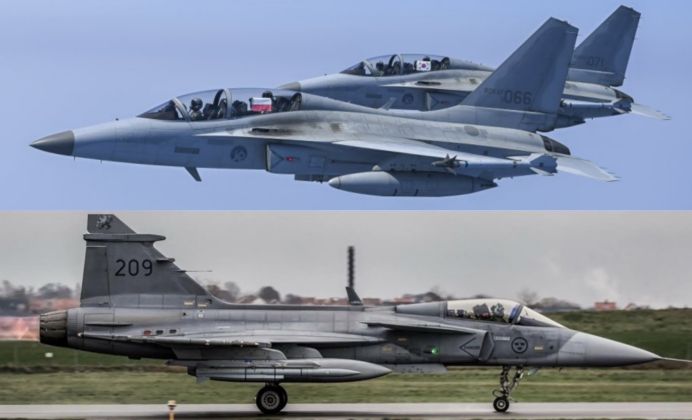
FA-50 (top) and Gripen Fighters
The results of simulated engagements between Gripen and FA-50 lightweight fighters respectively fielded by the Royal Thai Air Force and the Philippine Air Force have been reported by a number of sources, and were held in Darwin, Australia, from July 12 to August 2. The fighters represent the most capable in both countries’ respective fleets, with the outcome of their engagements having been speculated since they were first announced to have been scheduled on July 16. Simulated engagements were initially widely expected to result in victories for Thai air units, as the Gripen, although being one of the lightest modern fighters in the world, was designed from the outset for high intensity combat roles, where the much cheaper FA-50 by contrast is a derivative of the T-50 trainer lightly adapted for combat use. Both aircraft put out near identical levels of thrust and have very similar weights, with both being NATO-compatible ‘very light’ fighters smaller than regular light fighters such as the F-16, and coming from the same weight range as the rival Chinese JF-17. Aside from their low costs, such aircraft are prized for the ease with which they can be kept at high levels of availability.
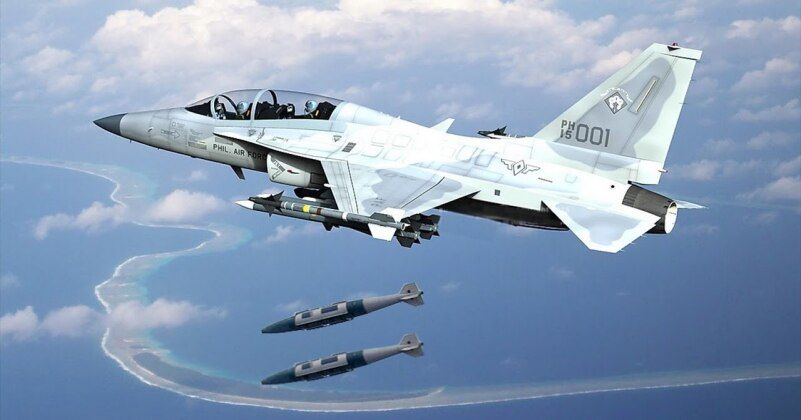
Assessing the capabilities of the two fighters, although the Gripen C/D retains access to superior weaponry for air to air engagements, most notably the AIM-120 air to air missile, the FA-50 is considerably more sophisticated, and integrates more modern sensors and avionics. The aircraft have gained considerable praise from Philippine officials form their combat performances and advanced precision bombing capabilities when providing air support for counterinsurgency efforts, with President Rodrigo Duterte having stressed that the aircraft were far better suited for such roles than American F-16s. With the FA-50’s production and operational costs remaining considerably lower, the outcome of the exercises could have detrimental implications for the Gripen program, as the Swedish firm SAAB has failed to secure foreign orders for the aircraft for close to a decade. SAAB President and CEO Micael Johansson in August 2022 informed reporters of his “extreme frustration,” blaming political factors for the lack of sales, which reflected Stockholm’s much more limited ability to lobby for sales particularly compared to Paris and Washington. With the Royal Thai Air Force reported earlier in the year to be considering Gripen acquisitions, it is among the services that may see its acquisition strategy influenced.
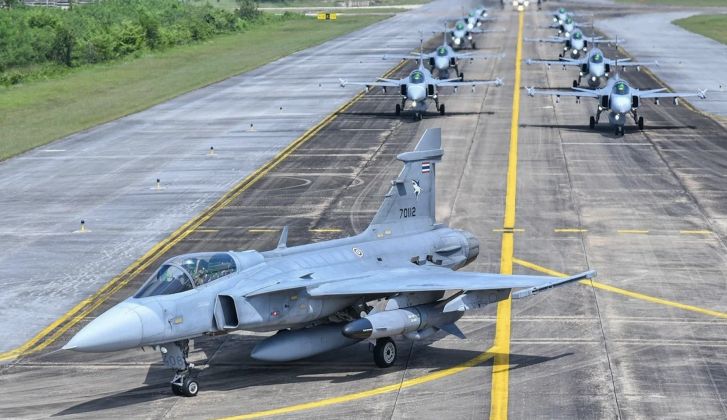
The Korean FA-50 and the T-50 trainer by contrast have increasingly taken global markets by storm, with Thailand and Iraq having acquired trainer variants while Senegal, Poland, Indonesia, the Philippines and Malaysia have ordered combat variants. The U.S. Air Force is also planning to lease the T-50 due to signifiant delays in the development of the indigenous Boeing T-7 trainer. A Polish order for 48 of the aircraft in July 2022 allowed the fighter to make its first breakthrough into NATO markets, with further orders by countries across Eastern Europe currently expected. Incremental upgrades to the FA-50 have significantly enhanced the class’ combat capabilities. The Gripen C/D and the T-50 notably both use the same American F404 engine, although the newer Gripen E/F variant, which is not fielded by Thailand, uses the enhanced F414 derivative of the design. While this has left both programs vulnerable to vetoes from Washington on possible sales, most notably South Korea’s planned sale to Uzbekistan in the mid-2010s, an indigenous engine is currently being developed in Korea. This engine is expected to have commonality with that being developed by Hanwha Aerospace for the country’s KF-21 fifth generation fighter. The contrast between the Gripen and FA-50 programs highlights a turning point in both countries’ fighter industries, with the Gripen expected to be Sweden’s last indigenous fighter, while the FA-50 is expected to be the first in a long line of South Korean fighters that use growing proportions of domestic technologies.
