
More ‘Effective’ Korean T-50 Jets Could Soon Come to the Philippines as President Duterte Slams ‘Utterly Useless’ American F-16 Fighters
Military Watch Magazine Editorial Staff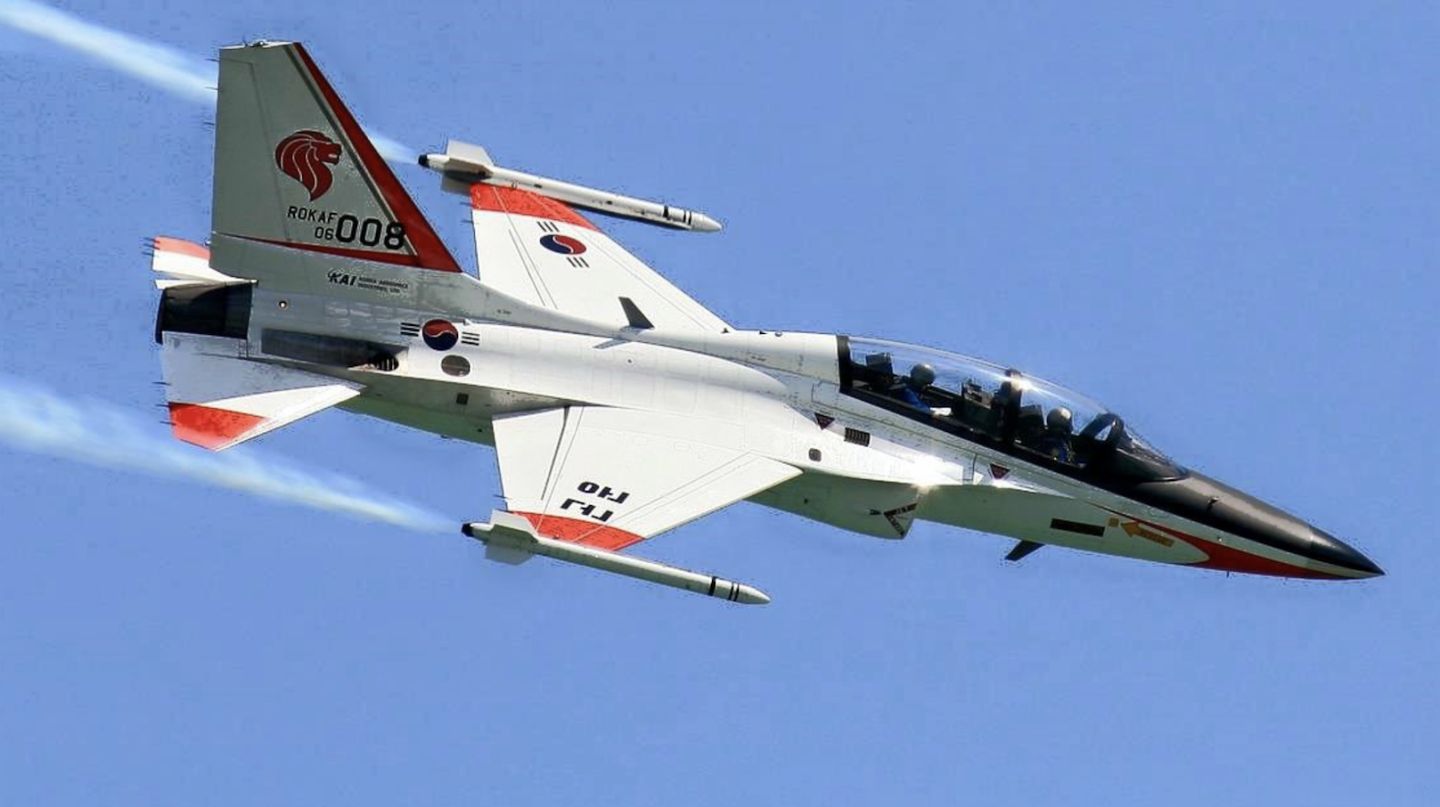
South Korean KAI T-50 Fighter Jet
Following intense criticism of the United States for attempting to intervene to prevent the Philippines’ acquisition of Russian made Kilo Class attack submarines, with Washington threatening grave consequences should Manilla go ahead with the deal, President Rodrigo Duterte has blamed the U.S. for attempting to hamper this country’s military modernisation efforts. The President went on the slam the American F-16 Fighting Falcon single engine light fighters the country had sought to sell to the Philippines as “utterly useless,” indicating a likely cancellation of plans to acquire the costly jets. He stated regarding the fighter acquisition: "What I need are just propeller driven planes for anti insurgency. We don't need F16 and yet they dangle before us after they insulted us.” The government in Manilla had previously expressed frustrations with Western nation’s restrictions on arms sales, cancelling a prolific deal to acquire light helicopters from Canada in February 2018 due to what were perceived as highly intrusive restrictions placed by Ottawa on the aircrafts’ use - amounting to an interference in the Southeast Asian state’s internal affairs. Non Western suppliers, namely Russia and South Korea, have by contrast imposed no similar terms and offered arms at far more competitive prices.
With the Manilla having expressed its frustration at Washington’s own extensive restrictions placed on the use of munitions, and its failure to provide even basic rifles for the Philippines’ police force for counterinsurgency due to its opposition to the country’s campaign, these rifles were supplied at a fraction of the price by Russia - in what was widely seen as a goodwill gift to make inroads in the strategically critical Southeast Asian state. The United States’ attempt to block the sale of attack submarines, while Western states were unable to provide a competitive alternative of their own and most would in any case very likely be unwilling to do so, may well have been a last straw which could prompt Manilla to cancel the planned acquisition of the F-16 entirely. While the Philippines was previously bound under Treaty of General Relations, signed July 1946 when the country was granted its formal independence by the United States, to obtain Washington’s permission in the case that it should acquire arms from any party other than the U.S., the country’s freedom today to turn to non Western sources for arms is likely to result in a major shift in its arms acquisitions - one which has already begun to occur and from which South Korea and Russia are poised to become prime benefactors.
Speaking regarding the history of his country’s partnership with the United States, President Duterte stated: “It's hard for you to say we are friends. We are friends but remember we are friends because you made us a colony years ago. It was not a friendship agreed upon.” According to Defence Secretary Delfin Lorenzana, President Duterte had by contrast to the F-16 shown considerable satisfaction with the performance and cost effectiveness of the South Korean KAI T-50 light fighter. The Secretary stated regarding the President’s response when observing the effectiveness of the Korean jet during counterinsurgency operations: “when he saw how effective (the fighter) was” in combat against jihadist militants in Marawi City in 2017. “We may acquire an additional 12 but it depends on what kind of build up the air force wants.” The country's Air Force has prioritised acquiring further T-50 jets over the purchase of fighters such as the F-16, a platform arguably better suited to the country’s defence needs than the American Fighting Falcon. While neither jet is particularly well suited to protecting the country from major external threats such as China’s PLA Navy, a role for which heavier elite fighters such as the Russian Su-34 or the U.S. F-15E would be ideal - though the latter is well beyond Manillla’s defence budget, the T-50 is more suitable for a basic strike and counterinsurgency role.
The T-50 was designed as both a trainer and light attack jet, capable of carrying a number of advanced air to ground munitions, flying at impressive speeds of Mach 1.5, just slightly lower than the elite new F-35’s Mach 1.6, and most importantly of all, is extremely simple to maintain and easy to operate. Operational costs are far lower than those of the F-16, reducing the strain on the country’s defence budget, while ease of maintenance allows for a higher sortie rate against insurgent targets. Combined with a considerably lower aquisitional cost than the Fighting Falcon, its dual use as a trainer, and Seoul’s willingness to export the jets freely without intrusive conditions and without restrictions on which other parties the Philippines may or may not form defence ties, the South Korean T-50 appears to be the ideal alternative for the Philippines to the American F-16. While the military would be investing primarily in more advanced air to air combat capabilities should It acquire the F-16, its primary field of advantage over the Korean jet, for a dedicated light attack role the T-50 appears a better fit. Considering the archipelago nation's isolation and the extremely low likelihood of a major air attack, the T-50 appears more than sufficient. Should relations between Manilla and Washington continue to deteriorate, acquisition of further T-50 jets in stead of the F-16 thus remains a considerable possibility.
