
Evaluating Sweden’s Gripen E Next Generation Fighter
Military Watch Magazine Editorial Staff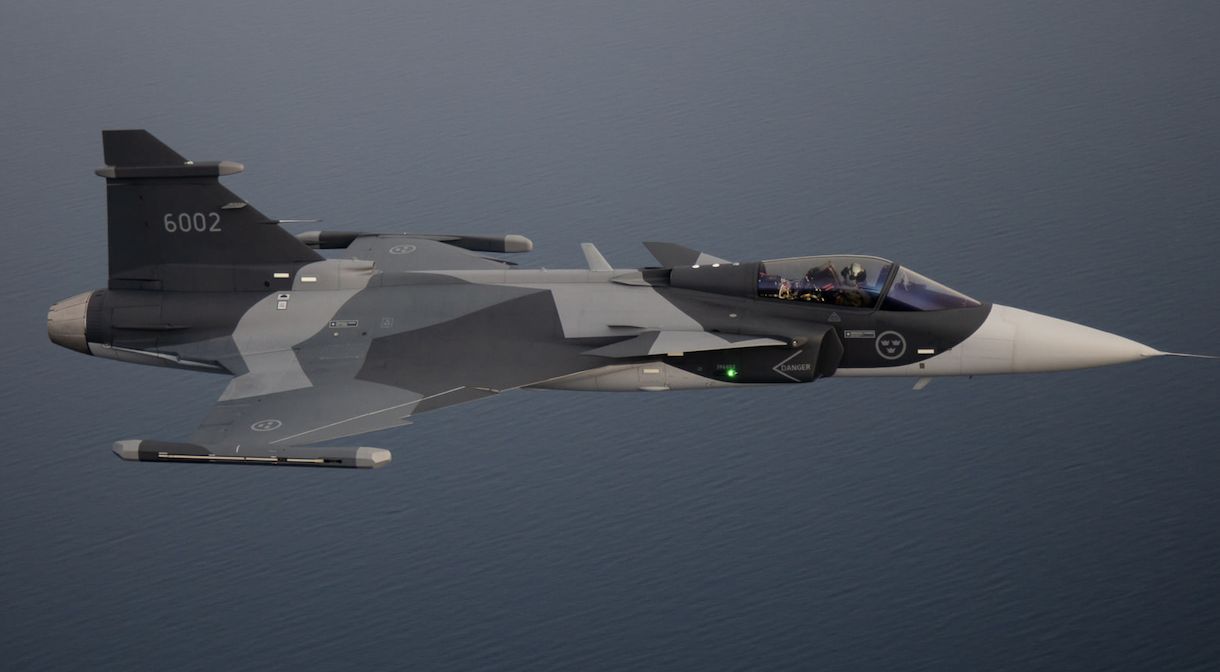
Saab Gripen E '4+ Generation' Fighter
The Swedish Air Force is expected to begin to commission Gripen E ‘4+ generation’ fighter into frontline units by 2021, following the production of the first serial units from April 2019. The service currently deploys an estimated 96 Gripen C fighters in six squadrons of sixteen, very light aircraft comparable to the Sino-Pakistani JF-17 with a role similar to that of the heavier American F-16 Fighting Falcon. The aircraft use a single Volvo RM12 afterburning turbofan engine, a licence produced variant of the American General Electric F404 which powers the twin engine F-18C Hornet medium fighter, giving the Gripen a thrust of just 80 kN with afterburners. The aircraft are considered increasingly obsolete in the face of modern threats, with Russia’s deployment of modern Su-35 and Su-30SM2 fighters outperforming the lightweight Swedish jets across the spectrum. Indeed, even older Russian fighters such as the Su-27SM2 Flanker have over three times the engine power of the Gripen, which coupled with more powerful radars, a superior flight performance and longer ranged missiles, provides a significant advantage. The Gripen E was thus developed both to keep Sweden’s defence sector at least somewhat competitive in the export market, and to narrow the gap between its frontline fighter units and those of rival powers.
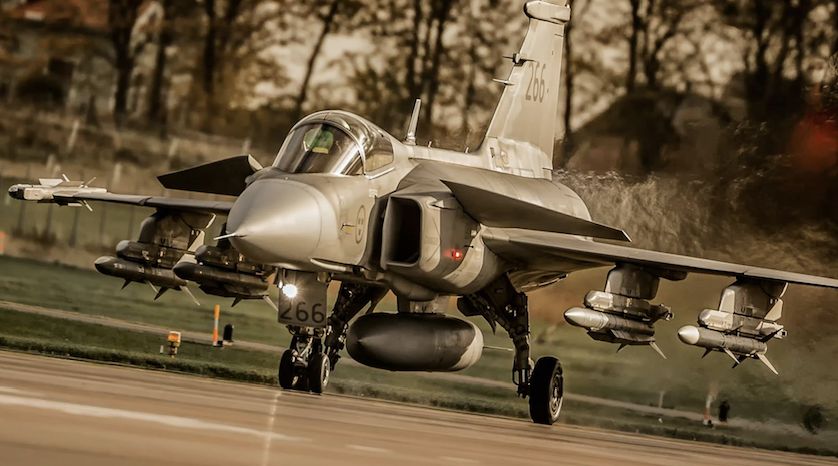
The Gripen E’s most notable improvement over its predecessor is its use of a new and considerably more powerful engine, the General Electric F414, which powers the U.S. Navy's F-18E Super Hornet medium weight fighters in twin configuration. In the Gripen’s single configuration this will provide a thrust of 97.9 kN, a significant improvement although still inferior to the F-16’s F110 at 131 kN in earlier variants and 140 kN in later ones. By comparison, twin AL-41 engines powering Russian Su-35 and Su-57 fighters can between them put out over 284 kN - meaning next generation Russian jets are still more than three times as powerful as their Swedish counterpart and much faster, better at. climbing more manoeuvrable. While the Gripen E’s flight performance is superior to the original Gripen C, it is still below average, inferior to the main frontline American fighter the F-16 even in its oldest iterations, and particularly lacking when compared to high end fighters such as the F-22, F-15 and Su-30. Sweden has attempted to compensate for this with a new AESA radar, superior weapons, namely the integration of the European Meteor missile for air to air combat, and new avionics and electronic warfare systems. The Italian made Selex ES-05 Raven AESA radar, however, is not thought to be as sophisticated as other AESA radars such as the American AN/APG-81 and Chinese Type 1475 (KLJ-5) which are at the cutting edge of radar technology, and is more comparable to very early AESA radar designs such as Japan’s Mitsubishi J/APG-1 developed in the late 1990s for the F-2 fighter. Combined with its very small size, this leaves the radar’s ability to make full use of the Meteor missile’s extreme range in serious doubt, and will limit the lightweight fighter's situational awareness. With the Gripen E likely to be Sweden's last indigenous fighter, heavily reliant on foreign technologies as components as it is, the fighter's ability to compete on export markets remains questionable. Its next generation successors are set to be developed under joint programs with other European states.
