
Evaluating the Gripen Three Decades On - Will it be Sweden’s Last Indigenous Fighter Jet?
Military Watch Magazine Editorial Staff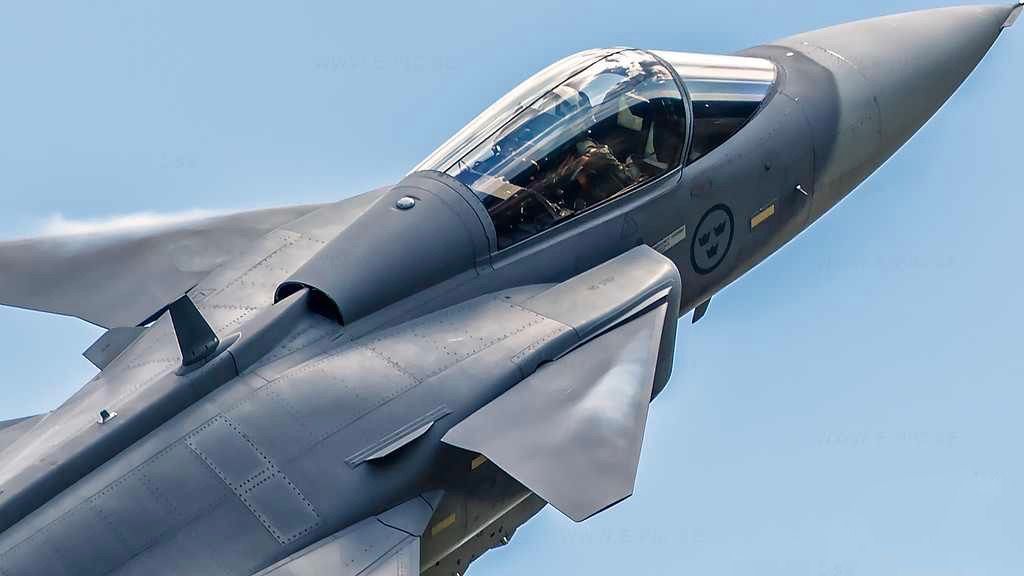
Saab Gripen Single Engine Light Fighter
Sweden’s Gripen single engine light fighter saw its first flight on December 9th 1988, and was one of the first fourth generation combat aircraft to enter service in Europe. The aircraft was designed to replace replace the ageing Saab 35 Draken and 37 Viggen, and would come to comprise the entirety of the country’s fighter fleet by 2005. Much like other European jets of its time, the aircraft makes use of a distinctive canard delta wing design - and approximately 250 of the jets have been built over three decades. The fighter would enter service in 1996, eight years after its first flight and a full eighteen years since its American counterpart - the F-16 Fighting Falcon - was first inducted into the U.S. Air Force. The Gripen and the Fighting Falcon have often been compared for their capabilities - both being designed as light, versatile, low cost and low maintenance platforms to serve in Western air fleets.
Due to considerable shortcomings in Sweden’s own military aviation, which was unable to contend at a fourth generation level, the Gripen has relied heavily on U.S. technologies since the beginning of its development. The Gripen’s engine for example is an American F404 designed to power the U.S. Navy’s F-18 Hornet - though the American jet makes use of a twin configuration where the Gripen uses just a single one. Sweden’s inability to manufacture advanced air to air munitions meanwhile has led to a heavy reliance on U.S. munitions - particularly the AIM-120 missile which are key to providing the European jet with beyond visual range air to air capabilities. The AIM-120B operated by the Swedish Air Force provides Gripen fighters with a 75km engagement range - though Gripen fighters in Hungarian service make use of the more capable AIM-120C which provides a 105km range. The fighter’s sensor technologies have also relied heavily on U.S inputs - without which the viability of a Swedish fourth generation fighter program would be highly questionable.
The Gripen has suffered from the extremely small scale on which it has been manufactured, with a production run amounting to 5.5% of that of its American counterpart the F-16. This provides the F-16 with the benefit of economies of scale - meaning that while its engine is more powerful and it is in most respects a more capable fighter, it is considerably cheaper than its Swedish counterpart. While the F-16 is the most combat tested fourth generation fighter in the world, the Gripen has never seen a major combat operation and remains almost completely untested - which further undermines its ability to compete on international markets. While the fighter is ageing, and a more capable replacement appears several years away due to European manufacturers’ struggles to develop a next generation combat jet with high end technologies comparable to those in the United States, the Gripen’s manufacturer SAAB has modernised the design overtime to integrate a number of next generation technologies. This has led to three major variants of the Swedish fighter which have incrementally become more advanced: the Gripen A, Gripen C and Gripen E. The Gripen C built on the capabilities of the A variant with more advanced electronic warfare systems and better compatibility with high end modern munitions, as well as an in flight refuelling capability. The Gripen E further introduced a much increased internal fuel capacity, two additional external hardpoints, an advanced AESA radar and an updated engine.
While capable, the Gripen E is extremely costly with a price comparable to and likely to exceed that of the American F-35A fifth generation fighter - which integrates advanced radar evading capabilities, the latest sensor and electronic systems and an engine over twice as powerful and has over double the takeoff weight - leaving its Swedish rival far behind. The Gripen may well be the last Swedish fighter jet to enter mass production, with the country having struggled to manufacture a fourth generation aircraft and forced to look to participation in larger programs with other European powers to compete in the fifth and sixth generations. SAAB can be said to have succeeded in developing a highly versatile combat platform which in some aspects is capable of rivalling the U.S. F-16, though only with extensive inputs from the United States.
