
Chinese Satellite Footage Reveals U.S. Expanding Cruise Missile Deployments at Forward Japanese Bases
Military Watch Magazine Editorial Staff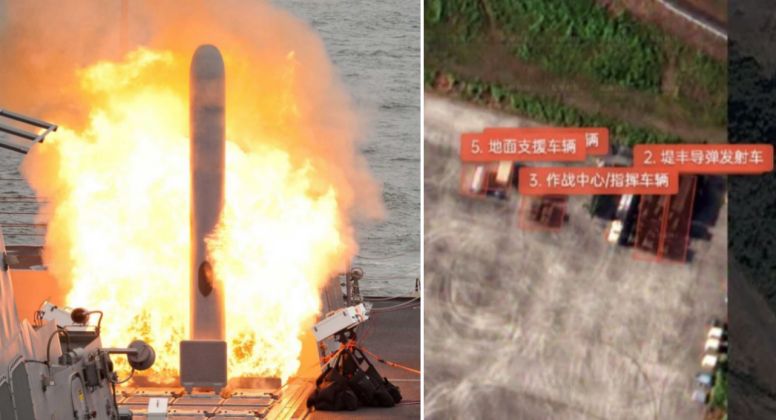
Tomahawk Cruise Missile Launch and Satellite Image of Typhon Launchers in Japan
The Chinese commercial satellite imagery firm MizarVision has published high-resolution images showing elements of the U.S. Army’s Typhon Mid-Range Capability missile system deployed in Japan’s Kagoshima Prefecture. Located at Kanoya Air Base on the southern island of Kyushu, which is one of the closest military facilities to Chinese territory, the satellite footage identified launchers, support vehicles, and associated equipment. The deployment of Typhon systems, which were previously prohibited under the Intermediate Range Nuclear Forces Treaty, has been highly controversial, and is expected to further escalate tensions between China and U.S.-aligned countries in East Asia
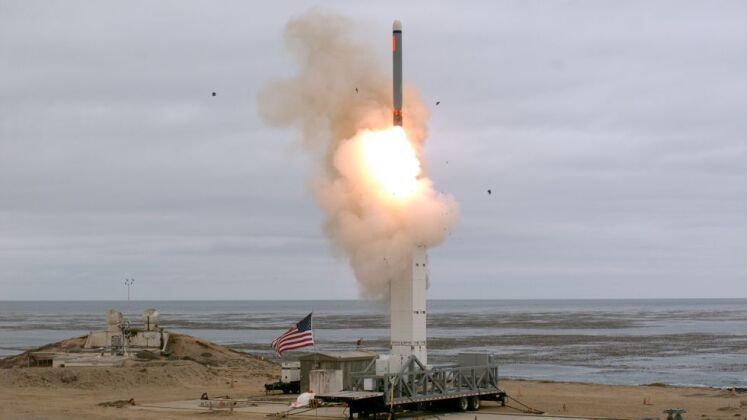
The Typhon missile system represents one of the U.S. Army’s most significant new land-based strike capabilities in the Pacific theatre, and can launch both Tomahawk land attack cruise missiles with ranges of approximately 1,600 kilometres, and SM-6 missiles capable of engaging aircraft, missiles, and hostile warships at shorter ranges. The deployment itself reflects the United States’ broader strategy of expanding land-based missile capabilities along the First Island Chain stretching from Japan through Taiwan Island to the Philippines, to hold targets across much of China’s eastern coastline at risk.
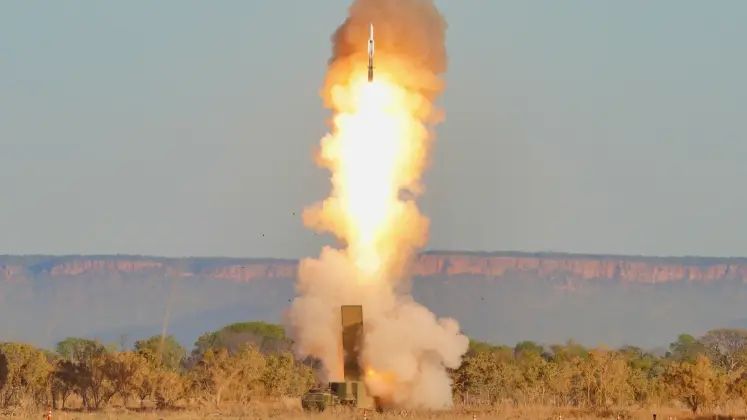
The U.S. Army made its landmark first deployment of the Typhon system to the Philippines in May 2024, while in July 2026 the Army demonstrated the system’s capabilities during live fire testing in Australia. Beijing has consistently condemned the deployment of intermediate-range U.S. missiles in Asia, arguing that such systems increase regional tensions and undermine strategic stability. As China lacks foreign military bases capable of similarly hosting forward deployments of missile systems near the United States mainland, it is expected to increasingly focus on fielding carrier groups, attack submarines, and intercontinental range stealth bombers that can similarly hold targets across the Pacific within reach.
The publication of the images underscores how commercial satellite companies are increasingly becoming participants in geopolitical competition. MizarVision has established a reputation for tracking major military developments, having previously published imagery of U.S. force concentrations in the Middle East ahead of the country’s initiation of a military assault against Iran, including deployments of U.S. aircraft carriers, aerial refuelling tankers, fighters, and air defence systems. Although officially a commercial enterprise, the firm operates in China’s rapidly expanding commercial remote-sensing sector, which has increasingly demonstrated intelligence-gathering capabilities comparable to those once reserved for governments.
