
China Deploys Russian-Supplied Su-30MK2 Long Range Fighters For Bomber Escort Mission Over Key Disputed Island
Military Watch Magazine Editorial Staff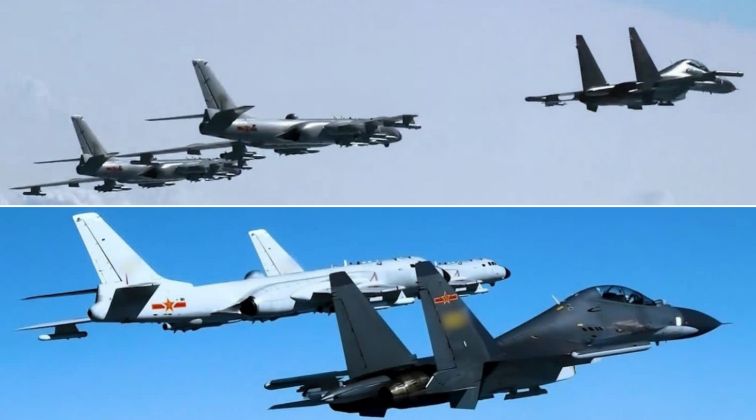
Chinese Su-30MK2 Fighters Escort H-6 Bomber Patrol Around Huangyan Island
The Chinese People’s Liberation Army (PLA) Navy has deployed Su-30MK2 long range fighter aircraft for operations over Huangyan Island in the South China Sea. The aircraft escorted H-6L bombers as part of a major show of force to demonstrate China’s effective jurisdiction over the island’s territorial waters and airspace, with its strategic location and disputed status making such operations strategically vital. The Su-30s were equipped with R-77 Russian-supplied active radar guided air-to-air missiles and indigenous YJ-91 anti-ship cruise missiles, while the H-6 bombers were armed for anti-ship roles with much larger YJ-12 cruise missiles. When procured in 2004, the Su-30MK2 was by far the most advanced fighter type in Chinese service, although its capabilities today are considered decades behind the cutting edge.
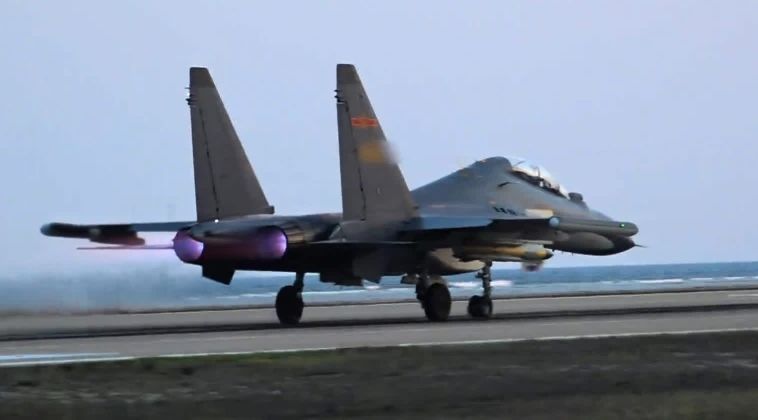
The Su-30MK2 was developed specifically to meet the needs of the PLA Navy, and compared to the Su-30MKK design on which it was closely based, integrated improved avionics providing superior communications, computing, intelligence, surveillance, target acquisition and reconnaissance capabilities. Its new Sokol radar could engage 50 percent more targets simultaneously and had a larger antenna array, as well as double the range against naval surface targets which optimised the fighter for a maritime strike roles. The Su-30MK2 also benefitted from the addition of electro-optical pods such as the Sapsan-E targeting pod and M400 reconnaissance pod. The Navy notably acquired the aircraft in very limited numbers, with just 24 procured, as the defence sector began to develop more advanced fighters domestically, most notably the J-11B which entered service in 2009.
The Su-30 was developed as an enhanced longer ranged derivative of the Soviet Su-27 Flanker air superiority fighter, and inherited its very long range, high weapons carrying capacity, and capacity to carry an outstandingly large radar. These attributes were all highly prized for a maritime strike fighter, and although the Su-30MK2 is now effectively obsolete for high end air-to-air operations, it remains highly viable as a cruise missile carrier. China has developed its own enhanced variants of the Su-27 design, with the most capable, the Air Force J-16 and Navy J-15B, widely considered the world’s most capable pre-fifth generation fighter types. The Navy was in 2025 confirmed to have operationalised its first fifth generation fighter type, the J-35, eighth years after the first fighters of the new generation became operational in the Air Force. It is considered likely that the J-35 will eventually replace the J-11B and the Su-30MK2 in the Navy’s land based fighter units. With Chinese sixth generation fighters projected to be ready for service entry in the early 2030s, it is also highly possible that Navy fighter units will leapfrog fielding fifth generation fighters entirely.
