
China Quadruples the Range of its HQ-16 Air Defence System: New Enhanced HQ-16F Variant Tested in Live Fire Drills
Military Watch Magazine Editorial Staff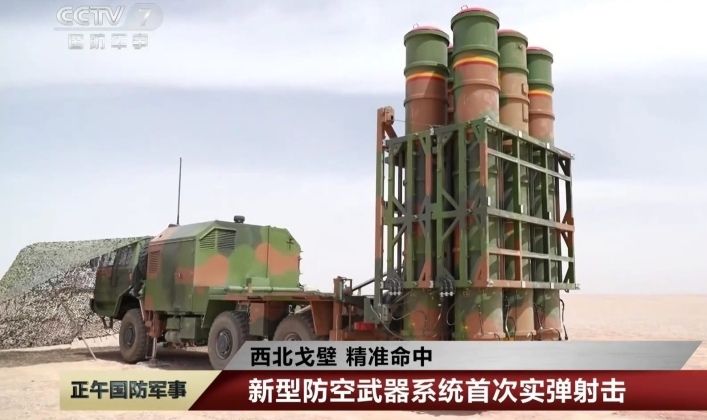
Launcher From HQ-16F Long Range Air Defence System
The Chinese People’s Liberation Army 73rd Group Army of the Eastern Theatre Command has conducted live-fire exercises in the northwestern desert, utilising its newly supplied HQ-16F long range air defence systems to destroy a stealth target drone. Developed by the Shanghai Academy of Spaceflight Technology, the new system provides a substantial increase in engagement range while retaining compatibility with existing vertical launch systems. The missile is believed to continue using radar-guided interception techniques combined with modern datalink and command-guidance features inherited from previous HQ-16 variants. Such systems are optimised to engage a broad range of aerial threats, including fighter aircraft, helicopters, drones, cruise missiles, and potentially some tactical ballistic missile targets.
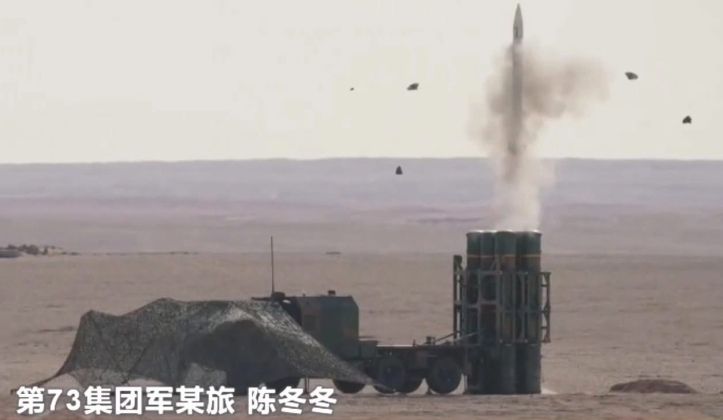
The 73rd Group Army is stationed in Fujian province, adjacent to the Taiwan Strait, which is considered a leading potential hotspot for hostilities. The sensitivity of the location is considered likely to be the reason why the first HQ-16s were prioritised for deployment in Fujian. While the launch system's appearance remains largely unchanged from prior variants of the HQ-16, the missile features a slimmer, almost tailless design, which is highly distinctive from those of the HQ-16A B and C variants. The introduction of this new missile into service the primary factor extending the system’s maximum range to 160 kilometres, where the HQ-16A and a 40 kilometre range, and the B and C variants had 70 kilometre ranges. A major achievement of the program is that it has achieved a significantly greater performance from a missile that remains compatible with existing launch infrastructure, achieving 229 percent the range of its predecessors without enlarging the missiles it uses.
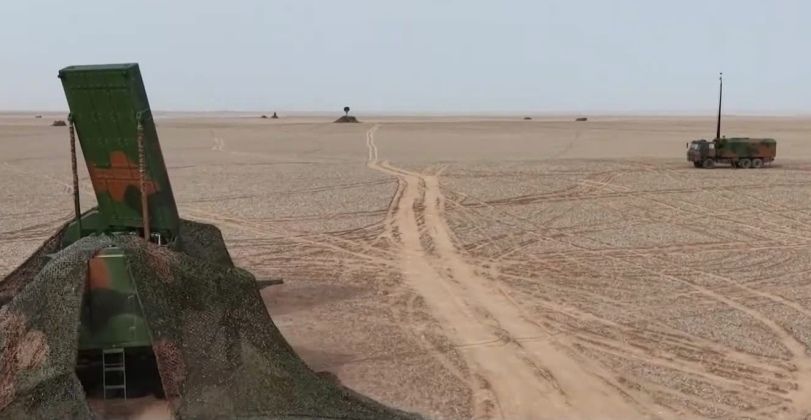
Like earlier HQ-16 systems, the HQ-16F employs vertical launch techniques, allowing a ship or ground battery to engage threats approaching from any direction without first rotating launchers toward the target. This provides much faster reaction times against saturation attacks involving multiple aircraft, drones, or incoming anti-ship missiles. New system has a longer range than the HQ-22 and HQ-9, and is surpassed in its range only to the HQ-9B, HQ-19 and HQ-29 systems. The new system’s capabilities have raised questions regarding its role, as while the first HQ-16 variants were broad equivalents to medium-range systems such as the Russian Buk, successive upgrades have steadily increased range, seeker sophistication, electronic counter-countermeasures, and engagement flexibility. The result is a missile family that now occupies a much broader operational niche, blurring the distinction between medium-range and long-range fleet air defence.
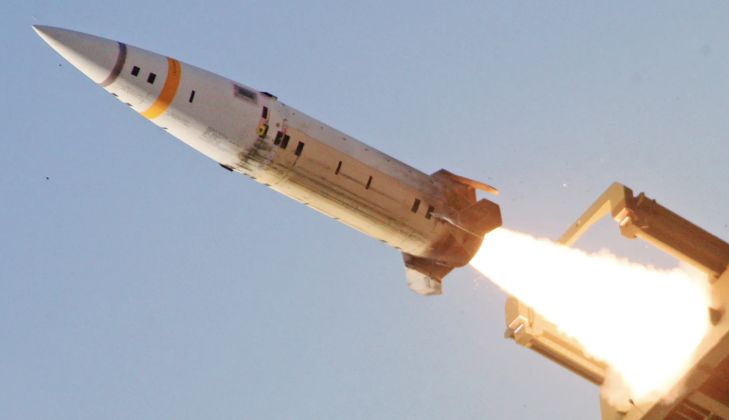
Air defence in the Taiwan Strait has taken on newfound importance due to sales of U.S. HIMARS rocket artillery and ATACMS ballistic missiles to the Republic of China Armed Forces based on Taiwan Island, which remain in a state of civil war with the Chinese mainland. Not only is this arsenal aimed squarely at key military bases and critical infrastructure in Fujian, but the establishment of a Joint Firepower Coordination Centre by the Republic of China Ministry of National Defence has from late January allowed U.S. personnel stationed in Taipei to oversee planning and potential use of local missile forces, providing Washington with an opportunity to prioritise targets that maximise economic damage to its strategic rival. The threat to security from this growing U.S.-supplied arsenal is expected to increase, with confirmation having been issued in February that ATACMS ballistic missiles were being considered for deployment just 16 kilometres from the mainland coast.
