
China Promises More Frequent Aircraft Carrier Operations as Carrier Shandong Returns From South China Sea
Military Watch Magazine Editorial Staff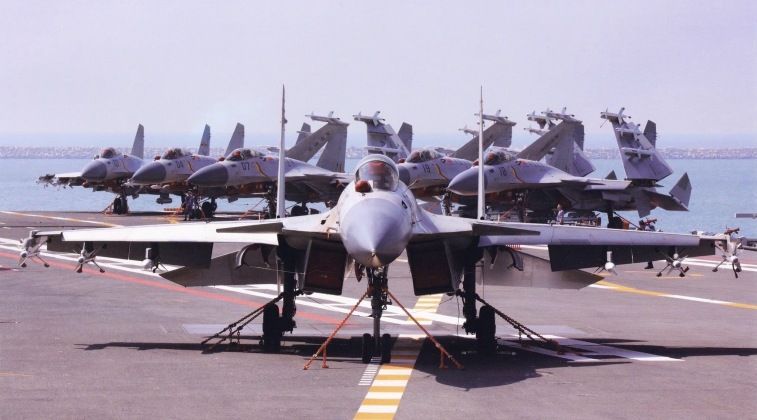
J-15 Flying Shark Fighters on Carrier Deck
Following naval drills by the Chinese People’s Liberation Army (PLA) Navy led by the new aircraft carrier Shandong in the South China Sea, navy spokesman and senior captain, Gao Xiucheng, said on May 2nd that the strike force had completed exercises. Regarding the possibility of future operations, Gao stated: “We hope the outside world can view [the Shandong’s exercise] objectively and rationally. The PLA Navy will continue to organise similar exercises according to the plan regularly in the future.” He stressed that the drills were “legitimate and can enhance Chinese capabilities to protect national sovereignty, security, and development interests.” China's navy currently operates three carrier warships, with a further two in testing and two more under construction. The Shandong was commissioned in December 2019, following the country’s first carrier the Liaoning in 2012, with both ships being based on the Soviet Kuznetsov Class design but seeing very extensive improvements over the Kuznetsov Class ship in Russian service ranging from sensors and defence systems to prolusion systems, electronic warfare systems, and the fighters on their decks.
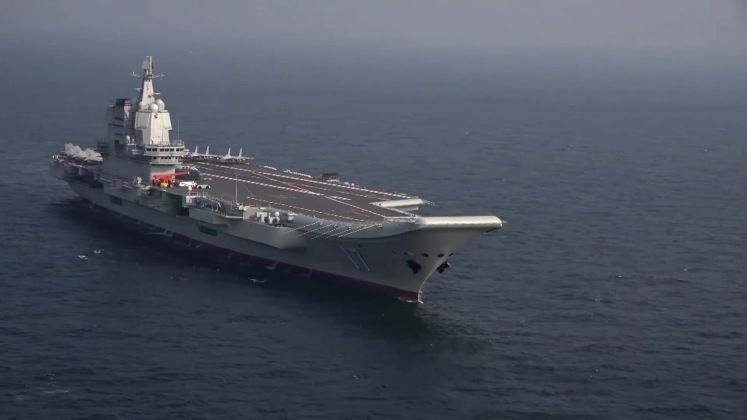
Closely coinciding the Shandong’s operations, the Liaoning took a combat force into the Philippine Sea and held its own drills in early April. Senior Colonel Wu Qian, a spokesperson at China’s Ministry of National Defense, stated regarding plans to deploy the ships more frequently: “The aircraft carrier is not a ‘homebody’ and it will be the norm for the aircraft carriers to sail far away.” The drills have coincided with a growing U.S. Military presence in the region, and while the current carriers are not considered peer competitors to the U.S. Navy’s Nimitz and Gerald Ford Class supercarriers they provide the PLA Navy with valuable experience in carrier operations at an accelerated tempo.
Both the Liaoning and Shandong displace approximately 70,000 tons each, making them the heaviest carriers outside the U.S. Navy, although two much heavier supercarriers are currently under construction and will be flattop designs with electromagnetic catapult systems. This will largely bridge the performance gap with the Gerald Ford Class, and provide a distinct capability advantage over the older Nimitz Class which makes up the bulk of the American carrier fleet. The carriers are also set to deploy more capable and diverse air wings, including J-15D electronic attack jets, J-15B air superiority fighters, KJ-600 AEW aircraft, and a range of stealth drones for reconnaissance and strike operations.
