
China’s First Supercarrier Nears Completion: More Ships Closely Follow As Massive Carrier Fleet Expansion Gains Momentum
Military Watch Magazine Editorial Staff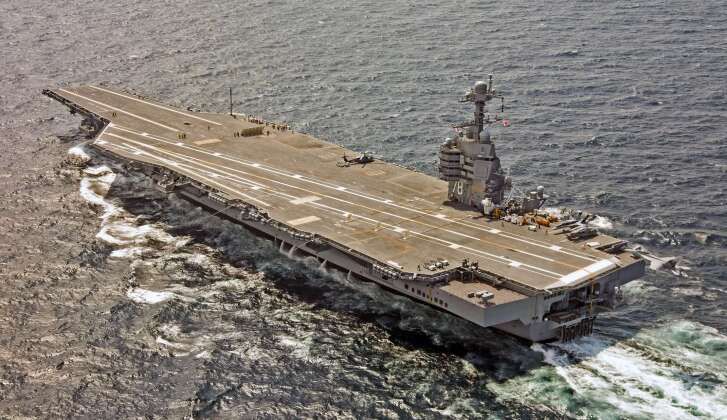
Gerald Ford Class Supercarrier
The first of two Type 002 Class flattop carriers for China’s People’s Liberation Army (PLA) Navy has reportedly neared completion at the Jiangnan Shipyard in Shanghai, which is expected to represent the first ship of its kind in the world capable of contending with the U.S. Navy’s Gerald Ford Class supercarriers at a peer level. The ship will likely be the sixth carrier in Chinese service, following on from the Type 001 and Type 001A 70,000 ton ships Liaoning and Shandong, and three more recently laid down 40,000 ton Type 075 Class ships. While the former two use a ski jump design similar to the British Queen Elizabeth Class or Russian Kuznetsov Class ships, and the latter three are only capable of deploying aircraft with vertical landing capabilities, all of which restrict the weights of the fighters they can launch, the Type 002 will be able to deploy much heavier aircraft. This represents its primary advantage over older carrier designs, and is facilitated by its integration of an electromagnetic catapult launch system (EMALS) which gives aircraft more energy upon takeoff. The U.S. Navy supercarrier USS Gerald Ford is currently the only ship in the world with such capabilities, although it is still far from ready for combat deployments.
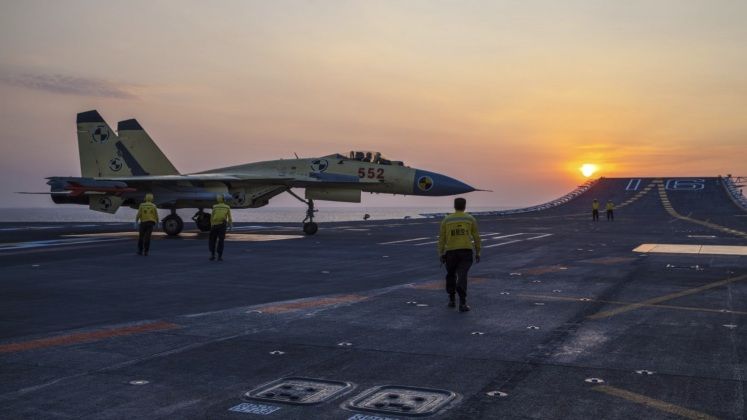
The Jiangnan Shipyard is expected to begin a three year expansion which will include construction of a new ship design and research centre and expansion of shipbuilding infrastructure. This investment is thought to be made with an expansion of the carrier building program in mind, either because more than two Type 002 Class ships are expected to be built or because the even larger and more ambitious Type 003 Class ships are expected to begin construction by around 2025. Where the Type 002 uses a conventional propulsion system and displaces 85,000 tons, the Type 003 is expected to be nuclear powered and displace over 100,000 tons - making it the largest carrier design in the world. Although the Type 002 is more than adequate as an asset for combat in the Asia-Pacific region, the Type 003 will be well suited to operating globally much further from Chinese coasts, and is expected to see a carrier onboard replenishment aircraft developed alongside it to fulfil a similar role to the American C-2 Greyhound.
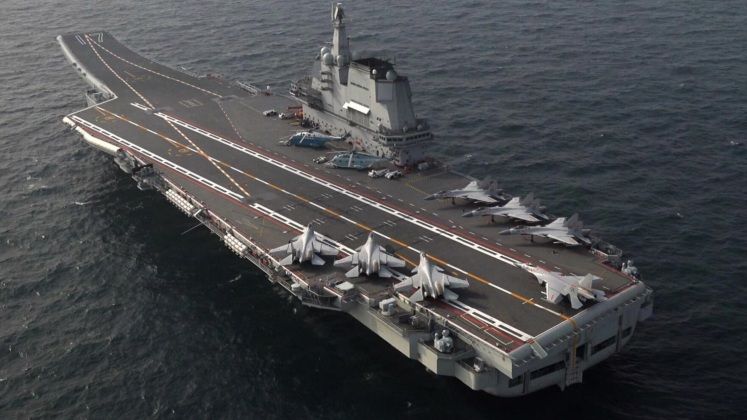
A new very large dry dock and repair yard on Hainan Island in the South China Sea will be large enough to accommodate both Type 002 and Type 003 Class supercarriers, and while China is expected to field seven carriers overall by 2025 it remains uncertain how many it plans in the long term. The Type 002 and Type 003 Class ships will both benefit from some of the most diverse air wings in the world, including KJ-600 fixed wing airborne early waring aircraft, J-15B ‘4++ generation” heavyweight fighters and navalised derivatives of the GJ-11 unmanned strike fighter among other assets. Key to facilitating a high rate of expansion of the carrier fleet is the very large scale production of destroyers, nuclear powered attack submarines and replenishment ships which are key to supporting carrier operations. Destroyers are currently being launched from Chinese shipyards at a rate of 8-10 ships per year, and the Type 055 Class its widely considered the most capable destroyer in the world. Other navies such as Britain, which has only six destroyers and is not planning to build any more, have struggled to field enough to escort their carriers. More capable Chinese destroyer classes still are expected to be launched before the first Type 003 Class carrier, possibly alongside the country’s first missile cruisers which will be heavier than destroyers.
