
China’s KJ-600 Breaks American Monopoly: Carrier Based AWACS Aircraft Performs First Flight
Military Watch Magazine Editorial Staff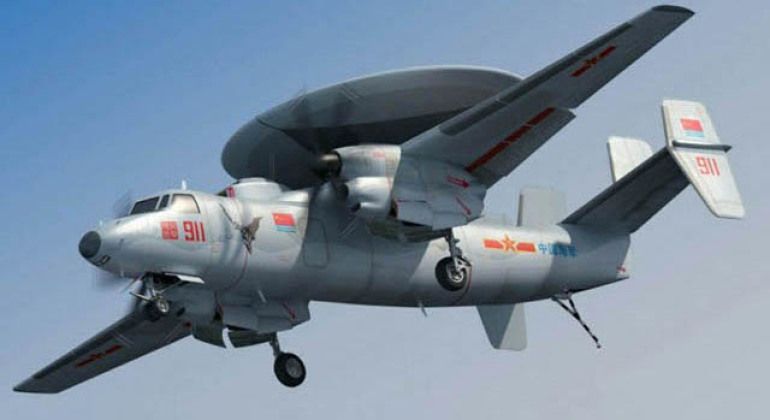
Chinese KJ-600 AEW Aircraft - artwork
China’s KJ-600 carrier based airborne early warning (AEW) aircraft performed its first flight on August 28th, making the country the only one other than the United States to have successfully developed such a platform. The aircraft resembled the American E-2 Hawkeye platform which deploys from U.S. Navy supercarriers, and from the French medium carrier Charles De Gaulle, and is expected to provide the Chinese People’s Liberation Army (PLA) Navy’s carrier air wings with at least a peer level of situational awareness to its American counterparts. Chinese shipyards are currently constructing two Type 002 Class supercarriers, which will be the first outside the United States to integrate electromagnetic catapult launch systems allowing them to deploy heavier aircraft including fighters with more fuel and munitions as well as large AEW aircraft. It is expected that the KJ-600 will continue flight testing until the first Type 002 Class ship begins sea trials, after which it will be integrated into its air wing. The KJ-600 is far from China's first AEW aircraft, with four preceding classes currently in service, but it is the first designed for carrier operations and integrates features such as folding wings and a lighter airframe optimised for takeoffs from short runways.
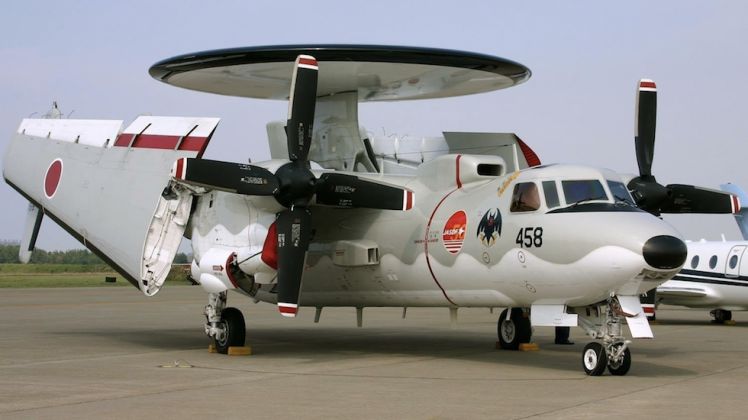
China’s two operational carriers the Liaoning and Shandong notably use helicopters for airborne early warning - much like carriers in Britain, Russia and India - with ships from these countries all lacking catapult launch systems needed to facilitate deployment of fixed wing AEW aircraft. Aircraft such as the E-2 and KJ-600, however, are not only much faster but also have a much greater endurance and, most crucially, can carry radars many times as large for much greater situational awareness. This is critical not only for detecting threats such as enemy warships, fighters, bombers and missiles further away, but also for commanding fighter units to maximise efficiency and even for guiding long range missiles towards their targets. While enhanced variants of the J-15 Flying Shark carrier based fighters, set to deploy from China’s upcoming carriers, will integrate powerful new AESA radars, and the J-15 can accommodate a much larger radar than rival carrier based fighter classes such as the French Rafale or American F-35C, fighters in general are much more limited in the size and power of the sensors they can deploy relative to dedicated AEW platforms. It remains to be seen whether the KJ-600 will also be deployed for ground based operations, and whether it will gain attention on export markets with Russia in particular likely to be a client should it press ahead with its own plans for a next generation EMALS-equipped carrier.
