
China’s Game Changing KJ-600 Carrier Based AWACS Platform Nears Completion; A Rival to the American E-2 Hawkeye
Military Watch Magazine Editorial Staff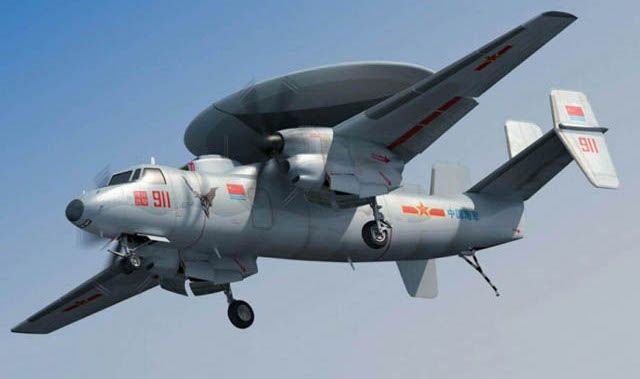
KJ-600 AWACS Platform
Recent reports indicate that China’s armed forces have completed a number of successful tests involving the KJ-600 airborne early warming platform - a propeller driven aircraft designed to deploy from the decks of the country’s aircraft carriers. Replacing helicopter based radar early warning systems, the KJ-600 can fly far higher and further and carries a considerably more powerful radar - allowing it to act as an effective force multiplier to its fighter contingents in much the same way as the American E-2 Hawkeye onboard the U.S. Navy's own supercarriers. The new Chinese propeller driven aircraft is the only aircraft of its kind in the world other than the E-2, where the vast majority of aircraft carriers either relying on helicopter based airborne radar systems such as the Russian Kuznetsov Class, Indian INS Vikramaditya and British Queen Elizabeth Class, or lacking these entirely such as the Thai warship Chakri Narubet, Japanese Izumo Class and U.S. Navy Wasp and America Class ships. Recent photos have shown a KJ-600 sitting on the flight deck of a mock carrier runway in the city of Wuhan - with such ground based replicas of carrier systems often used to test new hardware. The photos have, according to a number of analysts, served as a strong indication of the Navy’s intention to deploy the support aircraft from future electromagnetic catapult equipped carrier warships.
While China’s Liaoning and Type 001 aircraft carriers, the former currently in service and the latter currently undergoing sea trials, make use of basic ski jump launch systems which limit the takeoff weights of aircraft from the warships’ decks, future warships currently under construction are set to make use of electromagnetic launch systems (EMALS) which will allow aircraft to launch with considerably more energy - and so with far greater weights. The KJ-600 has hardly been the only aircraft testing to use such systems, with new variants of the J-15 Flying Shark carrier based air superiority fighter also being tested to make use of EMALS. Able to deploy far more munitions and carry a full tank of fuel, combined with a number of next generation upgrades including AESA radars, thrust vectoring systems, stealth coatings and new PL-15 air to air missiles, new variants of the J-15 which will fly from China’s future carriers alongside the KJ-600 will have capabilities well beyond those of the original Flying Sharks currently deployed on the Liaoning. New electronic attack specialised variants of the J-15 - analogous to the U.S. E/A-18G Growler but faster, longer ranged and higher flying - are also under development for deployment from the new carriers, and due to their relatively light weights may also be developed for deployment from older carriers using a ski jump system.
With the capabilities of the new fighter wings onboard China’s planned EMALS equipped carriers far superior to those of the first two carrier warships - and arguably to those of rival carrier warships given their lack of dedicated air superiority fighters - retired by both the U.S. and Russian Navies due to their immense costs - the KJ-600 is set to further serve as a force multiplayer for the country’s carrier based air wings. The platform is estimated to be able to track several hundred targets simultaneously and guide dozens of air to air missiles to intercept targets at once - making use of a far more powerful radar which is particularly potent when working alongside long ranged air to air missiles such as the PL-12, PL-15 and upcoming PL-21 and PL-12D. At extreme ranges, the aircraft’s radar systems can be used to detect incoming threats and coordinate appropriate responses - while for offensive operations the aircraft can also serve as flying command posts and even air traffic controllers for incoming military traffic, particularly useful for large landing operations. The KJ-600 goes a long way towards bridging the capabilities of China's carriers and those of the United States, and will provide Chinese carrier air wings with a considerable advantage over those deployed by rival warships fielded by states such as Britain, Japan or India which lack comparable support aircraft.
