
China Unveils World’s Longest Ranged Carrier-Based Ship Hunter with New J-15T Configuration on Supercarrier Fujian
Military Watch Magazine Editorial Staff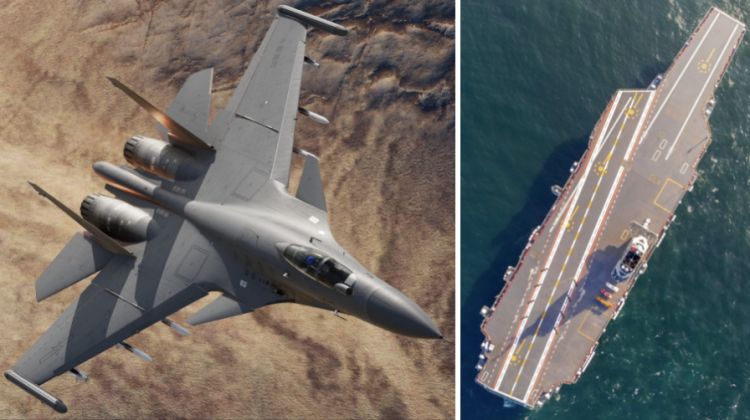
Chinese J-15T Fighter and Supercarrier Fujian
The Chinese People’s Liberation Army Navy has for the first time revealed the anti-shipping configuration of its new long ranged carrier-based fighter, the J-15T, with the aircraft seen carrying four YJ-83K anti-ship cruise missiles. The image highlights the significant anti-surface firepower that China’s latest carrier air wing is able to bring to bear, with the fighters having been procured both to modernise the air wings of the Navy’s two older aircraft carriers Liaoning and Shandong, and its new supercarrier the Fujian. Not only does the J-15T have a far higher weapons carrying capacity and longer range than Western carrier-based fighters, but its operations from the Fujian also allow for higher takeoff weights due to its electromagnetic catapult launch system - a system only the U.S. carrier USS Gerald Ford otherwise has.
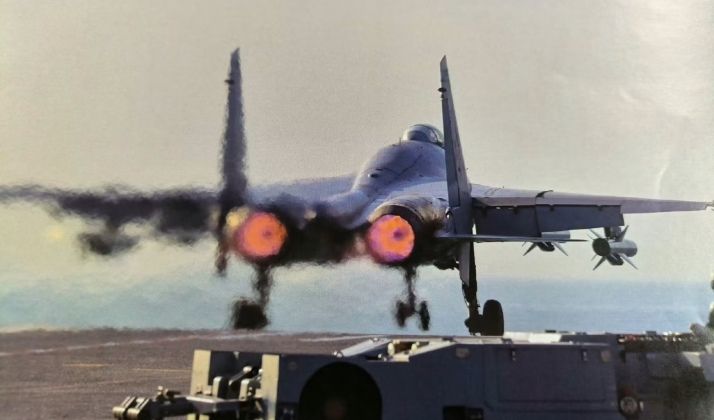
The YJ-83K is a well-established subsonic anti-ship cruise missile weighing approximately 700 kilograms, and with a 230 kilometre range. A J-15T carrying four such weapons therefore departs with roughly 2.8 tonnes of anti-ship ordnance before accounting for air-to-air missiles or external fuel tanks. This highlights demonstrates the substantial payload made possible by both the aircraft’s strengthened structure compared to prior J-15 variants, and by the integration of electromagnetic catapult launch systems. The new launch system can thus significant extend both the aircraft’s range and its combat effectiveness.
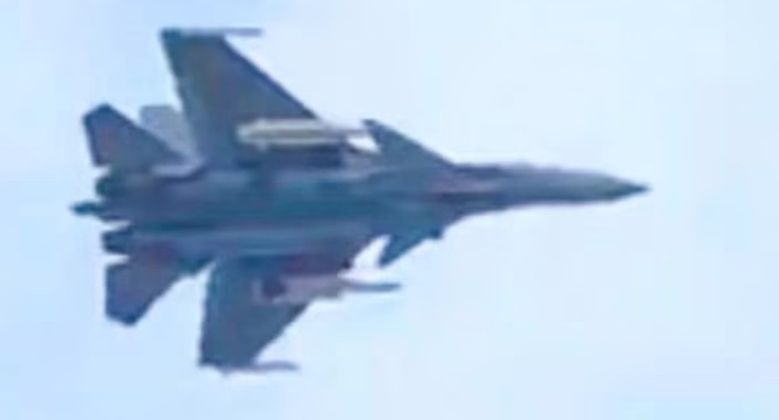
It is notable that the YJ-83K is not the most capable anti-ship missile type which has been integrated onto the J-15T, with unofficial photographs taken by Chinese aviation enthusiasts in February having captured one of the fighters carrying two YJ-15 missiles during what appeared to be flight testing. The new missile provides a substantial leap in capability over the YJ-83K, including a near hypersonic speed and a range of 500 kilometres. Its distinctive aerodynamic configuration includes three sets of control surfaces extending from front to rear: forward strakes integrated around the air intake, rectangular mid-body fins, and rear control surfaces mounted near the engine nozzle. Analysts estimate its weight at between one and two tonnes, making it significantly larger than the YJ-83K, with each J-15T estimated to be able to carry up to four.
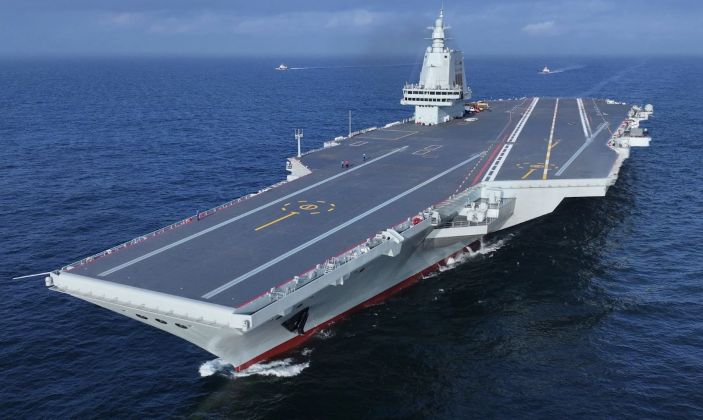
The Fujian displaces approximately 85,000 tons, compared to the approximately 100,000 ton displacements U.S. Gerald Ford class and Nimitz class carriers. The Chinese ship has three catapult launch systems for aircraft where the U.S. ships have four. The use of nuclear propulsion systems by U.S. supercarriers also provides them with a significantly greater endurances, and is expected to allow it to sustain its maximum speeds for significantly longer. Where the Nimitz class’ far older design places greater limitations on fighters’ takeoff weights, however the Gerald Ford has continued to suffer from wide ranging performance issues with its subsystems. These issues have affected its weapons elevators, electromagnetic catapults, human waste management and sensors, with a Project on Government Oversight report accordingly having referred to the program as an example of “how not to build a ship.”
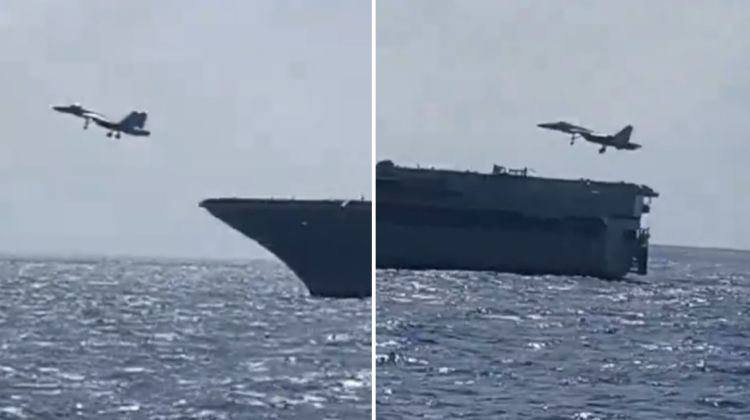
Although the Fujian has a number of disadvantages, its air wing is in many respects much more capable than those of U.S. supercarriers, with the J-15 and J-35 both benefitting from significantly longer ranges and higher weapons carrying capacities than the F-18E/F and F-35C, carry much larger radars, and have superior flight performances with much higher thrust-weight ratios. Its KJ-600 AEW&C systems relied on to boost situational awareness and provide long range targeting support are also much newer and thought to integrate more advanced electronics and more powerful radars. The J-15T is in many respects now the world’s premier maritime strike fighter, with its very long range and high missile payload in particular far surpassing those of all other carrier based fighter types, complementing the advanced capabilities of its new generations of weaponry. The potency of the Fujian’s air wing itself complements the significant advantages which Chinese destroyer escorts have established in their long range anti-ship capabilities over their U.S. counterparts.
