
China Achieves ‘Five Essential Capabilities’ For World Leading Aircraft Carrier Fleet
Military Watch Magazine Editorial Staff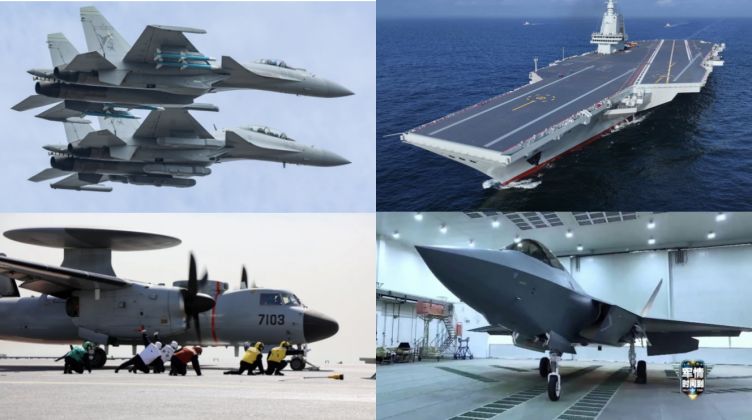
Chinese PLA Navy J-15 and J-15D, Fujian, KJ-600 AEW&C, J-35 Fighter
Following the commissioning of China’s first supercarrier the Fujian into service, in November 2025, and the warship’s subsequent considerable progress towards increasing its operational capabilities, the Chinese Ministry of National Defence has elaborated on key development goals for the country’s aircraft carrier program. Defence Ministry Spokesman Senior Colonel Jiang Bin was specifically asked to comment on the Navy's successful commissioning of all “five essential capabilities for aircraft carriers,” which the Fujian is the only warship outside the U.S. Navy to have achieved. He stated on May 9 that achieving these five capabilities represented vital link in forming the systematic combat capability of aircraft carrier formations, and was a significant achievement in the PLA Navy’s accelerated transformation and development.
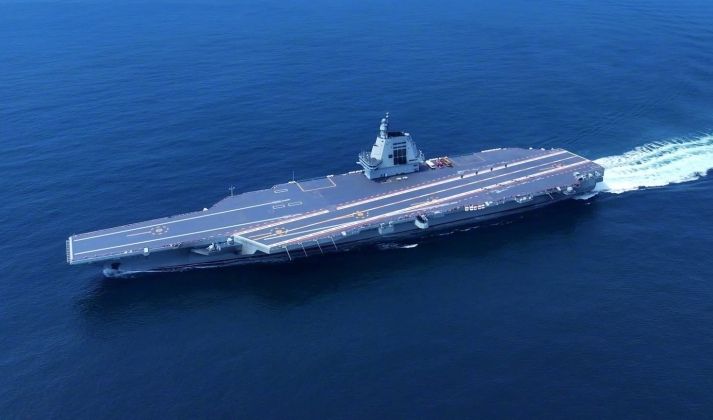
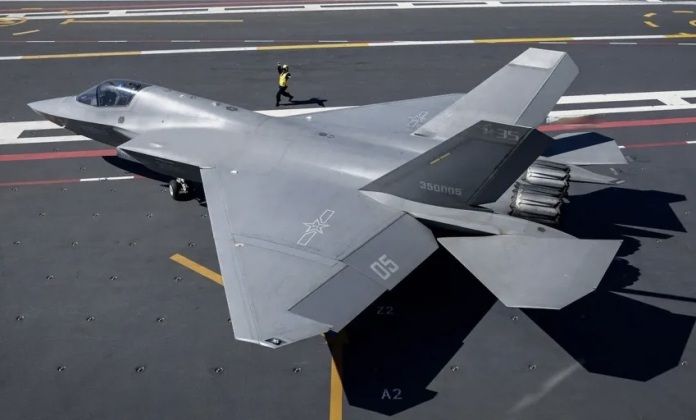
The five essential capabilities referred to include the integration of carrier-based fifth generation stealth fighters, multirole catapult-assisted carrier-based fighters, fixed-wing carrier-based early warning aircraft, fixed-wing electronic warfare aircraft, and anti-submarine helicopters. China is the only country to field carrier-based fifth generation fighters integrated with an electromagnetic catapult system, which provides energy for launches with high weights, with the U.S. Navy having suffered considerable delays integrating its F-35C fighters with these systems. Other than a small number of Russian Su-57 fighters, China and the United States are the only countries to have produced fifth generation fighters, with the U.S. producing the F-35, including the carrier based F-35B and F-35C variants, while China produces the J-20 and J-35, the latter which has both land and carrier based variants.
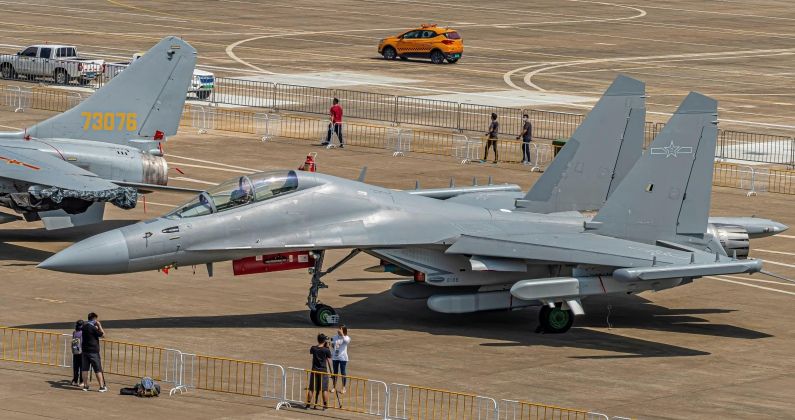
China and the United States are also the only countries that produce carrier based fixed with electronic warfare aircraft, with the J-15D having been brought into service as a counterpart to the U.S. Navy’s EA-18G Growler. The J-15D was first confirmed to be in service in November 2024, and has distinctive large wingtip electronic warfare pods, while lacking the infrared search and track systems and guns of J-15 fighter variants. J-15Ds can serve as force multipliers for carrier air wings, significantly improving survivability by jamming enemy sensors, while also providing a highly potent asset for air defence suppression using anti-radiation missiles that home in on radar emissions.
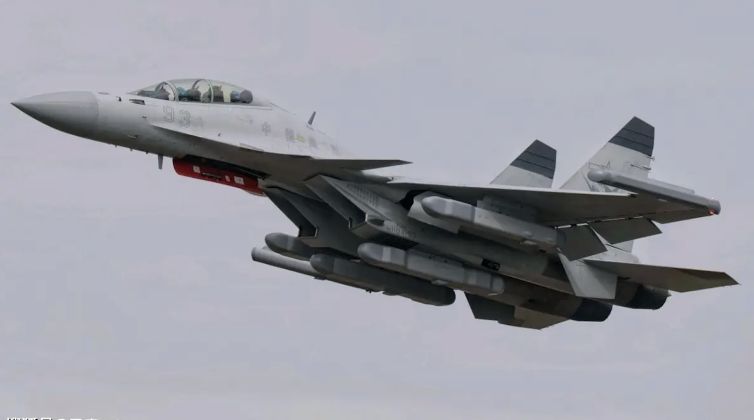
Electronic warfare systems are built in across much of the J-15D’s fuselage, namely conformal and blade antennas, while a wide range of complementary classes of electronic warfare pods and air to surface missiles can be carried under the aircraft’s wings and below the fuselage. The J-15D’s development is thought to have benefited considerably from experience developing and operating the J-16D land-based electronic warfare plane, with both designs being heavily enhanced and modernised derivatives of the J-11 fighter design. Compared to the EA-18G, the J-15D has a significantly longer range, a far higher capacity to accommodate large sensor, pod, and weapons loads, and a superior flight performance.
In April Chinese state media outlets confirmed that the Fujian would undergo a full transition from initial to full operational capability before the end of the year. Commenting on the transition, state media quoted defence expert Wei Dongxu observed: "When we see the Fujian achieving full aircraft loadouts and demonstrating the ability to launch and recover aircraft across its entire deck, we can consider its combat capability to be fully developed.” Once far sea exercises begin in the Pacific, the possibility of external interference, including contact with surveillance aircraft and other ships from potentially unfriendly countries, will require strike group to respond quickly, flexibly, and precisely. Far-sea training thus requires both a high level of combat readiness and comprehensive preparation for emergency situations. China’s geography, in particular the location of hostile states across its maritime approaches, means far seas carrier training will pose significant greater difficulties than is the case for other navies such as the U.S.
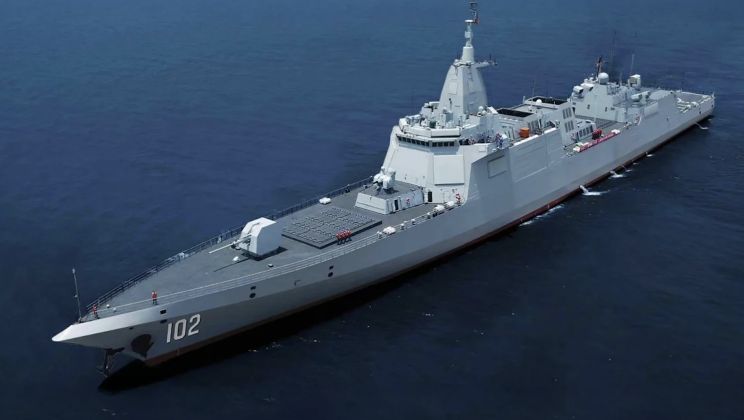
Elaborating on progress seen in the Chinese carrier program, Defence Ministry Spokesman Senior Colonel Jiang noted building a strong Navy embodies the century-old aspiration of the Chinese nation to grow into a maritime power, highlighting that this serves as an important guarantee for China’s rejuvenation. Noting that the Navy was entering the new era, with the functions of various weapon platforms having been continuously improved, achieving leapfrog development and innovative breakthroughs. China’s carrier program is notably considered an area where the standing of its navy is less outstanding, as while the capabilities of the Fujian are considered broadly on par with those of the U.S. Navy’s Gerald Ford class supercarriers, Chinese Type 055 class destroyers, Type 095 class nuclear powered submarines, and YJ-20 anti-ship ballistic missiles, are among a wide range of assets that are considered distinctly world leading in their capabilities. The standing of the carrier fleet is expected to continue to improve rapidly, with both conventional and nuclear powered supercarriers currently being under construction.
