
New Details on China’s First Nuclear Powered Supercarrier Currently Under Construction
Military Watch Magazine Editorial Staff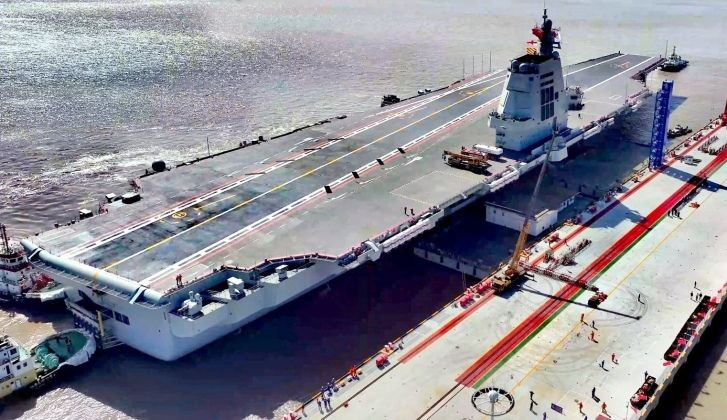
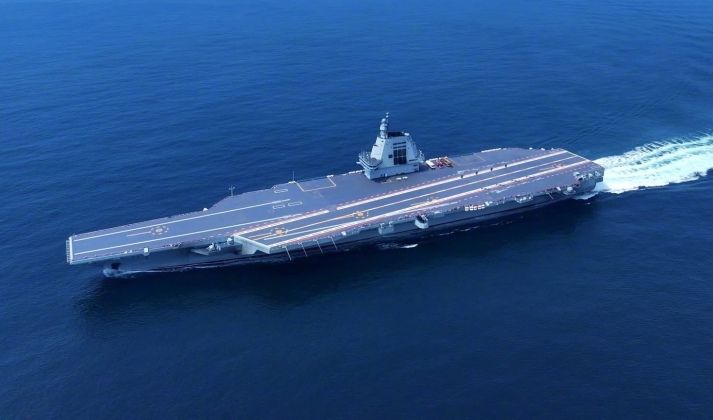
Chinese Supercarrier Fujian
Following the publication of images in October confirming progress in the construction of a new Chinese supercarrier, the Japanese think tank the National Institute for Basic Policy Research (NIPPR) has provided a new assessment of satellite images taken at the Dalian Shipyard where the warship is being constructed. After new images from the shipyard in November showed the installation of a nuclear reactor containment structure, confirming assessments that the ship would be nuclear powered, NIPPR more recently confirmed that the imagery showed features highly consistent with the construction of nuclear powered carriers, contrasting with prior Chinese aircraft carrier programs which had all produced conventionally powered ships. Although there were prior indications that the new supercarrier would be nuclear powered, including reports in November 2024 indicating that a nuclear reactor prototype for surface warships was being constructed near the city of Leshan, this has become increasingly certain as construction has continued to progress.
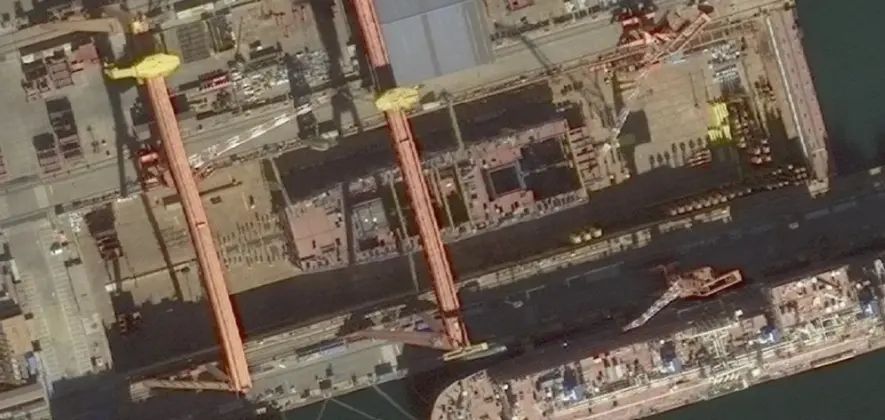
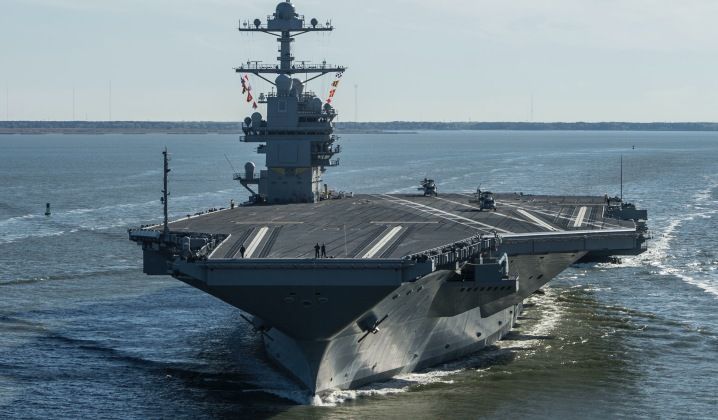
Researchers at NIPPR compared the images from Dalian with satellite photos of the Newport News Shipbuilding yard in Virginia, where the only other types of nuclear powered supercarriers, the Nimitz class and Gerald Ford class ships, have been built for the U.S. Navy. Nuclear powered carriers under construction at both facilities all have two frames of similar size, approximately 16 meters by 13 meters, positioned where reactor containment vessels are installed. Researcher Maki Nakagawa observed regarding the commonalities between the two countries’ nuclear supercarrier programs: “The size and shape of the frames confirmed in the Dalian shipyard images closely resemble those seen on nuclear-powered aircraft carriers under construction in the United States and are believed to be frames for reactor containment vessels.” “The Chinese military could possess an aircraft carrier with capabilities comparable to U.S. carriers by the early 2030s,” she concluded.
In parallel to work on expanding the carrier fleet, infrastructure expansion is underway at a naval facility in Qingdao, Shandong Province, not far from the capital Beijing, which currently serves as the home port for the aircraft carrier Liaoning. The expansion of piers and the building of demagnetisation facilities, which are designed to reduce a ship’s magnetic signature, could allow the facility to eventually accommodate a supercarrier in the early 2030s. A new naval airfield has also been established near by with carrier landing training facilities and associated hangars, indicating plans to further expand carrier training on land. The Liaoning is currently the only Chinese carrier capable of accommodating manned fixed wing aircraft based in the East China Sea, with the newer carriers Shandong and Fujian both based in the South China Sea. The next supercarrier is expected to be based alongside the Liaoning, which has particularly significant implications for Japan, and for the United States which bases the bulk of its forces in Northeast Asia in the country.
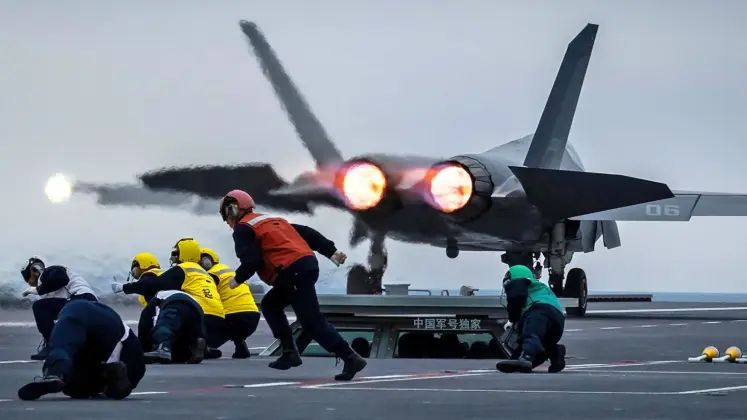
The Chinese People’s Liberation Army Navy commissioned its first supercarrier, the Fujian, into active service on November 5, with the ship currently being the only supercarrier in service outside the U.S. Navy. At 85,000 tons, it is smaller than the 100,000 ton Gerald Ford class ships, and can launch just three aircraft simultaneously rather than four. Its air wing, however, is comprised of significantly newer and more advanced aircraft, including fifth generation fighters which Gerald Ford class ships’ air wings have yet to integrate. Chinese shipyards are currently constructing two new carriers, including a second conventionally powered supercarrier, which may be a similarly sized sister ship to the Fujian, as well as the aforementioned nuclear powered supecarrier. The latter is expected to displace close to 110,000 tons, making it the largest warship in world history.
The parallel procurement of both conventionally and nuclear powered supercarriers highlights the People’s Liberation Army Navy’s dual focuses of projection power into East Asia, and more widely into the Pacific, with the two types of ships having complementary advantages. The importance of disputing the United States and its strategic partners’ blue water dominance has grown as these actors have increasingly targeted civilian shipping. A major milestone in these operations was the boarding of a cargo ship in the international waters in the Indian Ocean by U.S. special forces to secure dual use goods that were being shipped from China to Iran, which was removed and destroyed in what was widely considered a serious violation of international law. U.S. forces more recently on December 10 commandeered civilian tanker in international waters which had been transporting Venezuelan oil for export, as part of efforts to place pressure on its economy, which was similarly considered wholly outside the bounds of international law. This follows a series of similar operations, and has raised the possibility of China’s maritime trade routes being more seriously threatened. The much greater endurances of nuclear powered supercarriers allows them to form the core of much longer ranged strike groups with significantly less support from resupply vessels and less reliance on refuelling stops.
