
China’s New J-35 and J-15T Fighters Conduct Touch-and-Go Landings on Supercarrier Fujian
Military Watch Magazine Editorial Staff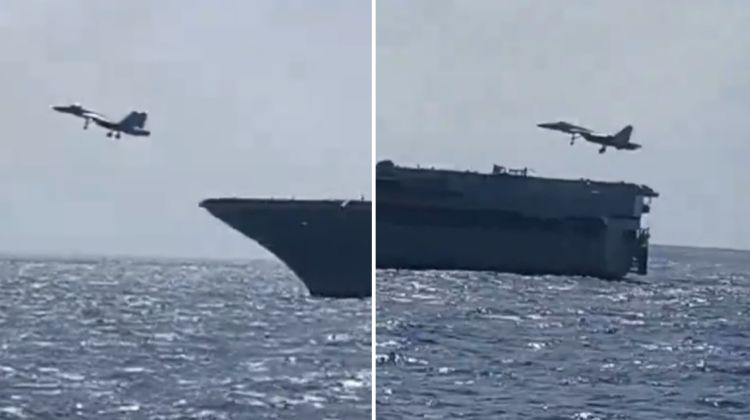
J-15 Conducts Touch and Go Landing on Supercarrier Fujian
New footage from the South China Sea has shown J-15T and J-35 fighter aircraft conducting touch-and-go landings on the Chinese People’s Liberation Army Navy’s new aircraft carrier Fujian, highlighting ongoing progress towards the warship’s air wing attaining a full combat capability, which is scheduled for later in the year. Such landings are one of the most important stages in carrier aviation training, and involve a pilot flying the full carrier landing approach, aligning with the deck, and briefly contacting the flight deck with the landing gear before immediately applying full power and taking off again rather than coming to a complete stop. On an aircraft carrier this allows pilots to practice the most difficult portion of carrier operations, namely the final approach and deck touchdown, while conducting many repetitions in a short period of time. Before pilots begin routine arrested landings, they often spend considerable time performing touch-and-goes to refine glide-slope control, lineup, throttle management, and deck-landing precision.
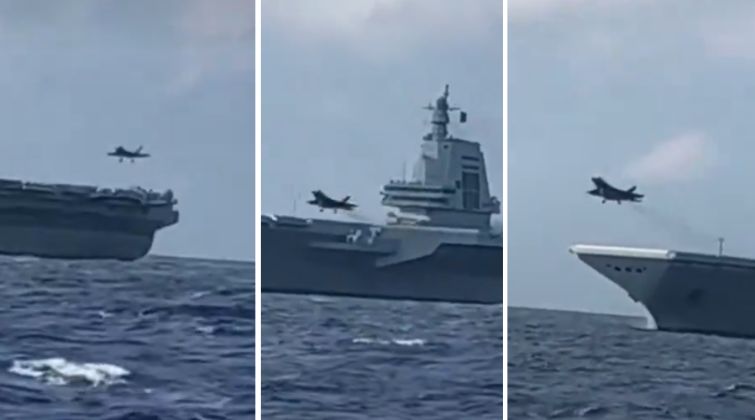
For seamen onboard the Fujian, touch-and-go operations test the ship’s aviation systems, landing aids, optical landing systems, precision approach equipment, air traffic control procedures, and deck crew coordination. Every successful approach confirms that the ship can provide stable guidance to pilots under realistic conditions. Because the aircraft immediately accelerates and departs, the operation places less stress on arresting gear and on the aircraft than repeated full recoveries, while still generating valuable data about flight deck procedures. The fact that both the J-15T and J-35, which were first introduced into service in the Fujian’s air wing, are jointly conducting touch-and-go landings aboard the carrier is a significant indicator that the warship and its air wing are moving beyond basic sea trials and into the demanding phase of integrating aircraft and warship into a single combat system.
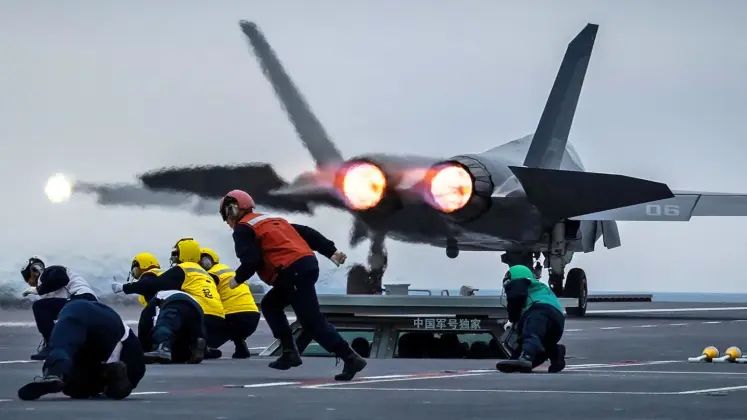
Simultaneous J-15 and J-35 operations suggest that China is working toward a mixed air wing concept, much like that the U.S. Navy intends to develop for its Gerald Ford class supercarriers with F-18E/F and F-35 fighters once the latter can be integrated. The two fighter types have highly complementary capabilities, with the J-15T being a ‘4+ generation’ air superiority fighter with a larger more powerful radar, longer range, and higher weapons carrying capacity, while the smaller J-35 benefits from world leading stealth capabilities. The publication of footage of touch and go landings on the Fujian closely follows confirmation that the J-35 is also being tested on the older aircraft carrier Liaoning, indicating plans to also modernise China’s two prior carriers with mixed air wings integrating fifth generation fighters.
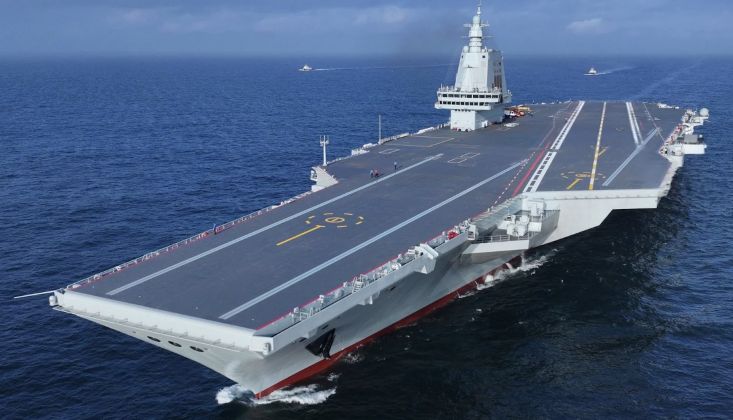
The Fujian’s construction and service entry in November 2025, represented a major landmark in China’s aircraft carrier development, with the warship being the country’s first supercarrier and first aircraft carrier with an electromagnetic catapult system. Alongside the J-35, it was also the first ship to integrate the KJ-600 airborne warning and control systems (AEW&Cs), which is considered a vital force multiplier for multiple kinds of operations. With only the U.S. Navy fielding similarly capable carriers, namely the Gerald Ford class supercarriers, experience operating the Fujian is highly invaluable for the future of the Chinese carrier program, with two supercarriers currently under construction, while several more are reportedly planned. Experience conducting touch-and-go landings on the ship’s flat deck is expected to be imparted onto the crews of future supercarriers to allow them to gain a full operational capability more smoothly and rapidly.
