
China’s ‘Flying Aircraft Carrier’ Makes First Flight: Jiu Tian ‘Mothership’ Deploys 100 Drones Over Long Ranges
Military Watch Magazine Editorial Staff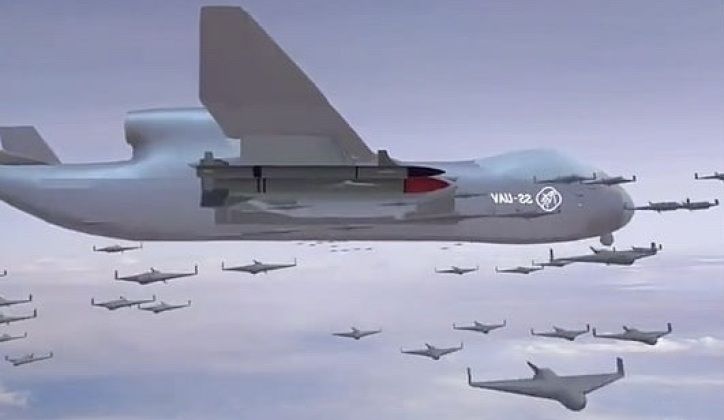
Artwork Showing Jiu Tian Aircraft Deploying Drone Swarm
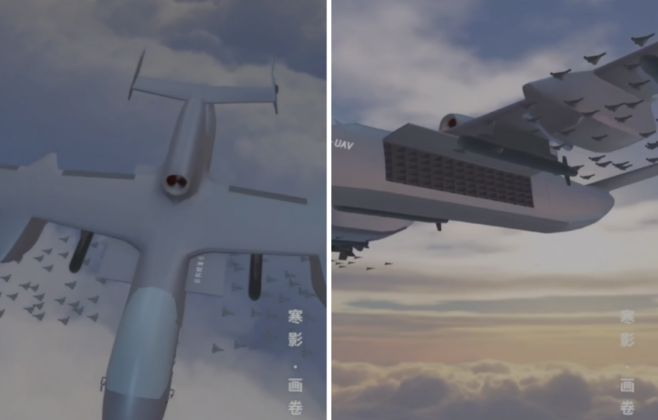
The Chinese Jiu Tian unmanned aircraft, commonly referred as the world’s first ‘drone mothership,’ has been confirmed to have made its first flight in Northwest China's Shaanxi Province, marking a major milestone in a unique program that promises to revolutionise unmanned air operations. With a 25 metre wingspan and 16.35 metre length, the large aircraft has the capacity to carry 100 small drones, which it can launch while airborne. Its 7,000 kilometre range and 15,000 meter operational altitude, the aircraft was designed to launch drone swarms far from Chinese waters, with the drones carried launching from high in the air allowing them to reach targets further away. This endurance places targets across East Asia within targeting range, and raises the possibility that it could be used for strikes as far as Guam, a central hub of U.S. military operations in the region.
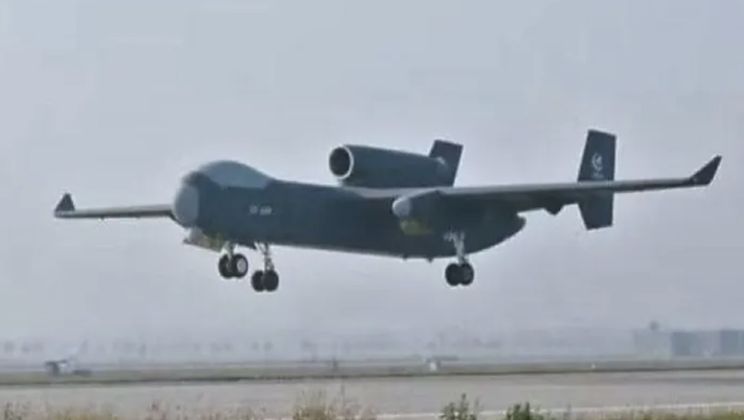
First unveiled at the Zhuhai Airshow in November 2024, the Jiu Tian is intended to serve both a launch platform for up to 100 drones, and as a control node for the aircraft, making it totally unique. Widely likened to a flying aircraft carrier, analysts have speculated that the program’s success could result in the development of larger drone carriers deploying greater quantities of unmanned aircraft over longer ranges. The aircraft’s capabilities are expected to prove to be highly complementary to those of China’s growing blue water navy, its vast arsenal of long range ballistic and cruise missiles, and its fighter fleet which is increasingly able to operate in the far seas due to improved ranges and greater aerial refuelling support. The possibility of several Jiu Tian aircraft being deployed to complement missile attacks on adversary carrier groups, for example, would complicate air defence efforts, and allow attack drones to be deployed from multiple unexpected directions, for which determining the point of launch may prove more challenging.
Commenting on the Jiu Tian program’s implications for local industry, the Chinese state media outlet People’s Daily projected: “its widespread deployment is expected to accelerate the integration of the industrial and innovation chains, inject new momentum into the high-quality development of the low-altitude economy and promote innovation and upgrading in the aviation industry.” The aircraft was built around a universal platform with modular mission payload design concept. Its development has occurred at a time when China has demonstrated increasingly distinct global leadership in unmanned aviation, and as a fast growing number of unmanned long range aircraft able to support power projection are also entering flight testing stages or being brought into active service. Other examples include the GJ-11 unmanned stealth bomber, the CH-7 unmanned high altitude stealth reconnaissance aircraft, and an unnamed intercontinental range stealth aircraft which is expected to serve as a strategic bomber.
