
World’s Most Powerful Heavy Lift Helicopters Airlift Air Defences onto Moscow Rooftops
Military Watch Magazine Editorial Staff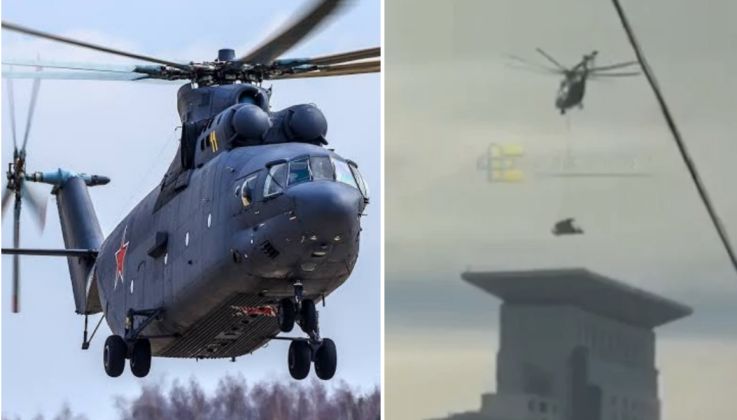
Mi-26 and Positioning of Pantsir-SMD-E on Moscow Rooftop
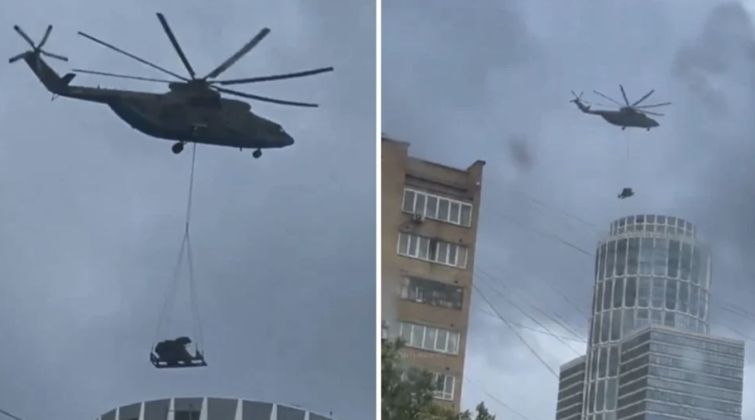
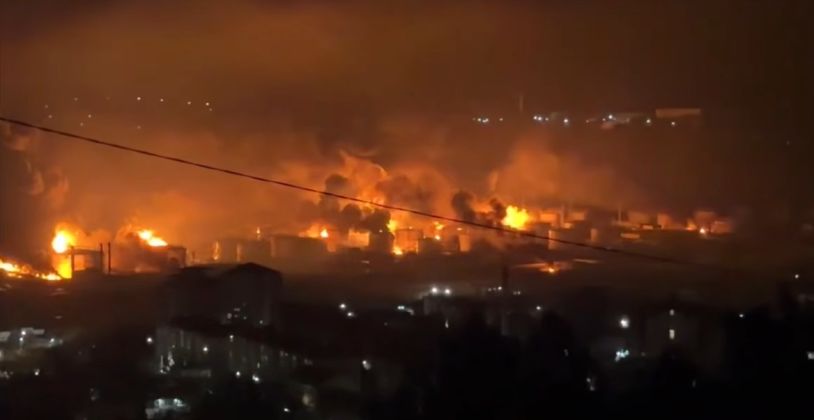
Footage from Moscow’s Sokolniki District has shown continued operations by the world’s largest and most powerful transport helicopters to position Pantsir-SMD-E stationary air defence systems onto the rooftops of high rise buildings, which appears to be part of an effort to rapidly expand a multi-layered defensive network across the capital to respond to the threat of drone attacks from Ukraine. Mi-26 helicopters were first seen lifting Pantsir-SMD-E systems onto rooftops in late May, and appear to have continued these operations to respond to imminent threats to residents, critical infrastructure and government buildings. Drone attacks launched from Ukraine against strategic targets in Russia have received very considerable support from across the Western world, including funding, training, supplies, and intelligence. Russian analysts have increasingly highlighted the Armed Forces’ inability to provide a viable defence against the increasingly frequent launches of large scale Ukrainian drone attacks, publishing images showing large urban blocks in flames across multiple population centres in the country.
The Mi-26 is not only the world’s heaviest and largest production helicopter, but also the highest-capacity rotary-wing airlifter ever built. It is capable of transporting payloads that no other operational helicopter can match. Designed during the Soviet era to transport equipment that previously required fixed-wing aircraft, it continues to stand apart from every other operational helicopter in its sheer scale and lifting capability. With a maximum payload of 20 tons, it can carry more than twice the load of most Western heavy-lift helicopters such as the CH-47 Chinook, and even rivals the cargo capacity of some fixed wing tactical transport aircraft. Its outstandingly large eight-bladed main rotor, measuring approximately 32 metres in diameter, is powered by two D-136 turboshaft engines, generating enough lift to carry armoured vehicles, artillery pieces, engineering equipment, or large numbers of personnel directly to locations inaccessible to fixed-wing aircraft.
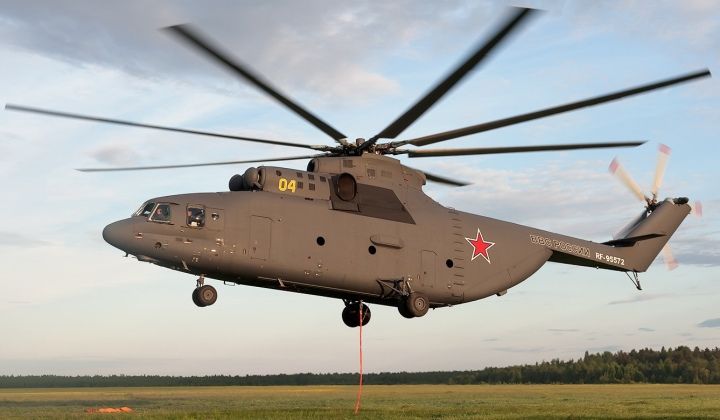
The Mi-26 was designed to be able to transport infantry fighting vehicles, mobile air defence systems, fuel trucks, or engineering machinery directly into remote forward areas without prepared runways, rapidly reinforcing isolated units or delivering bridging equipment and logistics to areas cut off by destroyed infrastructure. Its ability to relocate heavy equipment over mountains, forests, or rivers gives commanders a level of operational mobility, avoiding the need for either multiple flights by smaller helicopters or for lengthy ground convoys vulnerable to attack. The aircraft has also been extensively used for civilian purposes, including transporting power transformers, construction equipment, and prefabricated buildings into isolated regions, and supporting disaster relief and recovery operations. This has included lifting downed aircraft and helicopters that would otherwise require complete disassembly before transport, functioning as an aerial heavy crane in ways no other aircraft in the world can.
The Pantsir-SMD-E systems being airlifted onto Moscow rooftops were designed to protect static infrastructure from uncrewed aerial threats, with each able to integrate up to 48 small TKB-1055 anti-drone interceptors, or 12 larger 57E6 short-range command-guided surface-to-air missiles. Deploying the systems reduces the possibility of buildings obstructing each system’s line of fire. The growing reach of drone attacks being launched from Ukraine has raised the possibility that targets in central Russia, including industrial heartlands in the Urals region, also beginning to be fortified with similar measures to those seen in Moscow, if indeed this has not already begun. The sustainability of relying on air defences against drone attacks has nevertheless been called to question, fuelling calls within the Russian leadership to strike European facilities supporting the drone program as a means to cut off supplies.
