
Why the World’s Longest Ranged Rocket Artillery System is Playing a Central Role in China’s Taiwan Strait Exercises
Military Watch Magazine Editorial Staff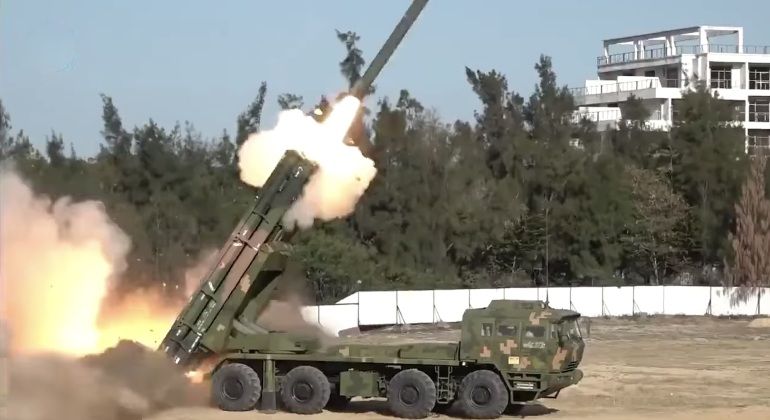
Chinese PCL-191 Rocket Artillery System During Justice Mission 2025 Exercises
The Chinese People’s Liberation Army Ground Forces have employed PCL-191 rocket artillery systems to participate in the Justice Mission 2025 large-scale joint military drills around Taiwan Island, with the assets demonstrating their ability to play a central role in possible conflicts in the Taiwan Strait. The system has pioneered unprecedented ranges for a rocket artillery asset, allowing it to launch low cost high precision bombardments against targets hundreds of kilometres away. Footage from mainland China has shown the system’s rockets passing over houses to strike simulated targets at sea around Taiwan Island. This capability has led it to be expected to play a particularly central role in both exhausting the air defences of the Republic of China Armed Forces based on Taiwan, and in supporting all stages of a potential campaign to reassert Beijing’s control over the territory.
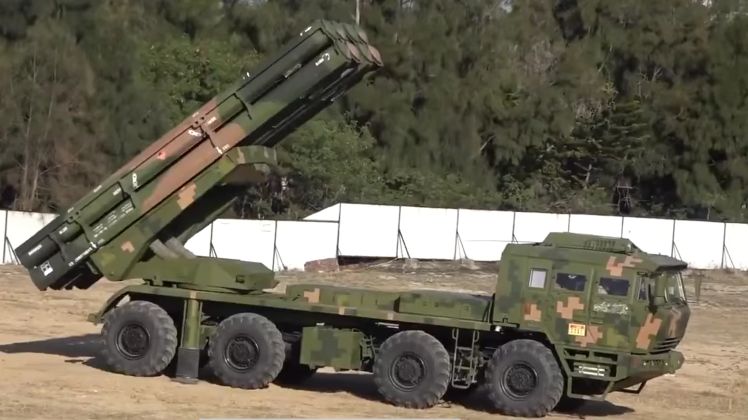
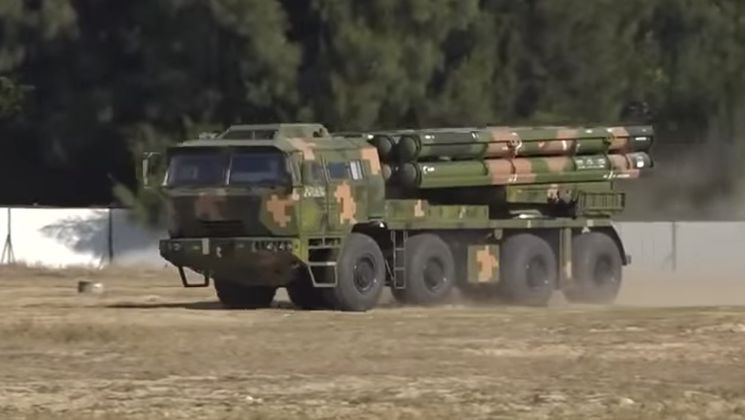
The PCL-191 has demonstrated a range of up to 350 kilometres using 370mm rockets, although lower cost lower calibre rockets can be utilised to strike closer targets. A 200 kilometre range is considered sufficient to launch bombardments of key targets across much of Taiwan’s northern and western regions. The system can also use higher cost ‘Fire Dragon 480’ 750 mm tactical ballistic missiles to reach targets of up to 500 kilometres away. Each of the system’s eight wheeled launch vehicles can deploy eight 370m rockets rockets, each of which can be guided to strike separate targets.
Reflecting their expected high utility in a Taiwan Strait conflict, two of the first brigades to deploy the PCL-191 in the late 2010s were located in Huzhou and Xiamen, both of which are within operational range of Taiwan. The 72nd Group Army’s artillery brigade’s master sergeant, Wang Tanshen, previously commented shortly after the PCL-191 system was operationalised that its range exceeded that of its closest predecessor by “seven times,” elaborating: “The new generation rocket artillery system has extended our firing range to cover everywhere we want to hit.” This was seen to refer to targets across the island.
The central role which rocket artillery systems have played in the Russian-Ukrainian War has led to significantly greater levels of importance being attributed to them, and stimulated to a surge in investment in procuring U.S. and South Korean origin systems across NATO. The United States has meanwhile modernised its own rocket artillery forces on the Korean Peninsula. Chinese and North Korean systems have continued to retain significant advantages over their counterpart fielded abroad in terms of range, with China having helped to shift the balance of power in Eastern Europe by sharing its rocket artillery technologies with Belarus under the Polonez rocket artillery program, which has used launchers and rockets produced in China and locally produced mobile vehicles. The Republic of China Armed Forces, which remain officially in a state of war with the Chinese People’s Liberation Army based on the mainland, have very limited strategic depth on Taiwan Island, which raises the possibility that rocket artillery can play a much more significant role than it does in the Ukrainian theatre where the primary targets on both sides remain beyond reach.
