
U.S. Surges Strategic Bomber Deployments in Europe For Long Range Strikes on Iran: Nearby Air Bases Destroyed in Missile Attacks
Military Watch Magazine Editorial Staff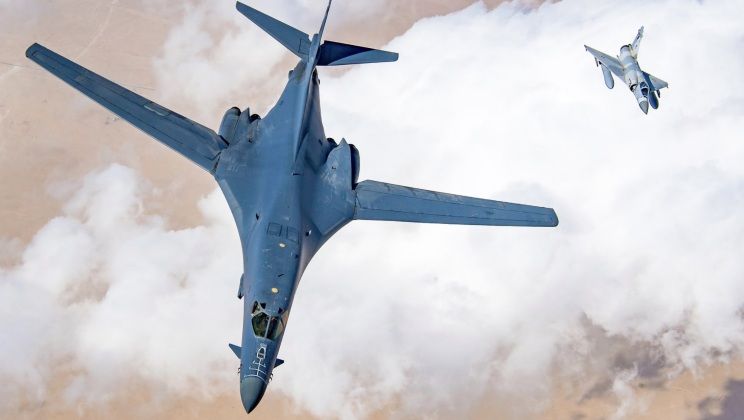
B-1B Bomber with Qatari Fighter Escort
The U.S. Air Force has continued to expand its strategic bomber deployments in Europe since the country launched an attack on Iran on February 28, with Iran’s large scale missile and drone attacks on U.S. air bases across the Middle East having made longer range strikes from bases outside the region preferable. Five B-1B bombers arrived at Royal Air Force Fairford in the United Kingdom on March 7-8, and another three at Ramstein Air Force Base in Germany. Three B-52H bombers then landed at Fairford on March 9. Additional bombers are also expected to deploy to Naval Support Facility Diego Garcia in the Indian Ocean. Although the B-1B and B-52H have intercontinental ranges, and can attack Iranian targets from bases on the continental United States, forward deployment significantly reduces maintenance requirements and allows sorties to be generated at much greater intensity.
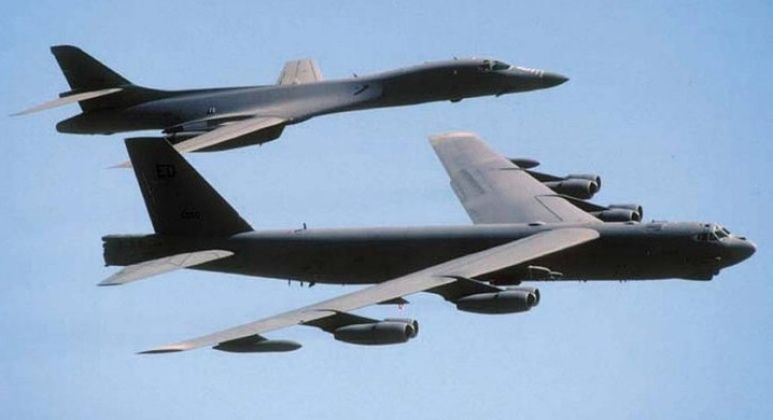

B-52H and B-1B bombers are not expected to be survivable inside Iranian airspace, but serve as cruise missile carriers to launch strikes from hundreds or even thousands of kilometres beyond the country’s territory. A pair of either type of bomber can delivery the same quantity of firepower as a full fighter squadron. The aircraft have been used extensively for offensive operations in the Middle East and Central Asia, including for strikes on Syrian government targets in 2018, and operations in Afghanistan from 2001-2021. Although Iran has placed orders for Su-35 long range fighters, which integrate R-37M long range air-to-air missiles that were specifically designed to counter strategic bomber attacks, the fact that these fighters have not been delivered limits Iran’s ability to respond to bomber strikes. Iran’s lack of missiles or drones capable of attacking air bases in Western Europe, however, remains the most significant constraint on its ability to respond.
