
U.S. Marines Train For Airborne Urban Assaults Spearheaded By F-35Bs and Ospreys
Military Watch Magazine Editorial Staff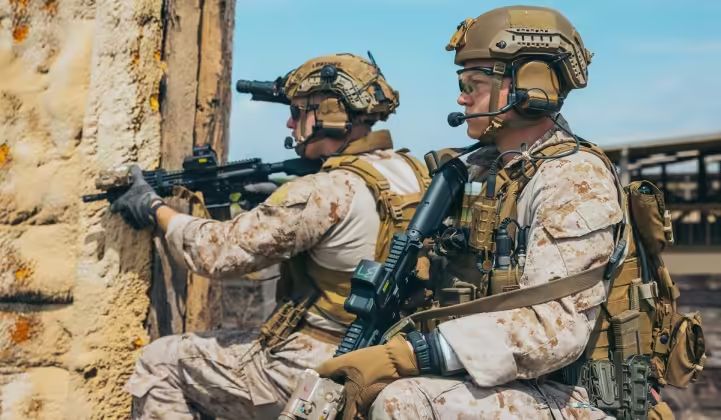
U.S. Marine Corps Personnel
USMC
The U.S. Marine Corps’ 13th Marine Expeditionary Unit have conducted Realistic Urban Training exercises simulating a limited-scale urban assault, which has demonstrated the strengthening of expeditionary forces’ capabilities to conduct rapid raids in contested and densely populated areas. The exercise provided insight into how the Corps is refining its expeditionary assault capabilities, which have applications in a wide range of contingencies, including in the Pacific where the Corps’ assets are increasingly heavily concentrated. The mission profile appears to combine aerial security, explosive breaching and building clearance, and showed an integrated air-ground force package built around the UH-1Y and MH-60S helicopters, MV-22B Osprey tiltrotor aircraft, and F-35B stealth fighters, all of which can operate from Wasp class and America class amphibious assault ships.
The exercises highlight the Corps’ growing focus on multidomain expeditionary warfare, emphasising speed, survivability, and network-centric capabilities. During the raid, a UH-1Y operated as a light attack helicopter to provide aerial security as the Maritime Raid Force advanced toward a target building. The aircraft served as an airborne sensor and monitored potential threats around the target area, supporting the situational awareness and providing real-time oversight of the operation. With this support from the air, the Maritime Raid Force personnel on the ground executed an explosive breach of the target structure, penetrating fortified positions rapidly to limit the time assault teams were exposed to potential hostile observation or fire. This highlighted the fact that speed remains particularly critical due to the high levels of threats in dense urban environments coming from multiple levels and directions simultaneously.
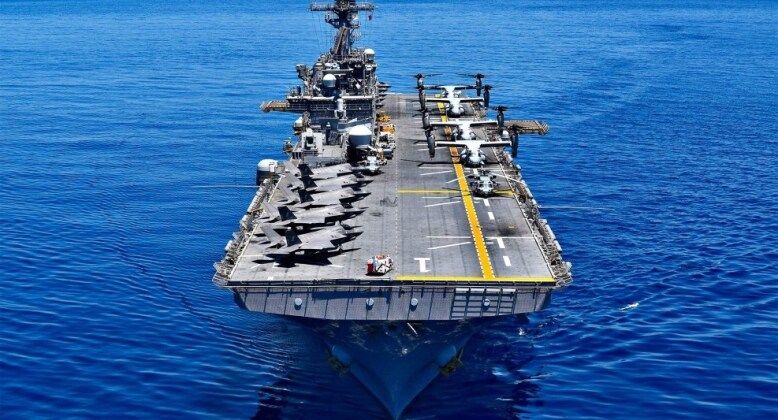
The Marine Corps has increasingly integrated the F-35B into planning for complex urban operations, with the fighter able to provide close air support and contribute to advanced intelligence collection, target identification, sensor fusion, and networked battlespace awareness. The transition to the F-35B from the older Harrier II aircraft represented a particularly major improvement for the Marine Corps, with the older aircraft having had a very limited range and strike capability, poor reliability, and a far poorer sensor package and flight performance which seriously limited the air support available. The F-35B’s ability to suppress hostile air defences around targeted urban areas is particularly highly prized, and beyond its radar and infrared sensors, its passive electronic sensors allow it to pinpoint radar sites across wide areas using their emissions.
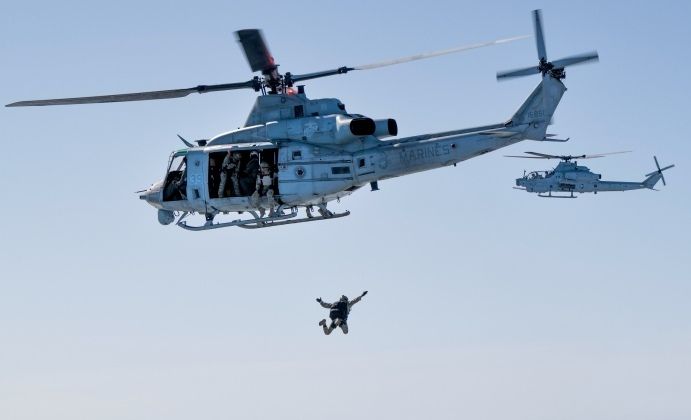
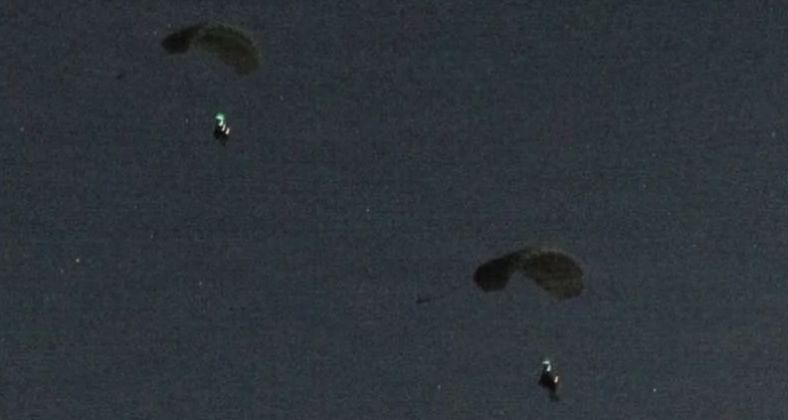
In January Marines and Naval special forces operating under the U.S. Armed Forces Indo-Pacific Command conducted free-fall training above Okinawa, Japan, to enhance precision insertion capabilities and survivability in contested environments across the region. Images sowed coordinated airborne operations supported by U.S. Marine Corps helicopters, including the UH-1Y and AH-1Z, with the terrain and airspace simulated closely resembling those seen in the First Island Chain. The exercise was carried out just a week after U.S. Army special forces were inserted by helicopter to attack Venezuelan targets and abduct the country’s president Nicolas Maduro. Exercises have highlighted the Marine Corps’ preparation for a range of offensive operations, with recent training having also concentrated on assaulting and capturing civilian shipping as part of distant blockade operations against hostile states. Such blockade operations are considered likely to be carried out against China should tensions worsen, and have already been carried out against Venezuela and to more limited extents against Iran and Russia.
