
U.S. Deploys Two B-52H Nuclear Bombers to Back Japan in Standoff with China
Military Watch Magazine Editorial Staff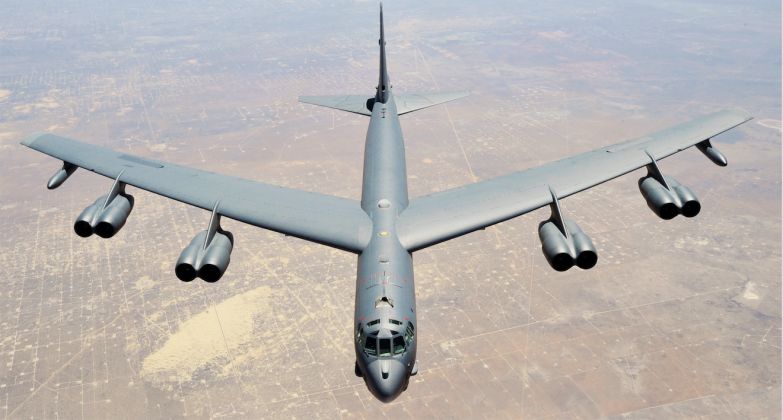
U.S. Air Force B-52H Bomber
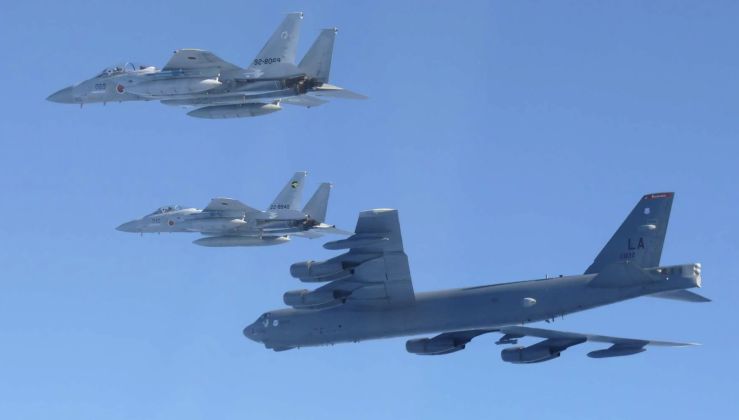
The U.S. Air Force has deployed two B-52H Stratofortress nuclear capable bombers for operations alongside Japan Air Self-Defense Force fighters, with the aircraft staging a joint show of force on December 11. Japanese government sources Tokyo described the show of force as a signal of alliance cohesion, while U.S. defense officials familiar with regional operations have confirmed the choice to deploy the B-52 was specifically intended to demonstrate combined long-range strike readiness. This follows rising tensions between Tokyo and Beijing, after Japan’s new prime minister, Sanae Takaichi, threatened to intervene militarily in the ongoing conflict between the People’s Republic of China on the Chinese mainland, and the Republic of China based on Taiwan, which have for decades remained in a state of civil war.
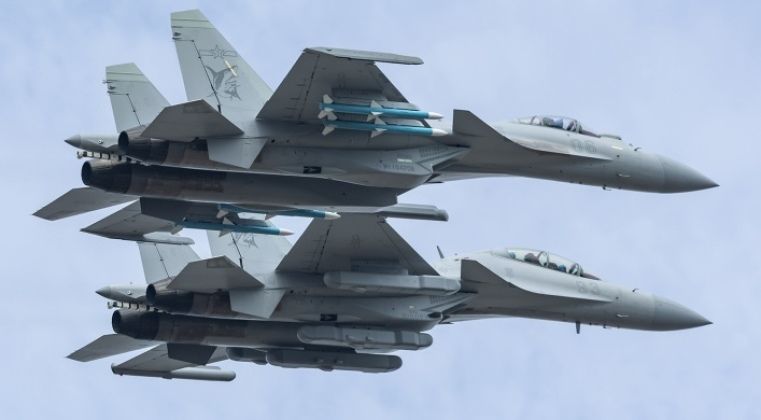
China responded to the Japanese prime minister’s threat by deploying the aircraft carrier Liaoning to conduct exercises near Japanese waters, with J-15B fighters operating from the carrier on December 6 locking onto two Japanese F-15J fighters and demonstrating the significant superiority of their sensors. Japan responded by deploying F-2 fighters armed with anti-ship missiles to simulate strikes on the Chinese carrier group. The rapid modernisation of the Chinese People’s Liberation Army has left Japan in a significantly weakened position, with the F-15J fighters that form the backbone of the fleet being long since obsolete, while even the newer F-2s are over a quarter century old and lack sufficiently long range weaponry. Japan’s small F-35 fleet has suffered from major development delays in being brought to the Block 4 standard, and as such has very limited compatibility with beyond visual range weaponry.
The B-52H has been at the forefront of offensive operations by the United States and its strategic partners across the world, with two of the aircraft in late November deployed to Minot Air Force Base for a Bomber Attack Demonstration over the Caribbean Sea aimed at placing military pressure on Venezuela. The aircraft have been deployed to stage multiple shows of force in the region from mid-October, alongside B-1B bombers. It has otherwise been involved in shows of force across the globe, from the Persian Gulf targeting Iran, to the Arctic targeting Russia. Although the B-52H first entered service during the Vietnam War, the shortcomings of both the newer B-1B and the B-2 bomber programs, including the former’s very low availability rates and the latter’s extreme sustainment costs, have resulted in an extreme reliance on the B-52.
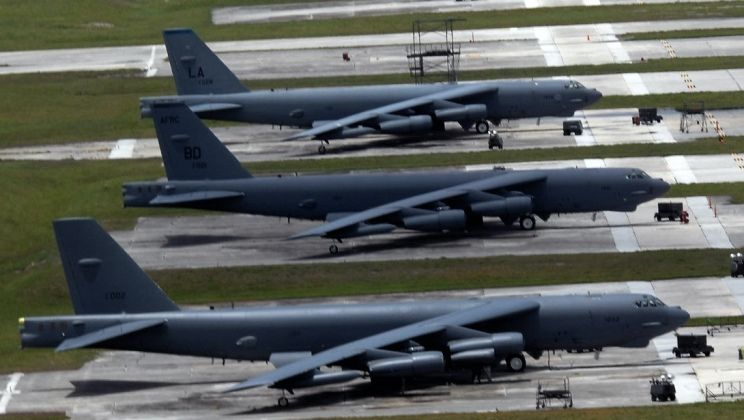
Although the eight engine bomber forms the backbone of the American strategic aviation fleet, its capabilities are increasingly out of date, with its ageing radar considered relatively straightforward to jam, while efforts to modernise the fleet under the B-52J program suffering significant delays and cost overruns. China, by contrast, was confirmed in October to have begun flight testing its first intercontinental range stealth aircraft, which is speculated to provide a much more sophisticated bomber capability allowing it to project power into the Americas from bases on Chinese territory. Nevertheless, China’s lack of strategic partners in the Western hemisphere capable of providing forward support, such as fighter escorts, remains a shortcoming, contrasting to the United States which maintains bases across East Asia and partnerships with states such as Japan that can provide forward support.
