
Japan Scrambles Large F-2 Fleet to Simulate Strikes on Chinese Carrier Group: Can They Pose a Real Threat?
Military Watch Magazine Editorial Staff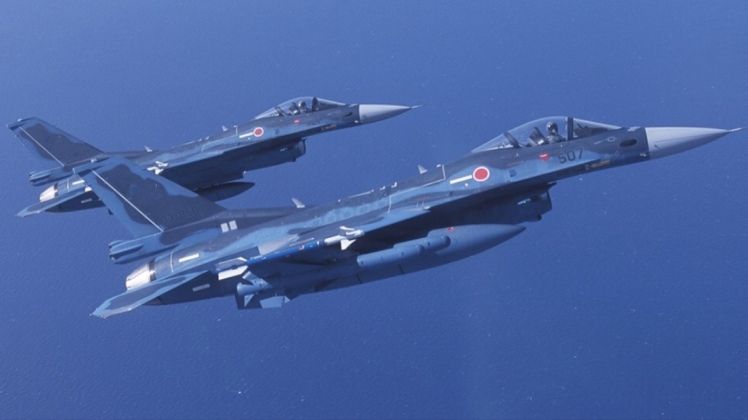
Japan Air Self Defense Force F-2 Fighters
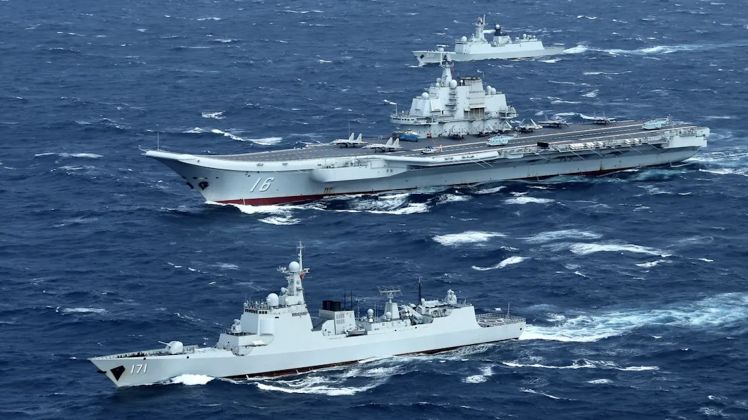
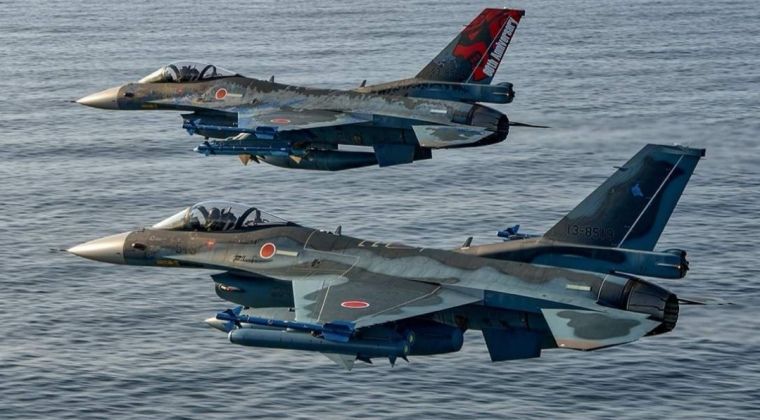
The Japan Air Self-Defense Force has scrambled a large number of F-2 fighters from Tsuiki Air Base equipped with ASM-2 air-to-ship missiles. The aircraft were reported by a number of sources to be participating in simulated strikes against the Chinese carrier strike group led by the aircraft carrier Liaoning, which is conducting exercises near Japanese waters. The F-2 is a heavily enhanced derivative of the American F-16 fighter, and although cutting edge for its time due to its its high use of advanced composite materials and integration of an active electronically scanned array (AESA) radar, its standing within against rival aircraft had diminished considerably as China has rapidly modernised its own aerial warfare capabilities. The limitations of the short ranged fighter, combined with those of the ASM-2, has raised questions regarding the F-2’s ability to seriously threaten Chinese carrier groups.
A primary factor limiting the ability of the F-2 to threaten warships in the Chinese carrier group is the limited performance of the ASM-2, which has a subsonic speed and an engagement range of just 150 kilometres. By contrast, modern J-15B fighters have air-to-air engagement ranges estimated at 250-300 kilometres using the PL-15 missile, and close to 500 kilometres using the PL-17, allowing them to shoot down F-2s from well beyond the Japanese jets’ engagement ranges even if only circling over their carrier groups. The J-15B is one of the longest ranged fighters in service anywhere in the world, and has a much higher endurance than any Western or NATO standard fighter type while also carrying a much larger and more powerful radar. This allows the fighters to be scrambled in the direction of the F-2s to further ensure that the Japanese jets cannot close to within firing range.
The cutting edge multi-layered air defences of the carrier group, which are provided by a Type 055 and two Type 052D class destroyers, is a significant further factor limiting the possibility of Japanese fighters armed with the ASM-2 posing a threat. Although the F-2 is one of just three fighter types in Japanese service, it remains the best suited for anti-shipping operations against Chinese carrier groups in spite of its limitations. The faster and longer ranged F-15J fleet is largely considered obsolete, and relies on technologies including sensors that date back to the late 1970s. The newer F-35 fifth generation fighters have still not been brought up to the Block 4 standard due to major development delays in the United States, and as such cannot employ any beyond visual range missile types like the ASM-2.
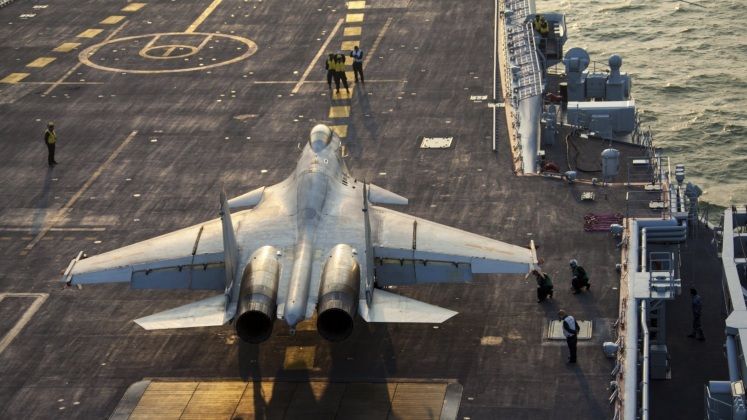
After passing through waters off of Okinawa, the carrier group led by the Liaoning on December 7 began training flights in the Pacific Ocean, with these exercises speculated to have been initiated in response to a rise in tensions between the two countries. After Japan’s new prime minister, Sanae Takaichi, threatened to intervene militarily in the ongoing conflict between the People’s Republic of China on the Chinese mainland, and the Republic of China based on Taiwan, which have for decades remained in a state of civil war, the mainland has staged significant shows of force aimed at Tokyo. J-15 fighters operating from the Liaoning reportedly formed radar locks on Japanese F-15 fighters over international waters southeast of Okinawa twice on December 6, preceding the initiation of exercises the following day. The balance of power between the two states has increasingly shifted in China’s favour over the past 30 years, with the J-15B’s recent service entry having revolutionised the capabilities of Chinese carrier air wings allowing them to hold their own much more effectively.
