
U.S. Air Force Revives Urgently Needed Cancelled Hypersonic Missile After Years of Failures and Delays
Military Watch Magazine Editorial Staff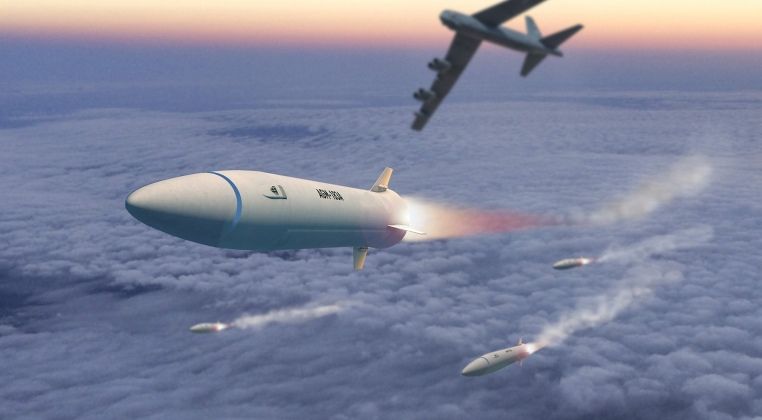
AGM-183 Hypersonic Missiles Launched By B-52 Bomber - Artwork
The U.S. Air Force has revived the AGM-183A Air-Launched Rapid Response Weapon (ARRW) program, after development was cancelled in 2023 due to serious delays and multiple failed flight tests. In its Fiscal year 2027 budget request, the U.S. Air Force requested over $296 million to support the development of the missile, which was designed as a two stage boost-glide hypersonic weapon. The missile uses a rocket booster to accelerate a non-powered hypersonic glide vehicle glider to optimal speed and altitude, after which the vehicle flies towards its target along a shallow in-atmosphere flight path. Originally developed as an air-to-ground missile for striking fixed targets, the program’s goals have now been altered to focus on providing anti-shipping capabilities, providing the U.S. Armed Forces with their first hypersonic anti-ship missile.
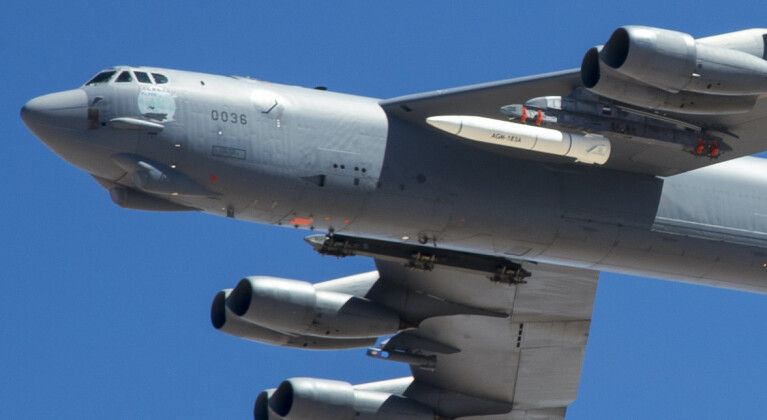
The U.S. Air Force has announced that it intends to integrate missiles developed under the ARRW program onto the B-52 and B-1 bombers, while adding that other types of aircraft may also integrate it in the future. The F-15EX fighter, which is by far the heaviest and has the highest weapons carrying capacity of any Western fighter type, is considered a leading candidate to integrate the missiles. While the AGM-183 was initially developed to attack stationary targets, achieving an anti-shipping capability will require the integration of a terminal guidance system to engage moving targets such as adversary destroyers. As the U.S. Navy’s surface and submarine fleets have increasingly been outmatched both technologically and numerically by new generations of Chinese ships, the new missile program has the potential to allow aviation assets to play a much greater role in targeting adversary shipping to help compensate for this.

The development of the AGM-183A was previously considered one of the most promising programs to help narrow the United States’ hypersonic missile gap with China, Russia and North Korea, which have all for years fielded missiles with advanced hypersonic glide vehicles. Iran and Russia are the only countries to have used such glide vehicles in combat, with Russia in late 2024 testing its new Oreshnik system against Ukrainian targets, while Iran in March 2026 used the Fattah 2 against targets in Israel. The AGM-183A had been reported canceled in March 2023 due to technical issues, before reportedly being revived due to the lack of viable alternative programs, and subsequently being again dropped from the Pentagon budget in March 2024. One prototype was launched from a B-52 bomber over Guam on March 17, 2024.
