
The Importance of Integrated Carrier Strike Groups to Naval Power Projection; Separating Leading Major Carrier Powers from Ineffective Ones
Military Watch Magazine Editorial Staff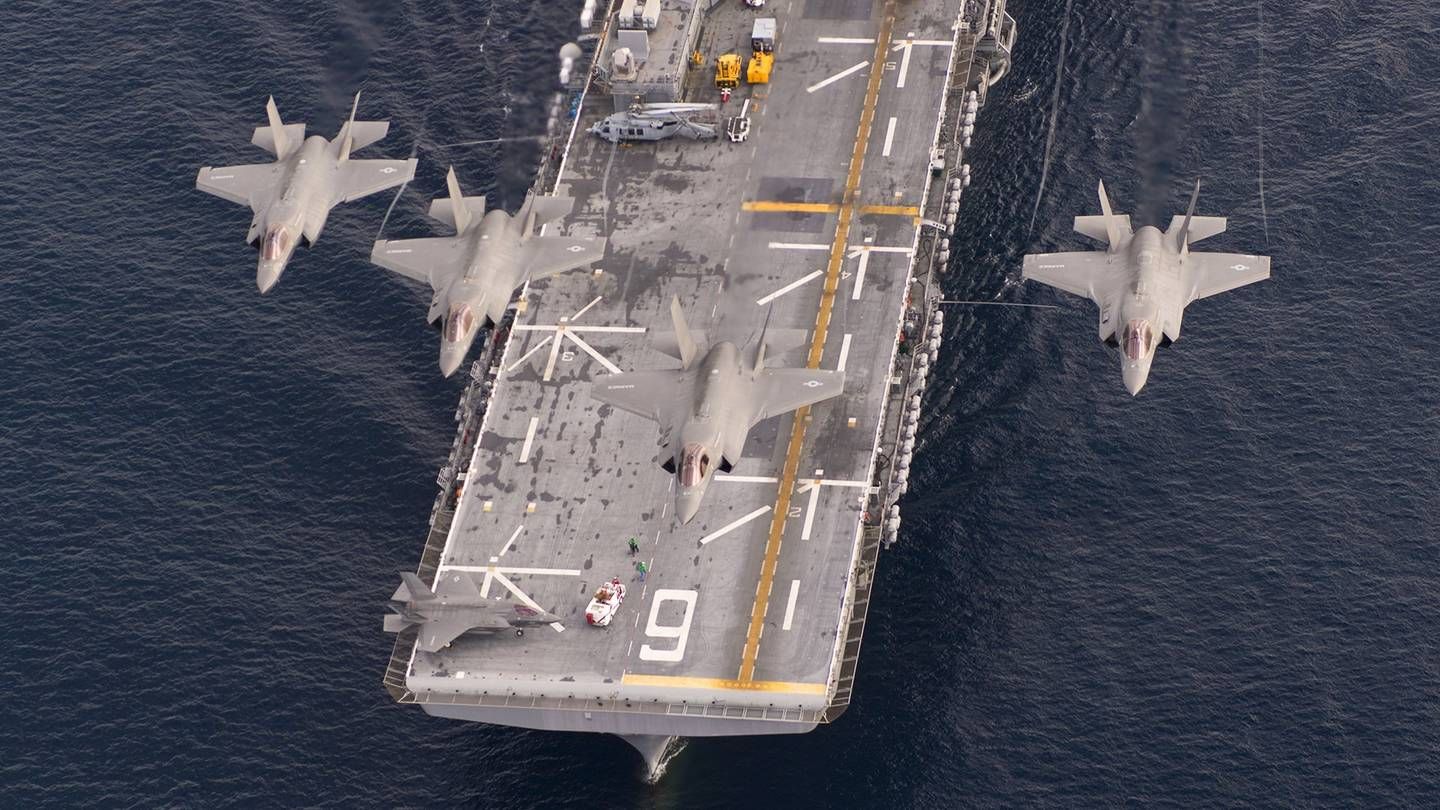
U.S. Navy F-35B Carrier Based Stealth Fighters Overfly Wasp Class Carrier
Aircraft and helicopter carriers are the heaviest naval warships fielded, surpassing even the largest destroyers today in their size and weight. With these warships being among the most ludicrous military targets in the world, and the destruction of an enemy carrier a key means to inflict heavy losses by striking at the heart of their fleet and thereby undermining naval operations, these ships most often require escorts by carrier strike groups, generally comprised primarily of heavy destroyers with support from lighter frigates and submarines. Without such a strike group, which provide defence against ballistic and cruise missiles, fighters and bombers, surface warships, submarines and in some cases even coastal missile and gun emplacements, a carrier is little more than a target for a well armed adversary. While some carriers are notably more capable of defending themselves than others, with Russian carriers in particular renowned for their large anti ship cruise missile arsenals and air defence systems allowing them to function more independently and with a smaller escort, no carrier can effectively conduct operations at sea against a competent adversary without protection of accompanying destroyers.
A number of major naval powers such as the United States, South Korea, Japan and China field carriers as part of large strike groups, and sizeable navies with several destroyer warships with the endurance necessary to carry out blue water operations far from a country’s coasts are key to using carriers effectively for power projection operations - the role for which the aircraft carrier was originally intended. A U.S. carrier strike group is comprised of a single supercarrier of the Nimitz or Gerald Ford class supported by at least one cruiser and at least two destroyers - and generally also include supply and logistics ships, additional destroyers and frigates for specialised tasks such as anti submarine warfare and missile defence, and one or more submarines. Carrier Strike Group One of the U.S. Navy’s Third Fleet for example is comprised of eight Arleigh Burke Class destroyers and a Ticonderoga Class guided missile cruiser. The Nimitz Class supercarrier USS Carl Vinson serves as flagship and deploys aircraft for electronic warfare - the E/A-18G Growler, anti submarine operations - the MH-60 Seahawk, carrier onboard delivery - the C-2 Greyhound, airborne early warning - the E-2C Hawkeye, basic fighter operations - the F-18C Hornet, and air superiority - the F-18E Super Hornet. Other countries’ carrier strike groups reflect their own capabilities, though none are at preset as diverse or flexible in the roles they can fulfil as those of the U.S. Navy.
While strike groups are essential for effective carrier operations, a number of smaller carrier powers deploy the warships predominantly for purposes of prestige - with the costly vessels suited only for minor disaster relief operations but incapable of being used effectively for power projection. Indeed, a number of carrier powers lack any high endurance destroyers whatsoever and as a result their ships spend the vast majority of their time in friendly waters rather than engaging in power projection operations. Thailand and Spain serve as prime examples, with both fielding aircraft carriers designed to deploy a number of combat helicopters and Harrier Jump Jets, but neither having even a single destroyer in their fleet to escort them for blue water operations. Brazil too lacks even a single destroyer but for decades fielded a large carrier warship, the Sao Paolo, which served almost exclusively for prestige purposes and rarely left port. The Brazilian Navy was unable to afford to operate the antiquated warship, acquired second hand from France, and a viable escort for blue water operations to make any use of the warship was never developed. Egypt’s two Mistral Class light carriers, the lightly armed Gamal Abd El Nasser and Anwar El Sadat ships, also lack destroyers to escort them - though the county’s close proximity to its potential adversaries in East Africa and the Middle East means that short range support from the country’s frigates may somewhat compensate for the lack of heavier warships. Australia too, fielding two Canberra Class light carriers, has only a single destroyer, the Hobart Class, to escort them for power projection operations in the Pacific - seriously limiting their usefulness. With Brazil set to commission a new light carrier, following the second hand purchase of the Royal Navy’s flagship HMS Ocean, the new warship will also lack the necessary support and will likely see through its service life in port as its predecessor did.
The Russian Navy today serves as another example of how a lack of destroyer warships can be a key inhibitor to developing an effective carrier fleet. Though the country’s aspirations to become a major blue water naval power during the 1990s were crushed with the cancellation of the Kuzetsov carrier and Ulyanvosk supercarrier programs as a result of the USSR’s collapse, Russia is currently considering the commissioning of a single supercarrier similar to the Ulyanovsk Class design under the SHTORM program. This warship will reportedly be lager than even the United States’ own Gerald Ford Class warships, and will deploy some of the country’s most formidable combat aircraft including navalised variants of the Su-57 heavy stealth fighter. While developing such a warship may well be feasible however, Russia’s ageing destroyer fleet and its inability to build new destroyers since the Soviet Union’s collapse and the loss of Ukrainian shipyards are likely to be a key inhibitor for such grand aspirations. It is one thing to commission a new carrier and develop advanced air superiority fighters for its deck, but quite another to restart the production of destroyers and build entire new shipyards and infrastructure needed to build the warships needed for a feasible carrier strike group. Should Russia commission a supercarrier without doing so, it would face an extreme mismatch between the capabilities of the warship and those of the destroyers escorting it - and when these destroyers are eventually retired without replacement the multi billion dollar carrier would be left unable to operate effectively. Should the Russian Navy seriously seek to develop advanced power projection capabilities for its surface fleet therefore, it must first seek to see through the promising Shkval Class destroyer program - to develop its first destroyers of the post Cold War era which can then be used to escort any subsequently developed carrier warships.
Ultimately while a number of naval powers field aircraft carriers, only a few have the capabilities to make full use of these warships - with the United States, China, Russia, France, India, Japan and South Korea being prime carrier powers today fielding sophisticated strike groups capable of protecting their flagships from all manner of threats. Italy and Britain to a lesser extent also retain such capabilities. Though commissioning an operating an aircraft carrier is no easy feat, the often ignored costs of becoming a carrier power also include developing the ships which will comprise a strike group which combined often outweigh the carriers themselves both in cost and in tonnage. As a fast growing carrier power, China’s People’s Liberation Army (PLA) Navy has invested heavily in developing advanced destroyer warships to escort its fast growing fleet - with the first Type 055 destroyer, according to many analysts the most capable in the world, being commissioned in parallel with the completion of the country’s first fully indigenous carrier warship. The potency of new Chinese destroyers may well somewhat compensate for the relatively small number of aircraft deployed by its early carrier warships such as the Liaoning and the lack of advanced carrier systems such as electromagnetic launch systems, with the success of accompanying warships as critical to a strike group’s success as the capabilities of the carrier itself. With new and more capable Chinese carriers set to be commissioned in future, fielding all manner of aircraft onboard fulfilling roles from airborne early warning to anti submarine warfare and air superiority, these could alongside new destroyers, submarines and frigates pose the first real threat to the primacy of the United States' carrier strike groups since the fall of the Japanese Empire.
