
The Legacy of the Soviet Union's Ambitious Aircraft Carrier Program - Part Two
Military Watch Magazine Editorial Staff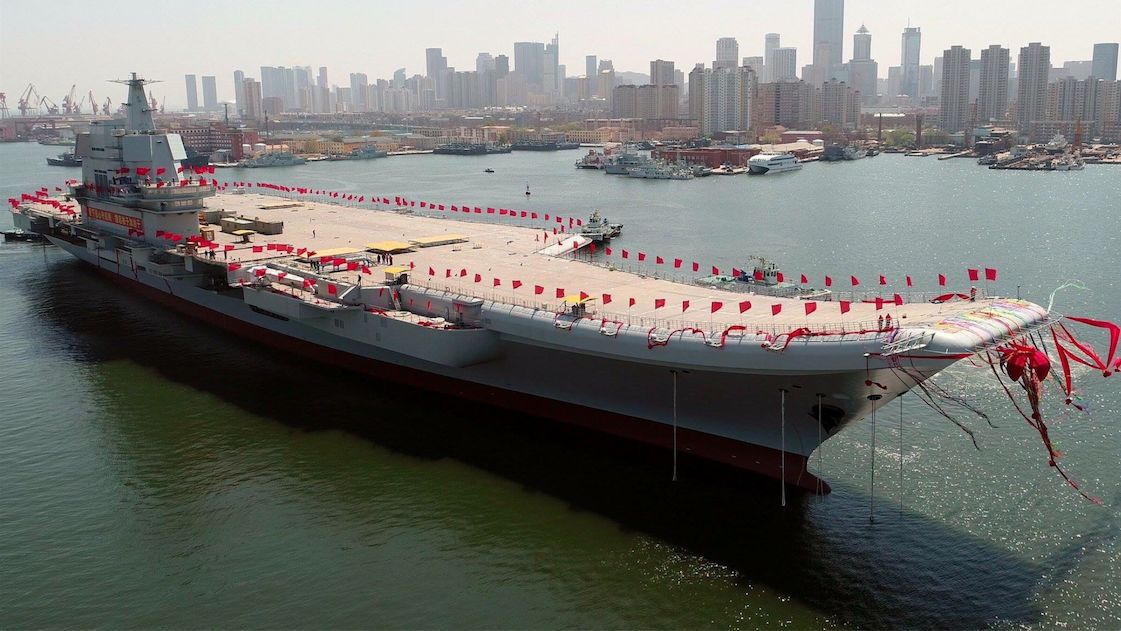
Chinese Type 001 Class Aircraft Carrier - a close derivative of the Soviet Kuznetsov Class
The collapse of the USSR in 1991 led to deep cuts in the defence budgets of successor states and the end of the carrier program. All but one of the Soviet Navy’s carrier fleet were decommissioned, sold or scrapped. The Moskva Class helicopter carriers were both decommissioned in 1991 and 1996 to reduce costs. Three of the Kiev Class aircraft cruisers were decommissioned in 1993, the fourth left service in 1996 and later modified and sold to India - where the ship was recommissioned as the INS Vikramadktya in 2013. It underwent extensive modifications to allow it to operate STOBAR aircraft such as the MiG-29K, of which several were then purchased from Russia. Of the three decommissioned carriers one was sold to South Korea and scrapped in Pohang. The other two were sold to China, one as a theme park and then hotel, the other as a museum piece.
Of the Kuznetzov Class ships one had been completed in 1990, and today serves as Russia's only carrier - the Admiral Kuznetsov. The second ship, though incomplete, was sold to China by Ukraine - where the Soviet Union's largest shipyards had been located. The warship was completed and commissioned into China's People's Liberation Army in 2012 as the country's first aircraft carrier - the Liaoning. These 67,000 ton ships are formidable assets to both the Russian and Chinese navies, and the technology China acquired from the Kuznetzov Class formed a critical base from which to develop its own carrier program. China's first indigenously built carrier, the Type 001A launched in 2017, shows strong similarities to and appears to be a slight variation of the Kuznetzov Class design - one conceptualised for a defensive role rather than power projection. Ukrainian specialists who had worked for the Soviet carrier program were employed by China to provide invaluable technological knowhow.
Regarding the carrier based fighters the USSR developed, the Yak-38 fighters were retired alongside the Kiev Class warships. The Yak-41 program intended to replace them would also be cancelled, though a number of its technologies were reportedly sold to the United States and used by Lockheed Martin to develop the F-35B vertical landing capable stealth fighter. The fighter jet, or a close derivative, may yet be revived in the near future as both Russia and China develop advanced helicopter carriers which are set to enter service in the early 2020s - for which a VTOL fighter could well be ideal. The technologies developed for the Yak-41, which reached a late prototype stage before its termination, are likely to prove invaluable for Russian and possibly Chinese naval aviation in the near future.
The conventional takeoff Su-33 and MiG-29K heavy and light fighters would come to operate from the Russian Navy's Kuznetsov Class warship - the former which was set to form the core of Ulyanovsk Class' carrier air wing. The MiG-29K was sold in large numbers to the Indian Navy for its carriers INS Vikramaditya and INS Vikrant. The technologies of the heavier Su-33 on the other hand were obtained by the Chinese military which, upon purchasing a Ukrainian prototype of the carrier based fighter, proceeded to develop the J-15 carrier based air superiority fighter which closely resembles the original Sukhoi platform. The Su-33 design remains among the most capable carrier based fighters in the world - though it is at present severely limited by the lack of a catapult launch system such as the steam system planned for the Ulyanovsk Class and installed on American Nimitz Class ships. This could soon change however, as the J-15 is deployed by more advanced and heavier Chinese carriers in future and newer variants begin to integrate more advanced avionics, sensors and munitions.
The termination of the Ulyanovsk Class supercarrier program, formerly set to give the USSR its first blue water carrier capability, put an end to these ambitions which Russia today has yet to achieve. While the first keel was laid in 1988 for the first carrier of this class, with the collapse of the USSR in 1991 construction was halted at 20% completion and the project was scrapped soon after. The design for the Ulyanovsk Class remains in Russian hands, and with the announcement of Russia's SHTORM supercarrier being under development the technical knowhow which would have allowed the USSR to build the Ulyanovsk Class may well become useful in the near future for Russia's potential new carrier program. With its economy a fraction of the size that of the USSR had been however, Russia may struggle to fund a single supercarrier - much less a fleet as the Soviet Union had planned to do. With China also reportedly planning to develop supercarriers, the research and development efforts put into the Ulyanovsk Class program could well prove invaluable for Russia's East Asian defence partner.
