
Shkval Class Destroyers; World's Most Heavily Armed Warships to Provide Russian Surface Fleet with Much Needed Upgrade
Military Watch Magazine Editorial Staff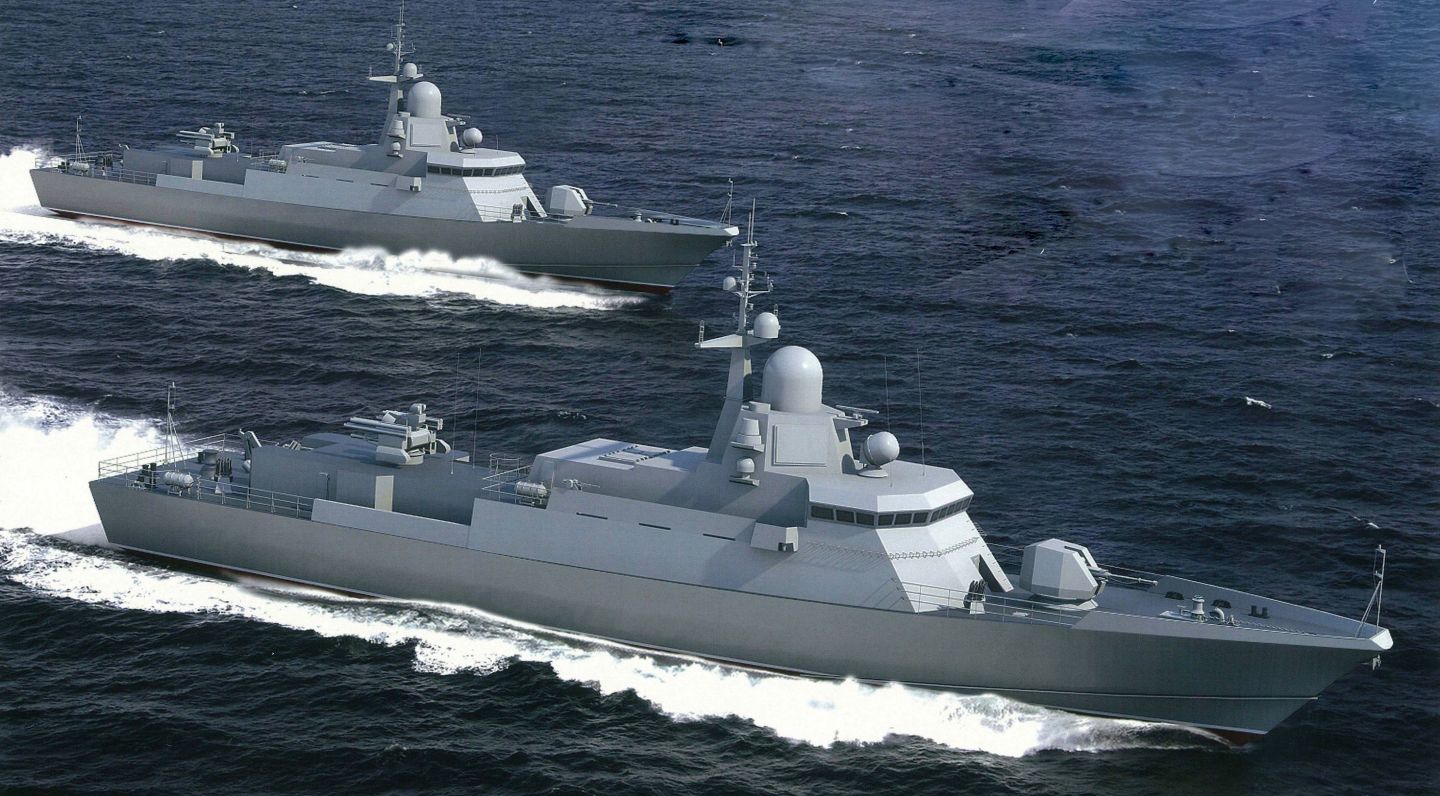
Russian Navy Next Generation Stealth Warship - Artwork
Since the collapse of the Soviet Union the Russian Navy has suffered from severe limitations on its ability to replenish its surface warships, with its shipyards unable to handle the large aircraft carriers and destroyers of the Soviet era. While in the final days of the USSR its shipyards were working on a pair of super carriers of approximately 80,000 tons each, from 1992 Russia would struggle to build destroyers of even 10,000 tons - let alone heavier surface warships. As a result of its inability to commission large new warships, Russia’s naval forces have had to rely on modernising older destroyers and meanwhile increasing their reliance on a variety of cutting edge attack submarine designs to better contest primacy at sea. New systems such as Kalibr cruse missiles and submarine stealth technologies have been key asymmetric assets in this regard.
In an attempt to restore its fleet and restart the late Soviet era drive to invest in naval power projection capabilities, the Russian military has sought to restart a number of weapons programs including the development of destroyers, carriers, and possibly even supercarriers and naval vertical takeoff capable fighters. A new guided missile destroyer is key to the success of a large carrier program, particularly a supercarrier, and with Russian shipyards already preparing to construct medium sized carrier warships displacing tens of thousands of tons they may well also soon be able to accommodate smaller destroyer sized vessels. Given the ambitious specifications the Russian Navy has for its future destroyers however, developing the warships may well prove considerably more difficult than developing carriers. The Project 23560E Shkval Class destroyer is expected to be commissioned in a fleet of at least twelve, with a relatively modest 10,000 ton displacement but with highly ambitious specifications far surpassing those of almost all existing warship designs.
Shkval Class ships are planned to enter service in the 2020s, at the same time as the new carriers, and the technologies they will field may well make them among the most capable vessels of their kind in the world. The warships will, much like the Soviet Union’s previous Kirov Class battlecruisers, be nuclear powered - making construction of propulsion systems for the new warships particularly complicated despite their relatively small size - and necessitating considerable maintenance. They are also expected to field Russia’s latest surface to air missile systems in a multi layered network similar to but likely more advanced than that of the Chinese Type 055 destroyer, potentially including a navalised variant of the S-500 for defence against missile attacks at extreme ranges including over the horizon - which would also allow the warships to target near orbit satellites and high value aircraft. Other systems deployed for air defence are likely include the 120km ranged Redut system, a navalised variant of the S-350E, and a naval variant of the short ranged Pantsir-M. Such an air defence network, a technological field in which Russia and the USSR before it have long excelled, is critical to projecting power at sea against modern threats - and is key to the success of carrier strike groups led either by uncoming 40,000 ton assault ships or by heavier supercarriers.
According to the Severnoe Design Bureau responsible for the Shkval Class program, the design of the destroyer began in April 2015. The destroyers will carry approximately to 200 vertical launcher cells using cold launch systems to deploy a variety of missiles, including anti ship, and submarine and air defence platforms. This will make the warships by far the most heavily armed in the world - with the Chinese Type 055 destroyer deploying 112 cells, the South Korean Sejong the Great Class 128 cells, and the U.S. Arleigh Burke Class 90-96 cells. Approximately 65% of the launch cells on the Shkval Class are projected to be allocated to air defence - with the ability to deny enemy aircraft the ability to operate near Russian carrier groups being particularly critical given the vast carrier based air wings of the United States Navy. The latest variants of the Kalibr are also likely to be deployed, as are long range hypersonic cruise missiles such as the Mach 8 scramjet powered 3M22 Zircon which are key to the Russian Navy’s strategy to ensure naval dominance despite the relatively small size of its surface fleet. A navalised variant of the Kh-47M2 Kinzhal hypersonic ballistic missile may also be deployed. Ultimately the Shkval Class appears to be a highly promising weapons program, though for the sake of simplicity and due to budgetary restraints they may well enter service as conventionally rather than nuclear powered warships. They are, according to advisor to the director general of the Krylov State Research Center Valeriy Polovinki who was heavily involved in the program's design stages, "meant to replace the Sovremennyy Class destroyers, the main anti-surface warships of the Russian Navy, as well as the Slava Class cruisers and the Udaloy Class anti submarine destroyers." Much like the United States and China, Russia is set to increasingly rely on a single class of multirole heavy surface warship which can be equipped to specialise in various roles depending on the composition of its missile arsenal - rather than fielding several less versatile but more specialised designs. The induction of a new destroyer class, arguably more than that of new aircraft carriers, would represent Russia’s return to the status of a major naval power - following on from resurgences in its space, aerial and ground warfare capabilities in the past decade after years of post Soviet decline.
